
You've had the same evening glass of wine for thirty years. Lately it makes you wobbly, a little foggy, and you can't tell if it's the wine, your new pills or just age. Which is it?
This guide uses the National Institute on Aging's "Facts About Aging and Alcohol" (content reviewed July 19, 2022) and NIAAA's pages on alcohol-medication interactions. It is general information, not a diagnosis; your doctor or pharmacist can tell you what is safe for you. If you want to learn more about reviewing a whole medicine list, take a closer look at the brown bag medication review.
Why the same drink can hit harder
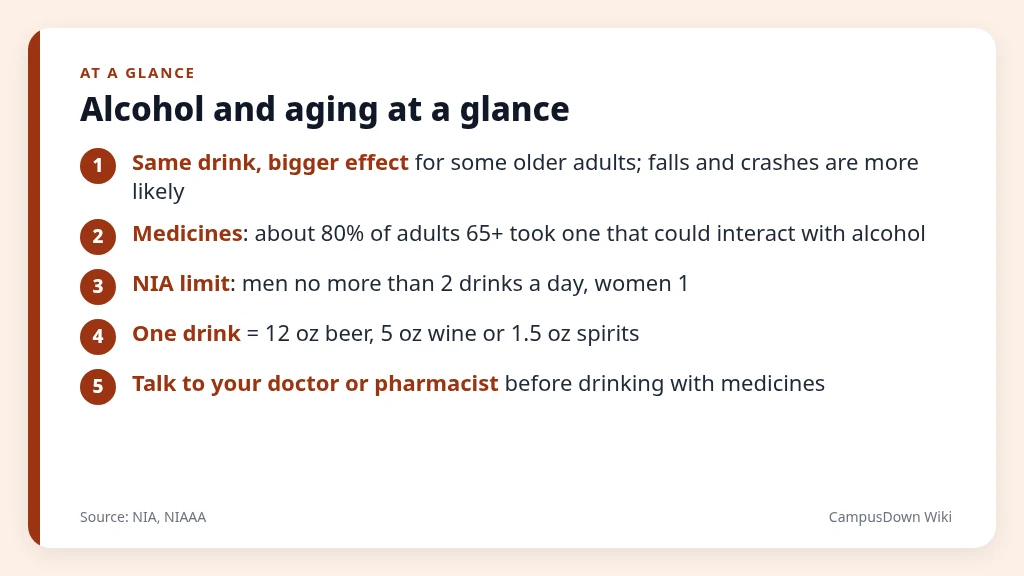
NIA says how the body handles alcohol changes with age, and that health problems or prescribed medicines may require that you drink less or avoid alcohol completely. Some older people feel the effects of alcohol more strongly without increasing the amount they drink, which makes accidents such as falls, fractures and car crashes more likely. It also says older women are more sensitive than men to the effects of alcohol. NIAAA says people 65 and older are at higher risk for harm, partly because of age-related changes in physiology and partly because older adults often take multiple medicines that may interact with alcohol.
NIA also notes that families, friends and health care workers may overlook drinking in older people because the effects are mistaken for other age-related conditions, for example a balance problem. See the fall prevention checklist.

What alcohol can do to health
NIA lists that alcohol can:
- Worsen conditions such as osteoporosis, diabetes, high blood pressure, stroke, ulcers, memory loss and mood disorders
- Make some conditions harder to diagnose, because changes in the heart and blood vessels can dull pain that might be a warning sign of a heart attack
- Cause forgetfulness and confusion that could be mistaken for signs of Alzheimer's disease or a related dementia
- Contribute to heavy-drinking-related harm such as liver damage and some cancers
NIA says alcohol is a factor in about 65% of fatal falls and about 30% of fatal motor vehicle crashes, as NIA reports them, so the practical rule is don't drink if you plan to drive, use machinery or do anything needing alertness.
Alcohol and medicines
NIA examples:
- Aspirin and alcohol raise the risk of stomach or intestinal bleeding.
- Large doses of acetaminophen with alcohol may cause liver damage.
- Some cough syrups and laxatives have a high alcohol content, which adds to the effect.
- Some sleeping pills, pain pills or anxiety/antidepressant medicines with alcohol can be deadly.
NIAAA says about 80% of people 65 and older took a medicine in the past year that could interact with alcohol, and that alcohol plays a role in about 1 in 5 overdose deaths involving prescription opioids (22.1%) and benzodiazepines (21.4%). Ask your pharmacist about every prescription, over-the-counter product and supplement. See polypharmacy and the Beers Criteria.
Get help now if
Mixing alcohol with opioids, sleeping pills, anxiety medicines or other sedating medicines can slow breathing and be deadly. If someone can't be woken, breathes slowly or turns blue, call 911.
How much is "a drink"?
NIA defines one drink as a 12-ounce regular beer, ale or hard seltzer; an 8- or 9-ounce malt liquor; a 5-ounce glass of wine; or a 1.5-ounce shot of 80-proof spirits. It says men should not have more than two drinks a day and women only one, and that drinking less is better for health than drinking more. NIA also warns drinks may be stronger than you think, depending on the actual serving. Your own limit may be lower, or zero, depending on health and medicines; ask your doctor.
When life changes
NIA says some people develop a harmful reliance on alcohol later in life, sometimes after major life changes such as the death of a spouse, moving to a new home or failing health, and that alcohol problems and depression often go together. See grief in older adults and depression in older adults. If you drink heavily and stop suddenly, withdrawal can be dangerous; ask your doctor before stopping on your own. See alcohol withdrawal and CIWA.
Reasons to cut back, and how
NIA's list of reasons includes keeping blood sugar under control, lowering blood pressure, keeping the liver working, lessening the chance of falling and feeling less sleepy the morning after. Ways it suggests:
- Count the ounces in each drink
- Choose alcohol-free days, and try non-alcoholic drinks
- Don't keep alcohol at home if it's a temptation
- Ask your doctor about medicines that may reduce cravings
- Talk to a counselor who knows older adults, join a support group or try Alcoholics Anonymous
- Use NIAAA's "Rethinking Drinking" and the NIAAA Alcohol Treatment Navigator
- Ask family and friends for help; if you slip, try again
Questions for your doctor or pharmacist
- Do any of my medicines or conditions mean I should avoid alcohol?
- What is a safe limit for me, if any?
- Could my dizziness, memory or sleep be related to drinking?
- Is it safe to cut back suddenly, or should I do it with supervision?
- Which resources do you recommend for support?
Example scenario: the evening glass
- Who
- Rufus, 71, a retired high school coach in Tucson, Arizona, began having a glass or two of whiskey most evenings after his wife died, and his doctor added a sleeping pill.
- What happened
- He had nearly fallen twice in the hall at night and thought it was just getting old.
- How it felt
- He felt lonely and a little defensive.
- What they did
- At his pharmacy review, the pharmacist explained alcohol with sedating medicines can be dangerous and suggested he talk with his doctor. Rufus chose alcohol-free days, set out a glass of sparkling water at six, joined a bereavement group and kept his follow-up.
- How it turned out
- Rufus said that saying the amount out loud was the hard part.
This is an illustrative example, not a real patient or a review.
Rufus's story is an illustrative example. Talk to your doctor or pharmacist about alcohol and your medicines; call 988 in the US if you are in crisis.
Most-asked questions about alcohol and aging
Does alcohol age your skin?
The sources here don't discuss skin; they focus on falls, medicine interactions, memory and health conditions.
Why people ask: "alcohol and aging skin" is #3 for "alcohol and aging" (US autocomplete, November 2026).
How does alcohol affect the aging brain?
NIA says alcohol can cause forgetfulness and confusion that may be mistaken for dementia and can worsen memory loss.
Why people ask: "alcohol and aging brain" is #4 for "alcohol and aging" (US autocomplete, November 2026).
How does alcohol affect older women?
NIA says older women are more sensitive than men to alcohol's effects, and its limit for women is one drink a day.
Why people ask: "alcohol and aging women" is #5 for "alcohol and aging" (US autocomplete, November 2026).
What are the effects of alcohol and aging?
A stronger effect from the same drink, more falls and crashes, medicine interactions, confusion, and worsening of some conditions.
Why people ask: "alcohol and aging effects" is #6 for "alcohol and aging" (US autocomplete, November 2026).
Does menopause change how alcohol affects you?
The sources here don't cover menopause; talk with your clinician about your own situation.
Why people ask: "alcohol and aging menopause" is #8 for "alcohol and aging" (US autocomplete, November 2026).
How does alcohol use affect older adults?
It can increase accidents, interact with medicines and worsen health conditions, per NIA and NIAAA.
Why people ask: "alcohol use and older adults" is #2 for "alcohol and older adults" (US autocomplete, November 2026).
How does alcohol affect older age?
The body handles alcohol differently with age, so a usual drink may have a stronger effect.
Why people ask: "alcohol and older age" is #3 for "alcohol and older adults" (US autocomplete, November 2026).
Is alcohol linked to falls in older adults?
NIA says some older people feel alcohol's effects more strongly, making falls and fractures more likely, and alcohol is a factor in about 65% of fatal falls as NIA reports it.
Why people ask: "alcohol and falls in older adults" is #4 for "alcohol and older adults" (US autocomplete, November 2026).
What about alcohol abuse in older adults?
NIA says alcohol misuse can follow major life changes and often goes along with depression; help includes counselors, support groups and NIAAA's resources.
Why people ask: "alcohol abuse older adults" is #5 for "alcohol and older adults" (US autocomplete, November 2026).
What about alcohol withdrawal in older adults?
Stopping suddenly after heavy drinking can be dangerous; talk to a doctor first, and see our alcohol withdrawal guide.
Why people ask: "alcohol withdrawal older adults" is #6 for "alcohol and older adults" (US autocomplete, November 2026).
How much alcohol consumption is okay for older adults?
NIA says men no more than two drinks a day and women one, and that some people need to drink less or none because of health or medicines.
Why people ask: "alcohol consumption older adults" is #7 for "alcohol and older adults" (US autocomplete, November 2026).
How are alcohol and depression linked in older adults?
NIA says depression often goes along with drinking too much, and loss or loneliness can contribute.
Why people ask: "alcoholism and depression in older adults" is #8 for "alcohol and older adults" (US autocomplete, November 2026).
What is alcohol and substance misuse in older adults?
NIA describes alcohol misuse as a pattern of drinking that can harm health and relationships; NIAAA notes medicine interactions raise the risk.
Why people ask: "alcohol and substance misuse in older adults" is #9 for "alcohol and older adults" (US autocomplete, November 2026).
Is alcohol bad for seniors?
It depends on health and medicines; NIA says some older adults should drink less or not at all.
Why people ask: "is alcohol bad for seniors" is #10 for "alcohol and older adults" (US autocomplete, November 2026).
Related on CampusDown
You can learn more about the senior health hub and check it for yourself in the fall prevention checklist. For managing many medicines in detail, see the Beers Criteria guide, and for dehydration risks see dehydration in older adults.
Frequently asked questions
- How many drinks are okay?
- NIA says men no more than two a day and women one, but some people should drink less or none.
- Why do I feel it more now?
- How the body handles alcohol changes with age, so the same drink can have a stronger effect.
- Can alcohol and my medicines interact?
- Yes; about 80% of adults 65+ took a medicine that could interact, per NIAAA.
- Can alcohol cause confusion that looks like dementia?
- NIA says it can cause forgetfulness and confusion that may be mistaken for dementia.
- Where can I get help?
- Your doctor, counselors who know older adults, support groups, AA, NIAAA's Rethinking Drinking and Alcohol Treatment Navigator.
The same drink may hit older adults harder, and medicines add risk. Know your limit with your doctor and pharmacist, watch for falls and confusion, avoid sedating combinations, don't stop heavy drinking suddenly without advice, and reach out for help.
Browse more guides like this in the Senior Health and Medicare hub.
This article is for general education and does not replace advice from your own doctor, nurse or pharmacist.