
Your patient was admitted for a broken wrist and says he "only has a couple of drinks a week." On day two he is sweating, shaky and picking at the sheets. What do you check, and what scale will the provider ask about?
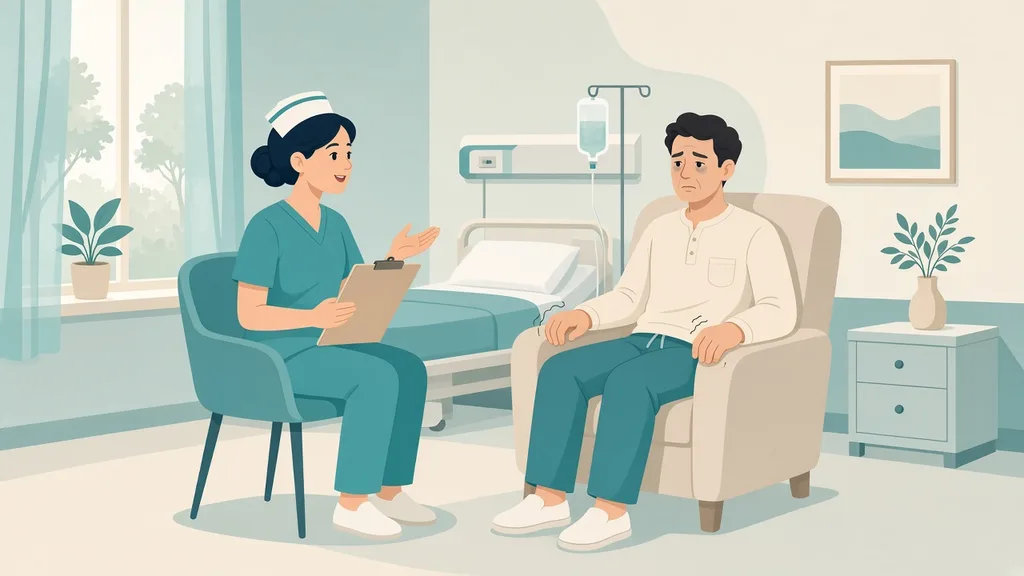
This guide explains alcohol withdrawal and the CIWA-Ar scale using OpenStax's Psychiatric-Mental Health Nursing (19.2 Alcohol Use Disorder) and Clinical Nursing Skills (20.2 Substance Use Disorder Assessment). It is a study aid, not orders; your instructor, facility protocol and the provider decide how withdrawal is assessed and treated. If you want to learn more about confusion in hospital patients, take a closer look at delirium in hospital.
What CIWA-Ar is
OpenStax says the Clinical Institute Withdrawal Assessment for Alcohol Scale, revised (CIWA-Ar) is the most widely used scale to determine the need for medically supervised withdrawal management. It's used in outpatient, emergency, psychiatric and general medical-surgical settings when there's clinical concern about alcohol withdrawal, and is typically used with a protocol containing medications to guide symptom-triggered treatment.

The ten items
OpenStax lists ten questions or observations:
- Nausea and vomiting
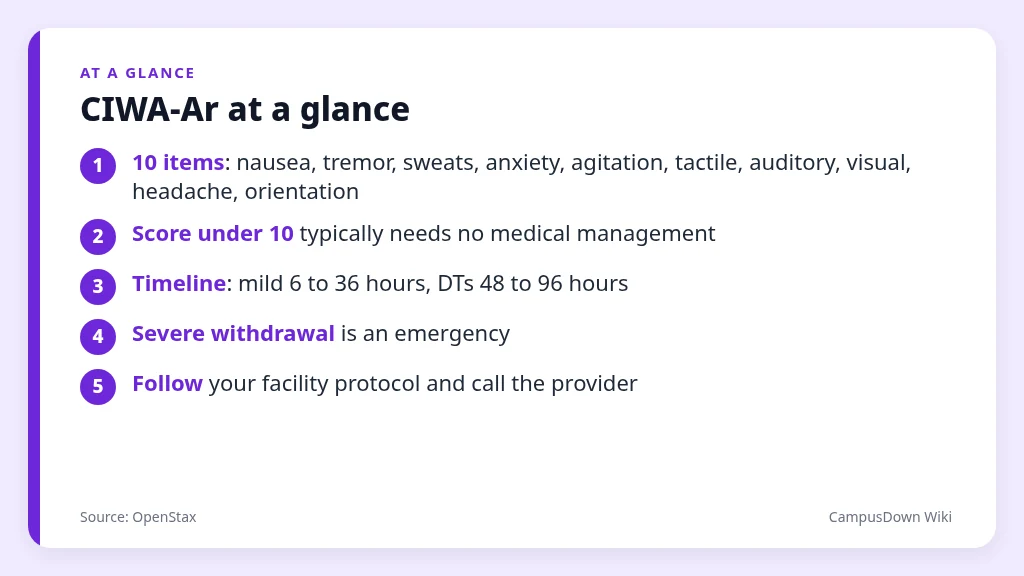
2. Tremor 3. Paroxysmal sweats 4. Anxiety 5. Agitation 6. Tactile disturbances 7. Auditory disturbances 8. Visual disturbances 9. Headache 10. Orientation (level of orientation)
Items use a Likert-type rating, and the nurse either observes (tremor, sweating, agitation) or asks about the symptom (nausea, anxiety, disturbances, headache). The official form gives the exact wording and point values; always use your facility's form and don't score from memory.
How it's done
OpenStax's clinical judgment example: the nurse has the client sit in a chair with their feet flat on the floor, takes and records vital signs, then goes down the checklist. Vital signs and the score together tell the team how withdrawal is progressing.
Scoring and what it means
OpenStax says clients with alcohol use disorder who have a CIWA-Ar score under 10 do not typically require medical management. Other score bands, and the score at which medication is triggered, vary by facility protocol, so this page doesn't list them; follow your unit's protocol and the provider's orders. A rising score or new severe symptoms should be reported right away, whatever the number.
OpenStax's case gives an example: a client with a score of 12 (anxiety, tremor, headache and mild sweating, no hallucinations, oriented) leads the nurse to notify the provider and use the CIWA protocol.
The withdrawal timeline
OpenStax's Clinical Nursing Skills chapter gives this timeline after the last drink:
| Time after last drink | Possible symptoms |
|---|---|
| 6 to 36 hours | Anxiety, minor agitation, restlessness, insomnia, tremor, sweating, palpitations, headache, craving, nausea, vomiting, diarrhea, sinus tachycardia, systolic hypertension, hyperactive reflexes |
| 12 to 48 hours | Withdrawal hallucinations (visual, auditory, tactile) |
| 6 to 48 hours | Withdrawal-related seizures |
| 48 to 96 hours | Delirium tremens (DTs): agitation, fever, severe tachycardia, hypertension, drenching sweats |
Without treatment, mild withdrawal generally begins within 6 to 36 hours and resolves in one to two days; moderate to severe symptoms can last up to six days. OpenStax says approximately half of patients with AUD experience withdrawal when they cut down or stop, and as many as 20 percent have severe manifestations such as hallucinations, seizures and DTs. Severe alcohol withdrawal is a medical emergency, best managed in an ICU.
MedlinePlus's patient-facing article words it a little differently: symptoms tend to occur within 8 hours of the last drink but can occur days later, and tend to peak by 24 to 72 hours. It says to go to the emergency room or call 911 for seizures, fever, severe confusion, hallucinations or irregular heartbeats, and that death is possible, especially if DTs occur. Different sources give slightly different windows, so learn the ones your instructor teaches.
Patients often underreport alcohol use, so nurses should watch for withdrawal signs in patients admitted for other reasons and notify the provider.
Get help now if
Hallucinations, a seizure, fever with severe sweating and a racing heart, or new confusion in a patient who may have stopped drinking can be delirium tremens, a medical emergency. Call for help and follow your facility's rapid response process.
Treatment basics (what you'll hear)
OpenStax says benzodiazepines treat the agitation common in withdrawal and prevent progression to seizures, hallucinations or DTs; the drugs used most often are diazepam (Valium), lorazepam (Ativan) and chlordiazepoxide (Librium). Anticonvulsants may be used with or instead of them to lower seizure risk. Because chronic alcohol use depletes thiamine and magnesium, patients typically receive IV thiamine, along with dextrose, to prevent Wernicke's encephalopathy (nystagmus, ataxia and confusion), and other electrolytes may need replacement; see calcium and magnesium for nurses. Doses and timing come from orders and protocols. See high-alert medications for safe-administration habits.
Safety priorities (student view)
- Fall risk: GI symptoms such as nausea and diarrhea lead patients to hurry to the bathroom unassisted; see fall prevention.
- Seizure precautions and a calm, low-stimulation environment per policy.
- Frequent reassessment on the schedule your protocol sets, with vital signs.
- Report rising scores, hallucinations, seizures or confusion using a structured format like SBAR.
- Document the time of the last drink if known, scores, vital signs, medications and the patient's response; see nursing charting basics.
- Treat the patient with respect and without judgment; withdrawal is a medical condition.
Study tips
- Memorize the ten items with a chant or a mnemonic of your own.
- Know the timeline numbers: 6 to 36, 12 to 48, 6 to 48, 48 to 96 hours.
- Remember score under 10: typically no medical management, and that facility protocols set the rest.
- Link thiamine to Wernicke's, and benzodiazepines to symptom-triggered treatment.
- Practice a one-line report for a rising score.
Questions for your instructor
- Which CIWA form and score thresholds does our facility use?
- How often do we reassess, and when do we call the provider?
- What are our seizure precautions?
- How do we document the last drink and scores?
- How does CIWA show up on exams?
Example scenario: the quiet second day
- Who
- Tobias, 26, a nursing student in Duluth, Minnesota, noticed on his clinical day that a patient admitted after a fall was sweaty, tremulous and picking at his blanket.
- What happened
- He wasn't sure whether to "make a fuss" because the patient had said he rarely drank.
- How it felt
- He felt uneasy and hesitant.
- What they did
- He told the nurse, who checked the patient, called the provider and started the facility's withdrawal protocol; Tobias helped with fall precautions and wrote down times and observations.
- How it turned out
- Tobias said he learned to report what he saw even when the history sounded reassuring.
This is an illustrative example, not a real patient or a review.
Tobias's story is an illustrative example. Real care follows your instructor, your facility and the provider's orders.
Most-asked questions about the CIWA scale
What is the CIWA scale used for alcohol withdrawal?
It guides assessment and symptom-triggered treatment of alcohol withdrawal, and is the most widely used scale for deciding on medically supervised withdrawal management.
Why people ask: "ciwa scale for alcohol withdrawal" is #2 for "ciwa scale" (US autocomplete, November 2026).
What is the CIWA scale range?
OpenStax says a score under 10 typically doesn't need medical management; other thresholds depend on your facility's protocol.
Why people ask: "ciwa scale range" is #3 for "ciwa scale" (US autocomplete, November 2026).
How is the CIWA scale scored?
Each of ten items is rated on the scale's Likert-type points using observation or patient answers, then the points are totaled; use your facility's form for exact values.
Why people ask: "ciwa scale scoring" is #5 for "ciwa scale" (US autocomplete, November 2026).
What are the CIWA scale questions?
Ten items: nausea and vomiting, tremor, paroxysmal sweats, anxiety, agitation, tactile, auditory and visual disturbances, headache and orientation.
Why people ask: "ciwa scale questions" is #6 for "ciwa scale" (US autocomplete, November 2026).
What does the CIWA scale mean?
It measures how severe withdrawal symptoms are, to guide how closely a patient is watched and treated.
Why people ask: "ciwa scale meaning" is #7 for "ciwa scale" (US autocomplete, November 2026).
How is the CIWA scale interpreted?
Under 10 typically doesn't need medical management; higher scores follow your protocol and provider orders, and worsening symptoms are reported.
Why people ask: "ciwa scale interpretation" is #9 for "ciwa scale" (US autocomplete, November 2026).
How do you do a CIWA scale assessment?
Seat the patient with feet flat, take vital signs, then go through the ten items by observing or asking.
Why people ask: "ciwa scale assessment" is #10 for "ciwa scale" (US autocomplete, November 2026).
How is the CIWA score interpreted?
See above: under 10 typically needs no medical management, and facility protocols set other steps.
Why people ask: "ciwa scale score interpretation" is #2 for "ciwa scale scoring" (US autocomplete, November 2026).
What is the CIWA score range?
The maximum and bands depend on the official form and your facility's protocol; OpenStax gives the under-10 benchmark.
Why people ask: "ciwa scale score range" is #3 for "ciwa scale scoring" (US autocomplete, November 2026).
How is the CIWA scale explained?
A ten-item bedside checklist used to rate alcohol withdrawal and guide symptom-triggered treatment under a protocol.
Why people ask: "ciwa scale explained" is #6 for "ciwa scale scoring" (US autocomplete, November 2026).
Related on CampusDown
You can learn more about the nursing student hub and check it for yourself in the delirium in hospital guide. For electrolyte care in detail, see calcium and magnesium for nurses.
Frequently asked questions
- How many items are on the CIWA-Ar?
- Ten.
- What does a score under 10 mean?
- OpenStax says it typically doesn't require medical management.
- When do DTs start?
- Typically 48 to 96 hours after the last drink.
- Why give thiamine?
- To prevent Wernicke's encephalopathy, since chronic alcohol use depletes thiamine.
- Why report withdrawal signs in other patients?
- Patients often underreport drinking, and severe withdrawal is a medical emergency.
The CIWA-Ar is a ten-item bedside scale that guides alcohol withdrawal care. Know the items, the timeline and your facility's protocol, keep patients safe, and report rising symptoms or confusion early.
Browse more guides like this in the Nursing Student and NCLEX hub.
This article is for general education and does not replace advice from your own doctor, nurse or pharmacist.