
You grab your inhaler during a wheezy night and wonder: how many puffs is too many, and when does needing it more mean something is wrong?

The albuterol inhaler is the rescue inhaler many people with asthma or COPD carry. This guide uses MedlinePlus's drug information on albuterol oral inhalation (last revised February 2016, so always compare with your own label and pharmacist's advice) and OpenStax's Clinical Nursing Skills chapter on inhaled medications. It is general information, not a prescription; your prescriber decides your dose and your action plan. If you want to learn more about warning signs, take a closer look at asthma attack signs.
What it does
MedlinePlus says albuterol is used to prevent and treat difficulty breathing, wheezing, shortness of breath, coughing and chest tightness caused by lung diseases such as asthma and COPD. The aerosol and powder inhalers are also used to prevent breathing difficulty during exercise. Albuterol is a bronchodilator: it relaxes and opens the air passages to the lungs.
It controls symptoms but does not make lung disease go away, and MedlinePlus says not to stop using it without talking to your doctor.

How it is used
- Usual schedule: MedlinePlus says the aerosol or powder inhaler is usually used every 4 to 6 hours as needed for symptoms; for exercise it's usually used 15 to 30 minutes before. Nebulizer solution is usually used three or four times a day. Follow your own label; this page doesn't set a dose.
- Use exactly as directed. Don't use more or less, or more often, than prescribed.
- Call your doctor if your symptoms get worse, if the inhaler no longer controls your symptoms, or if you find you need it more often than usual.
- Don't use it near a flame or heat; the canister may explode at very high temperatures.
- Keep it out of your eyes.
- Use the inhaler that comes with your canister, and never use that inhaler for another medicine.
Learn the warning signs of a bad day, and have a plan from your clinician. See asthma attack signs and COPD flare signs.
Technique and spacers
MedlinePlus says to read the written instructions that come with the inhaler, and to ask your doctor, pharmacist or respiratory therapist to show you and watch you practice. OpenStax's nursing guide describes metered-dose inhaler steps like these:
- Shake the inhaler and attach a spacer, if you use one.
2. Seal your lips around the mouthpiece (without a spacer, the inhaler may be held 1 to 2 inches from the mouth). 3. Breathe out, then press the canister as you breathe in. 4. Breathe in slowly for about three to five seconds, then hold your breath for five to ten seconds. 5. Breathe out slowly; repeat if more than one puff is prescribed.
A slow breath keeps the medicine from hitting the back of the throat. A spacer is a clear tube that lets you inhale the medicine more slowly and with control, and it should be cleaned regularly. Read the spacer guide and compare with a nebulizer in nebulizer vs inhaler. Your device may differ; follow your own instructions.
Counting puffs and replacing the inhaler
MedlinePlus says each albuterol aerosol inhaler is designed to provide 60 or 200 inhalations, depending on size, and each powder inhaler 200. After the labeled number, later puffs may not contain the right amount of medicine, so dispose of the inhaler after the labeled number even if it still sprays.
- If it has a counter, use it, and don't alter it.
- If it doesn't, divide the puffs in the inhaler by the puffs you use per day to estimate how many days it will last.
- Don't float the canister in water to test it.
- The powder inhaler should be discarded 13 months after opening the foil, after the expiration date, or after the labeled number of inhalations, whichever comes first.
Side effects
Tell your doctor if these are severe or don't go away (MedlinePlus): uncontrollable shaking of a part of the body, nervousness, headache, nausea, vomiting, cough, throat irritation, and muscle, bone or back pain.
Call your doctor right away for:
- Fast, pounding or irregular heartbeat or chest pain
- Rash, hives or itching
- Swelling of the face, throat, tongue, lips, eyes, hands, feet, ankles or lower legs
- Increased difficulty breathing, difficulty swallowing or hoarseness
Get help now if
If breathing gets worse right after using the inhaler (new wheezing or trouble breathing), MedlinePlus says to call your doctor right away and not to use it again unless your doctor says to. If you have severe trouble breathing, call 911.
Before you use it, tell your doctor or pharmacist
Per MedlinePlus: allergies (including milk proteins if you use the powder inhaler); the medicines you take, especially beta blockers, digoxin, diuretics, epinephrine, other bronchodilators, cold medicines, certain antidepressants and MAO inhibitors; and conditions such as irregular heartbeat, heart disease, high blood pressure, overactive thyroid, diabetes or seizures. Also tell them about pregnancy or breastfeeding. Bring all your medicines to your visits; see the brown bag review. If a racing heartbeat is a worry, see palpitations at night.
Common questions
- Cough: MedlinePlus lists coughing caused by asthma or COPD among the symptoms it treats, but a cough has many causes; see a clinician for a cough that lingers or worsens.
- Over the counter or price: MedlinePlus doesn't cover availability or cost; ask your pharmacist or insurer about your options.
- High blood pressure: MedlinePlus says to tell your doctor if you have it, and a fast, pounding heartbeat or chest pain after using it needs a prompt call.
- Missed doses: if you were told to use it on a schedule, use the missed dose when you remember unless the next one is near; don't double up.
Questions for your pharmacist
- How many puffs and how often is right for me, per my label?
- Do I need a spacer, and how do I clean it?
- How do I know when the inhaler is empty?
- What should I do if I need it more than usual?
- Do my other medicines interact?
Example scenario: the counter at zero
- Who
- Josephine, 29, a graduate student in Columbus, Ohio, kept using her rescue inhaler because it still sprayed, though she'd lost track of how many puffs she'd taken.
- What happened
- During finals week she needed it more often and her chest felt tight.
- How it felt
- She felt anxious and a bit careless.
- What they did
- She called her clinic, which checked her symptoms and told her to come in; the pharmacist showed her the dose counter and arranged a replacement. She wrote down her puff count each day after that.
- How it turned out
- Josephine said counting made it feel less like guessing.
This is an illustrative example, not a real patient or a review.
Josephine's story is an illustrative example. Real asthma care follows your clinician's plan; call 911 for severe breathing trouble.
Most-asked questions about the albuterol inhaler
What is the albuterol inhaler dose?
MedlinePlus says the inhaler is usually used every 4 to 6 hours as needed, or 15 to 30 minutes before exercise; your label and prescriber set your exact dose.
Why people ask: "albuterol inhaler dose" is #2 for "albuterol inhaler" (US autocomplete, November 2026).
What are the side effects of an albuterol inhaler?
Shaking, nervousness, headache, nausea, cough and throat irritation are listed; a fast or irregular heartbeat, chest pain, hives, swelling or worse breathing need a prompt call.
Why people ask: "albuterol inhaler side effects" is #3 for "albuterol inhaler" (US autocomplete, November 2026).
What is the albuterol inhaler dose for adults?
MedlinePlus doesn't give one dose for all adults; it says to follow your prescription label and use it every 4 to 6 hours as needed.
Why people ask: "albuterol inhaler dose for adults" is #5 for "albuterol inhaler" (US autocomplete, November 2026).
How do you use an albuterol inhaler?
Shake it, use a spacer if prescribed, breathe out, press as you breathe in slowly, hold your breath, and ask a clinician to watch you practice.
Why people ask: "albuterol inhaler how to use" is #7 for "albuterol inhaler" (US autocomplete, November 2026).
Is an albuterol inhaler used for a cough?
MedlinePlus lists coughing caused by asthma or COPD among treated symptoms, but see a clinician for a cough with an unclear cause.
Why people ask: "albuterol inhaler for cough" is #9 for "albuterol inhaler" (US autocomplete, November 2026).
What are the albuterol inhaler instructions?
Read the written instructions that come with your inhaler, ask for a demonstration, and follow your prescription label.
Why people ask: "albuterol inhaler instructions" is #10 for "albuterol inhaler" (US autocomplete, November 2026).
Can an albuterol inhaler affect high blood pressure?
MedlinePlus says to tell your doctor if you have high blood pressure and to call for a fast, pounding heartbeat or chest pain.
Why people ask: "albuterol inhaler side effects high blood pressure" is #9 for "albuterol inhaler side effects" (US autocomplete, November 2026).
Related on CampusDown
You can learn more about the medicines hub and check it for yourself in the asthma medications guide. For spacers in detail, see the spacer guide.
Frequently asked questions
- How often can I use it?
- MedlinePlus says usually every 4 to 6 hours as needed; follow your label and call your doctor if you need it more often than usual.
- How do I know it's empty?
- Use the dose counter or track puffs; dispose of it after the labeled number even if it still sprays.
- Is shaking normal?
- Shaking and nervousness are listed as common; call your doctor if they are severe or don't go away.
- Can I use it before exercise?
- MedlinePlus says the aerosol or powder inhaler is used 15 to 30 minutes before exercise for people prescribed it.
- Should I stop it if breathing gets worse right after a puff?
- Call your doctor right away and don't use it again unless told to.
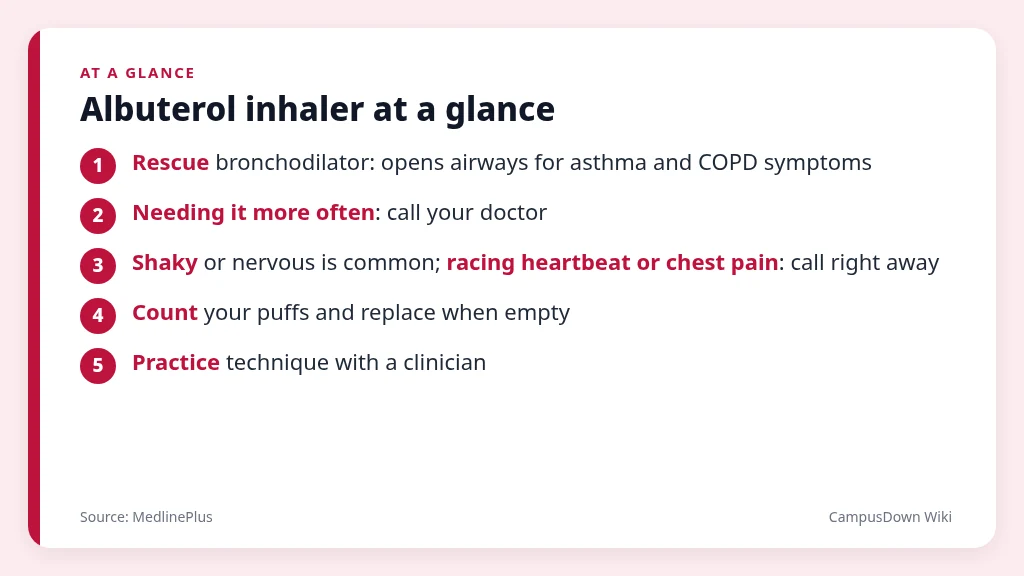
The albuterol inhaler is a rescue bronchodilator: use it as prescribed, count your puffs, practice technique with a clinician, and call your doctor when you need it more often than usual.
Browse more guides like this in the Medicines hub.
This article is for general education and does not replace advice from your own doctor, nurse or pharmacist.