
Are your compression socks helping your ankles, or hiding a problem? Compression socks are sold in drugstores and airports, and the numbers on the package, like 15-20 or 20-30, aren't self-explanatory. The wrong strength or the wrong person can matter.
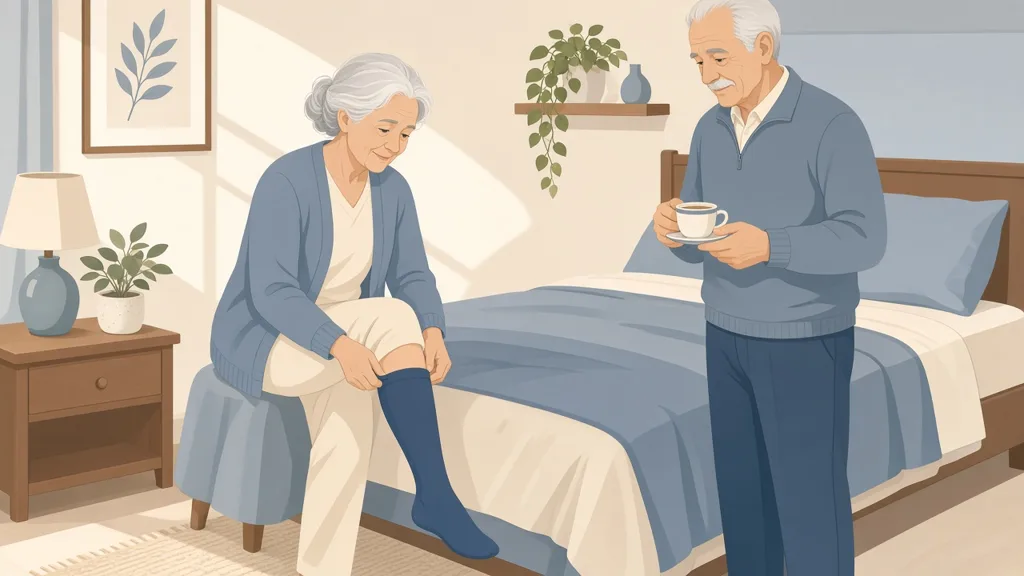
This guide is based on Mayo Clinic Store's education page on compression socks, NICE's clinical knowledge summary on compression stockings and an international consensus statement on risks and contraindications of compression treatment. It explains in detail how to choose and when to ask first. Ask your doctor or pharmacist what's right for your legs.
What "mmHg" means
Mayo Clinic's education page explains that mmHg means millimeters of mercury, and on compression socks it describes how much pressure the garment applies to the leg. Most medical socks are graduated: tightest near the ankle, with pressure decreasing up the leg, to help move blood back toward the heart.

15-20 vs 20-30 vs 30-40
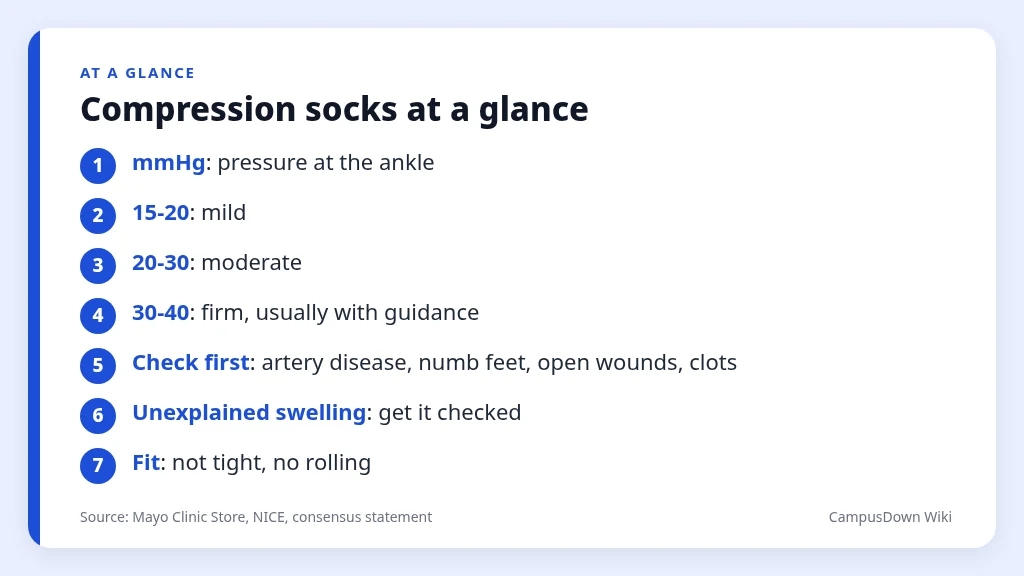
Mayo Clinic Store gives this quick comparison and stresses that these are starting points, not a prescription, and that not everyone benefits from the strongest compression:
| Level | Strength | Often considered for |
|---|---|---|
| 15-20 mmHg | Mild | Mild swelling or tired, achy legs; long sitting or standing |
| 20-30 mmHg | Moderate | More noticeable swelling; symptomatic varicose veins; some chronic vein problems |
| 30-40 mmHg | Firm to high | More advanced vein disease, skin changes or ulcers; generally with professional guidance |
Who should check first
Mayo Clinic says to talk with a healthcare professional before using compression if you have known or suspected peripheral artery disease (PAD) or another condition that reduces leg blood flow, and also if you have:
- Significant or unexplained leg swelling
- An open wound or leg ulcer
- Skin changes on the legs or feet
- Reduced sensation in the feet or legs
- A history of blood clots
- A known vascular condition, or new symptoms that haven't been evaluated
The international consensus statement says to check arterial circulation before any compression therapy, and that in severe artery disease sustained compression can be contraindicated, because pressure over the ankle or foot can injure skin. NICE says a holistic leg assessment, including artery disease, should come first; that lower-class compression can start without an ankle-brachial pressure index test when no red flags for arterial disease are present; and that the test can be unreliable in people with diabetes. Learn about numb feet in peripheral neuropathy in the feet and diabetes care in diabetes in older adults.
Get help now if
Sudden swelling in one leg, warmth, redness or calf pain, a cold or pale foot, or chest pain or breathlessness need urgent medical care, not a new pair of socks.
Swollen ankles: find the cause first
Swelling can come from the heart, kidneys, liver, medicines or a clot. Read swollen ankles in older adults and ask your clinician before using socks to manage swelling. If you have heart failure, weight gain with swelling needs a call to your team; see daily weights for heart failure.
Wearing them well
- Measure as the label directs (usually ankle and calf, sometimes in the morning); a wrong size can pinch or roll.
- Put them on in the morning, smooth out wrinkles, and don't let the top roll down.
- Take them off and call your clinician if you notice numbness, tingling, color changes, new pain or skin damage.
- Check your skin daily, especially the heels and ankles. If you already have skin damage, see wound care dressings and ask a nurse.
- Wear supportive shoes; see our fall prevention checklist because slippery socks on a smooth floor are a fall risk.
- Ask whether you need a prescription: Cleveland Clinic says stockings rated 20 mmHg or higher require a prescription in some settings; ask your pharmacist.
Example scenario: the stronger pair that didn't help
- Who
- Aloysius, 69, a retired tool-and-die maker in Rockford, Illinois, bought 20-30 mmHg socks after long days on his feet left his ankles swollen. His wife, Winona, 67, noticed a red mark circling each ankle by the afternoon.
- What happened
- His feet had been going numb for months from diabetes, and he'd stopped feeling the rub of the sock tops.
- How it felt
- Aloysius felt irritated that something sold in a pharmacy seemed to be hurting him. Winona felt guilty for suggesting the stronger pair.
- What they did
- She called his doctor's office, where a nurse asked about pulses, skin color and numbness and arranged a leg check before he wore them again. The clinician asked about his swelling, listed the circulation tests, and advised him to stop the stronger socks until he was seen. He checked his feet every evening, and Winona helped him with the heels.
- How it turned out
- Aloysius said he learned a number on a package isn't a prescription. Winona said the evening foot check became a quiet ritual they both trusted.
This is an illustrative example, not a real patient or a review.
Aloysius's story is an illustrative example. A clinician should assess any numb, swollen or discolored leg.
Most-asked questions about compression socks
What's the difference between 15-20 and 20-30 compression socks?
Mayo Clinic Store describes 15-20 mmHg as mild and 20-30 as moderate compression, with different uses. They're starting points; a clinician should match them to your needs.
Why people ask: "compression socks 15-20 vs 20-30" is #1 for "compression socks 15-20 vs 20-30" (US autocomplete, November 2026).
Which compression socks are tighter, 15-20 or 20-30?
The 20-30 mmHg socks apply more pressure at the ankle than 15-20 mmHg.
Why people ask: "which compression socks are tighter 15 20 or 20 30" is #9 for "compression socks 15-20 vs 20-30" (US autocomplete, November 2026).
Who should not wear compression socks?
People with known or suspected peripheral artery disease should get medical advice first, and so should people with open wounds, numb feet, unexplained swelling or a history of clots.
Why people ask: "compression socks who should not wear" is #1 for "compression socks who should not wear" (US autocomplete, November 2026).
What are the dangers of wearing compression socks?
Pressure can injure skin when circulation is poor, especially at the ankle and foot. Check circulation first if you have artery disease risk.
Why people ask: "what are the dangers of wearing compression socks" is #6 for "compression socks who should not wear" (US autocomplete, November 2026).
Is it bad to wear compression socks if you don't need them?
Mayo Clinic Store says not everyone benefits from stronger compression and that socks shouldn't replace evaluating new or unexplained symptoms.
Why people ask: "is it bad to wear compression socks if you don't need them" is #7 for "compression socks who should not wear" (US autocomplete, November 2026).
Are compression socks good for swollen ankles?
They may help in some cases, but swelling needs a cause, so ask your clinician first.
Why people ask: "compression socks for swollen ankles" is #1 for "compression socks for swollen ankles" (US autocomplete, November 2026).
Related on CampusDown
You can learn more about causes of swollen ankles, and take a closer look at heart failure daily weights if swelling and weight gain come together.
Frequently asked questions
- Can I sleep in compression socks?
- Only if your clinician says so. Many people take them off at night.
- Do I need a prescription?
- Mild levels are sold without one; higher levels may need fitting or a prescription. Ask your pharmacist.
- How long do compression socks last?
- Follow the maker's care label; stretched-out socks lose pressure.
- Are compression socks safe with diabetes?
- Ask your doctor first, especially with numb feet. Check it for yourself with a daily skin check.
Compression socks are a tool, not a diagnosis. Find out why your legs swell, ask whether your arteries and feet are safe for compression, and pick the lowest effective level your clinician recommends.
Browse more guides like this in the Home Medical Devices hub.
This article is for general education and does not replace advice from your own doctor, nurse or pharmacist.