
Why does the nurse use a thick gel dressing on one wound and a soft foam pad on another? Dressings aren't interchangeable bandages. Each is designed for a certain amount of drainage and a certain stage of healing. This guide explains the common types so you can follow the plan and ask better questions.

This guide uses the NICE evidence summary on advanced wound dressings, the British National Formulary (BNF) wound management guide and MedlinePlus patient instructions. The NICE and BNF documents come from the UK; they describe the same product categories used in the U.S. We explain in detail what each type does. A nurse or doctor must choose the dressing for your wound.
Why dressings matter
The BNF says the ideal dressing for moist wound healing keeps the wound moist with exudate but not macerated, free of infection and debris, at a good temperature and undisturbed by frequent changes. MedlinePlus says providers apply dressings to keep the wound moist, which promotes healing, and help prevent infection, and that you may need one or several types as the wound heals. The BNF adds that moist healing isn't appropriate in every case (for example gangrenous toes from vascular disease), which is another reason to let a clinician decide.

The main types
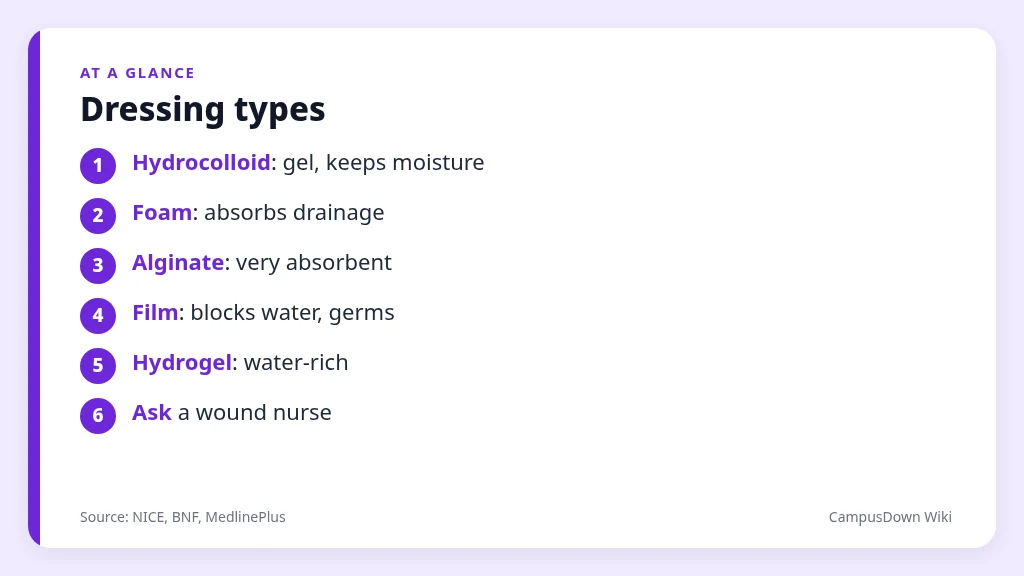
NICE describes these advanced dressings:
- Alginate: highly absorbent; it forms a gel when it touches the wound, which can be lifted off or rinsed away with sterile saline.
- Film: permeable to water vapor and oxygen but not to water or microorganisms.
- Foam: usually hydrophilic polyurethane foam designed to absorb exudate and keep the wound surface moist; some are silicone-coated for gentler removal.
- Hydrocolloid: occlusive; a matrix on a film or foam backing forms a gel for a moist environment.
- Hydrogel: cross-linked polymers with a lot of water, designed to absorb exudate or rehydrate a wound depending on moisture.
Other common supplies are plain gauze and moistened wet-to-dry gauze, which MedlinePlus says may be used with instructions from your provider.
Matching dressing to the wound
The BNF's table suggests, for example, hydrocolloid or soft polymer dressings for pink, low-drainage wounds, foam or alginate for moderate drainage and alginate, foam or hydrocolloid for heavy drainage, with hydrogel or hydrocolloid for sloughy wounds. It also says there have been few clinical trials able to show a clear advantage for any particular product, so the choice depends on the type and stage of wound, patient preference, site and cost. That's why one person's dressing may not suit another.
Hydrocolloid vs alginate
In plain terms, hydrocolloids keep a moist gel layer over a wound with little to moderate drainage, while alginates are used when there's more fluid to absorb. Don't swap them without advice; ask your nurse why they chose one.
Pressure injuries
For pressure injuries, the dressing is one part of care; relieving pressure comes first. Learn what stage means in pressure injury stages, and see prevention steps in pressure sores in bedbound people. People with diabetes or numb feet need special care; see peripheral neuropathy in the feet and diabetes in older adults.
Changing a dressing at home
MedlinePlus's wet-to-dry instructions give a good general pattern: wash hands before and after, wear non-sterile gloves, remove the old dressing (wet it with warm water if it sticks), gently clean the wound with warm water and soap, pat dry, check redness, swelling, odor and drainage, and bag the used supplies. Always follow your provider's instructions for your type of dressing, and ask who will change it; Medicare home health nurses may help.
Get help now if
MedlinePlus says to contact your provider for worsening redness, more pain, swelling, bleeding, a wound that's larger, deeper or dried-out and dark, increasing drainage, or drainage that's thick, tan, yellow, green or smells bad, or for a temperature of 100.5°F (38°C) or higher for more than 4 hours.
Example scenario: the dressing that kept rolling off
- Who
- Dashiell, 77, a retired long-haul truck driver in Spokane, Washington, had a slow-healing sore on his heel. His wife, Genevieve, 75, a retired pharmacy technician, changed the dressing each morning.
- What happened
- The adhesive edges kept curling in his sock, and one morning the dressing was soaked through and the skin around the sore looked white and soft.
- How it felt
- Dashiell felt frustrated that after months he still wasn't healed. Genevieve felt like she was failing at something she should have been able to do.
- What they did
- At the wound clinic, the nurse explained that the dressing was meant for lighter drainage than his sore was now producing, and that the white skin around it was from trapped moisture. She switched to a more absorbent type, showed them how to protect the edges, and set a schedule. She also asked about his circulation and numb feet, and arranged follow-up visits.
- How it turned out
- Dashiell said he finally understood the dressing was a tool for a specific wound, not a bandage. Genevieve said it helped to hear that wound care changes as the wound does.
This is an illustrative example, not a real patient or a review.
Dashiell's story is an illustrative example. Dressing choices depend on a clinician's assessment.
Most-asked questions about wound dressings
What are the wound dressing types?
Common advanced dressings include alginate, film, foam, hydrocolloid and hydrogel, plus basic gauze. Each handles moisture and drainage differently.
Why people ask: "wound dressing types" is #1 for "wound dressing types" (US autocomplete, November 2026).
What are wound dressing types and uses?
Alginates and foams absorb drainage, hydrocolloids keep a moist gel layer, films protect while letting vapor through, and hydrogels donate or absorb moisture.
Why people ask: "wound dressing types and uses" is #4 for "wound dressing types" (US autocomplete, November 2026).
What is a hydrocolloid dressing?
An occlusive dressing with a matrix that forms a gel on contact, keeping the wound surface moist.
Why people ask: "hydrocolloid dressing" is #1 for "hydrocolloid dressing" (US autocomplete, November 2026).
Can a hydrocolloid dressing be used on a pressure ulcer?
The BNF lists hydrocolloids among options for some wounds, but the choice depends on the stage and drainage. Ask the wound nurse.
Why people ask: "hydrocolloid dressing for pressure ulcer" is #5 for "hydrocolloid dressing" (US autocomplete, November 2026).
Are hydrocolloid dressings used for bed sores?
Sometimes, depending on the wound. A clinician should decide and show you how to change it.
Why people ask: "hydrocolloid dressing for bed sores" is #8 for "hydrocolloid dressing" (US autocomplete, November 2026).
What is an alginate dressing?
A highly absorbent dressing that forms a gel when it touches the wound.
Why people ask: "alginate dressing" is #1 for "alginate dressing" (US autocomplete, November 2026).
Alginate dressing vs hydrocolloid?
Alginates are for more drainage; hydrocolloids keep a moist environment with less. A clinician picks.
Why people ask: "alginate dressing vs hydrocolloid" is #7 for "alginate dressing" (US autocomplete, November 2026).
Related on CampusDown
You can learn more about compression socks for leg wounds only with medical advice, and take a closer look at pressure injury stages.
Frequently asked questions
- Should a wound stay covered or open to air?
- MedlinePlus says dressings keep a wound moist and help prevent infection; follow your clinician's plan.
- How often should I change the dressing?
- Your provider will tell you how often, and it depends on the type.
- Is gauze bad?
- No. Gauze has uses, including moistened gauze when your provider prescribes it.
- Can I use honey or silver dressings?
- Ask your clinician. Check it for yourself with the nurse before buying specialty products.
The right dressing depends on the wound, its drainage and its stage. Ask your nurse what the dressing does, how often to change it and what changes mean you should call.
Browse more guides like this in the Nursing Student and NCLEX hub.
This article is for general education and does not replace advice from your own doctor, nurse or pharmacist.