
When did anyone last look at the skin on her heels? For a person who can't move easily, a patch of red skin on a heel or tailbone can become a deep wound in days. The good news is that most pressure sores are preventable with small, steady habits.
This guide uses MedlinePlus's pages on pressure sores and "Preventing pressure injuries" and CMS's Durable Medical Equipment Reference List. It explains in detail how families can check and protect skin. Ask your doctor, nurse or physical therapist to teach you for your situation, and call early if skin changes.
What pressure sores are
MedlinePlus says pressure sores, also called bedsores or pressure injuries, form when skin and soft tissue press against a harder surface, such as a chair or bed, for a prolonged time. The pressure reduces blood supply, and lack of blood supply can damage or kill skin tissue. They commonly form where bones are close to the skin: heels, ankles, hips, tailbone, back, elbows. MedlinePlus warns that they can cause serious infections, some life-threatening, and that advanced sores are slow to heal, so early treatment is best.

Who is at risk
MedlinePlus lists people who:
- Spend most of the day in a bed or chair with minimal movement.
- Are overweight or underweight.
- Can't control the bowels or bladder or have leakage.
- Have decreased feeling in an area.
- Spend a lot of time in one position.
After a fall or hospital stay, risk rises; see hip fracture recovery for how early movement helps.
The daily skin check
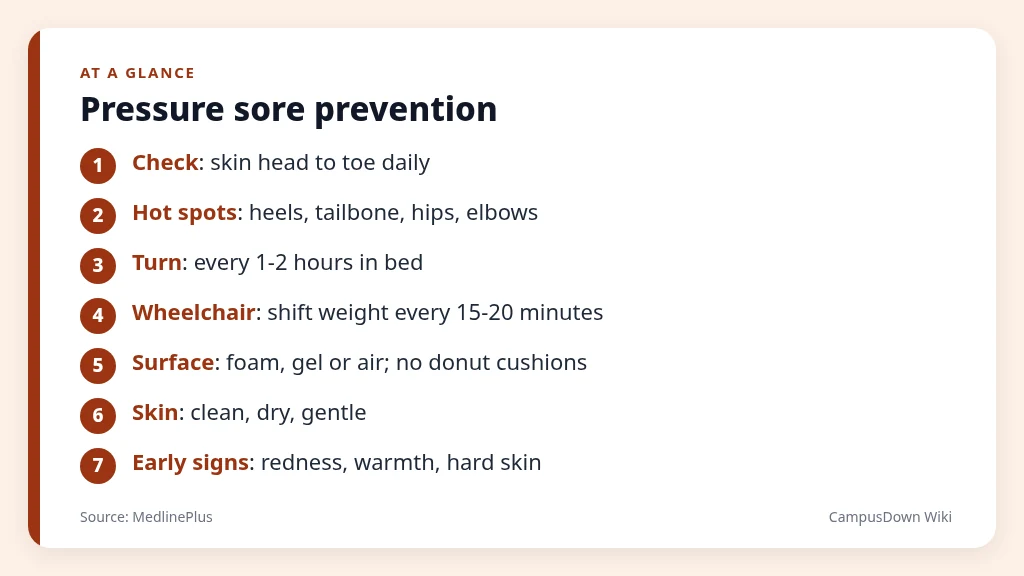
MedlinePlus says to check the body every day from head to toe, with extra attention to heels and ankles, knees, hips, spine, tailbone, elbows, shoulders and shoulder blades, back of the head and ears. Early signs to report:
- Skin redness (harder to see in people with darker skin tones)
- Warm areas
- Spongy or hard skin
- Breakdown of the top layers of skin or a sore
Learn what stages look like in pressure injury stages. Wound care belongs to a nurse or doctor; see wound care dressings for general background.
Protecting the skin
MedlinePlus advises:
- Wash gently with a soft sponge or cloth; don't scrub; avoid talc and strong soaps.
- Use moisturizer and skin protectants as directed by your provider.
- Clean and dry right after urinating or a bowel movement, and ask about protective creams.
- Eat enough calories and protein and drink plenty of water.
- Avoid clothes with thick seams, buttons or zippers that press, and keep clothing and sheets smooth and dry.
In bed
- Use a foam mattress or one filled with gel or air.
- Change position every 1 to 2 hours.
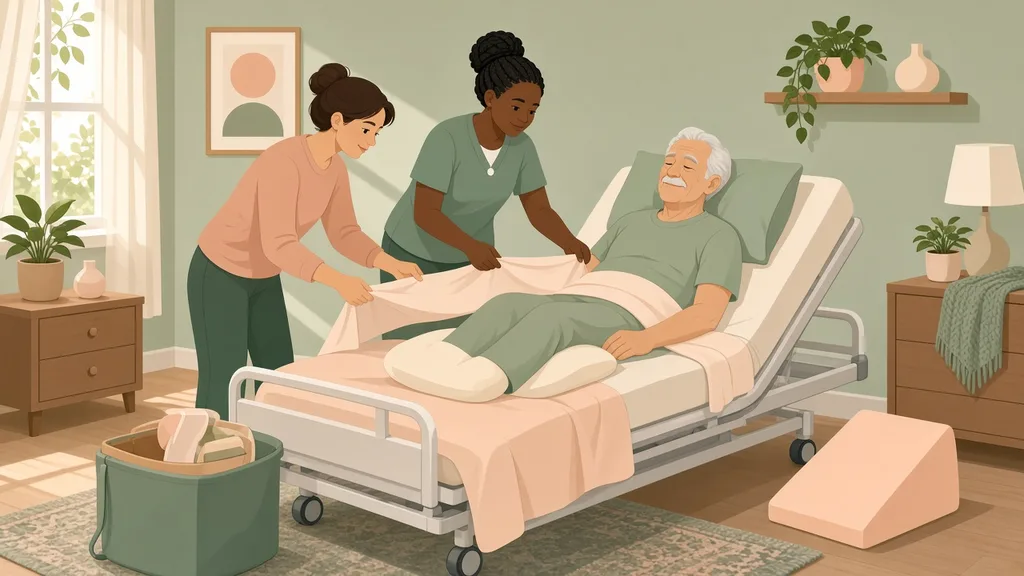
- Put a soft pillow or foam between knees and ankles when on your side; under the heels, or place a pillow under the calves to lift the heels, when on your back. Don't put pillows under the knees, which presses the heels.
- Never drag the person; lift or use a draw sheet.
- MedlinePlus says don't raise the head of the bed above 30 degrees to keep the body from sliding, which can harm skin. If the person needs the head raised for breathing, eating or heart failure, ask the care team how to position safely; our hospital bed guide discusses these needs.
In a wheelchair
- Make sure the chair fits, and have a provider or physical therapist check it once or twice a year.
- Sit on a foam or gel cushion; natural sheepskin pads may help.
- Do not use donut-shaped cushions.
- Shift weight every 15 to 20 minutes.
- Don't drag during transfers; ask a physical therapist to teach proper technique.
Medicare and pressure-reducing surfaces
CMS's equipment list (NCD 280.1) says pressure pads, mattresses and lamb's wool pads are covered if the patient has, or is highly susceptible to, pressure ulcers and the patient's physician is supervising treatment. It says mattresses are otherwise covered only where a hospital bed is medically necessary. Our Medicare DME guide explains the process; home health nurses can teach skin care.
Get help now if
Call your provider right away if you see a sore, or redness or other skin change lasting more than a few days, or an area that becomes painful, warm or drains pus. Seek urgent medical care for fever, new confusion or a rapidly spreading red area.
Example scenario: the heel nobody checked
- Who
- Fabian, 84, a retired ferry captain in Seattle, Washington, spent most days in a recliner or bed after a stroke. His daughter, Beulah, 58, had moved into the spare room to care for him.
- What happened
- One morning, while changing his socks, Beulah noticed a dark red patch on his heel that stayed red when she pressed it.
- How it felt
- Beulah felt sick with guilt that she'd missed it. Fabian felt humiliated that his body was failing him again.
- What they did
- She called his doctor the same day. A visiting nurse checked the area, showed Beulah how to float his heels with pillows under his calves, introduced a repositioning schedule and a draw sheet, and asked the doctor about a pressure-reducing mattress. Beulah began a daily head-to-toe skin check and kept a small log.
- How it turned out
- Fabian said he was grateful the nurse treated the heel as seriously as the stroke. Beulah said the daily check became part of their morning routine, like coffee.
This is an illustrative example, not a real patient or a review.
Fabian's story is an illustrative example. A nurse or doctor must assess any real skin injury.
Most-asked questions about pressure sores
What are the stages of bed sores?
Clinicians describe stages from reddened skin to deeper wounds. See our stages guide and ask a nurse to assess any sore.
Why people ask: "bed sores stages" is #2 for "bed sores" (US autocomplete, November 2026).
What causes bed sores?
Prolonged pressure on skin and soft tissue reduces blood supply and damages tissue, per MedlinePlus.
Why people ask: "bed sores causes" is #7 for "bed sores" (US autocomplete, November 2026).
What is bed sores treatment at home?
Prevention steps help, but an existing sore needs a provider's evaluation. MedlinePlus says early treatment is best. Call your provider when you see changes.
Why people ask: "bed sores treatment at home" is #8 for "bed sores" (US autocomplete, November 2026).
How do you treat pressure sores on the heels?
Take pressure off the heels (pillows under the calves) and tell your provider right away. Treatment depends on the stage.
Why people ask: "pressure sores on heels treatment" is #6 for "pressure sores" (US autocomplete, November 2026).
What about bed sores on the buttocks?
The tailbone and hips are high-risk spots. Shift position, keep skin clean and dry, avoid donut cushions and call your provider about redness or sores.
Why people ask: "bed sores on buttocks" is #5 for "bed sores" (US autocomplete, November 2026).
What are pressure sores stages?
Severity is staged by how deep the damage goes; a clinician should stage and treat the sore.
Why people ask: "pressure sores stages" is #7 for "pressure sores" (US autocomplete, November 2026).
Related on CampusDown
You can learn more about caring for yourself while caring for someone in caregiver burnout. If a sore has already formed, take a closer look at the stages guide and talk to a nurse.
Frequently asked questions
- How often should I turn someone in bed?
- MedlinePlus says every 1 to 2 hours. Ask the care team about the right schedule.
- Are donut cushions good for pressure sores?
- No. MedlinePlus says not to sit on donut-shaped cushions.
- Does Medicare cover pressure-reducing mattresses?
- CMS covers pressure pads and mattresses for people who have or are highly susceptible to pressure ulcers, with physician supervision. Check it for yourself with your doctor and supplier.
- Can a pressure sore heal on its own?
- Don't count on it. MedlinePlus says advanced sores are slow to heal and early treatment is best.
Pressure sores are easier to prevent than to treat. Check skin daily, keep the person moving, protect the heels and tailbone, and call a provider when skin changes.
Browse more guides like this in the Senior Health and Medicare hub.
This article is for general education and does not replace advice from your own doctor, nurse or pharmacist.