
What if the bed in your spare room is the wrong bed for the person you love? If someone you care for slides down in bed, can't sit up to breathe or eat, or you're lifting them from a low mattress, a hospital bed can change the daily routine. It can also change your out-of-pocket costs, so the rules matter.

This guide uses Medicare.gov's hospital bed page, CMS's Durable Medical Equipment (DME) Reference List and the DME MAC Local Coverage Determination (LCD) L33820 "Hospital Beds and Accessories". It explains in detail what is covered. Your doctor and the DME supplier can tell you how these rules apply in your situation.
What counts as a hospital bed
A hospital bed isn't a fancy mattress. The LCD describes fixed-height, variable-height, semi-electric and total electric beds, plus heavy-duty and extra-wide models. The main differences are in how the bed can be positioned and adjusted:
- Fixed-height: the bed stays at one height.
- Variable-height: the height can be changed, which helps with transfers.
- Semi-electric and total electric: motors do more of the adjusting. Ask the supplier exactly which functions are motorized, because Medicare treats the two types differently.

Does Medicare cover hospital beds?
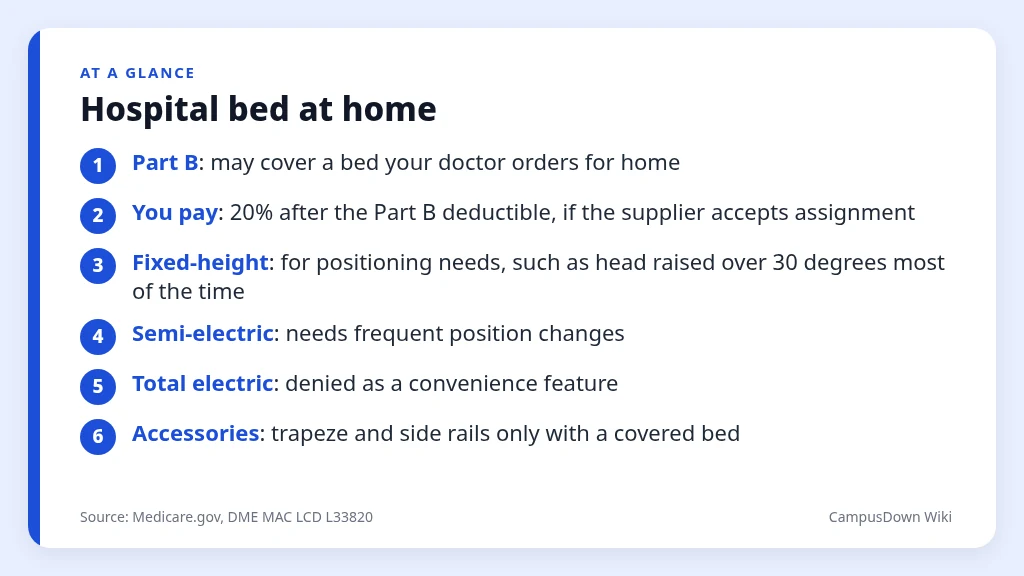
Medicare.gov says Part B may cover hospital beds as durable medical equipment if you're eligible: your doctor must order it for use in your home, and the item must be medically necessary. After the Part B deductible, you pay 20% of the Medicare-approved amount if the supplier accepts assignment. You may need to rent or buy the bed, depending on the item. Our Medicare DME guide explains rent-versus-buy rules.
The medical criteria for each type
The LCD says a fixed-height bed is covered if one or more of these apply:
- You need your body positioned in ways that aren't possible in an ordinary bed. The LCD notes that elevating the head or upper body less than 30 degrees doesn't usually require a hospital bed.
- You need positioning to relieve pain.
- You need the head of the bed raised more than 30 degrees most of the time because of congestive heart failure, chronic lung disease or problems with aspiration.
- You need traction equipment that can only be attached to a hospital bed.
A variable-height bed is covered if you meet one of those criteria and need a different bed height to transfer to a chair, wheelchair or standing position. A semi-electric bed is covered if you meet a fixed-height criterion and need frequent changes in body position or have an immediate need for a change in position.
Total electric beds: not covered
The LCD says a total electric hospital bed is not covered because the height adjustment feature is a convenience feature, and it will be denied as not reasonable and necessary. If you choose one, ask the supplier whether you'd pay the difference in writing.
Heavy-duty beds and accessories
- Heavy-duty extra-wide bed: covered when you meet a fixed-height criterion and weigh more than 350 pounds but not more than 600 pounds; an extra heavy-duty bed if you weigh more than 600 pounds.
- Trapeze bar: covered if you need it to sit up because of a respiratory condition, change body position for other medical reasons, or get in or out of bed. A heavy-duty trapeze covers people over 250 pounds.
- Side rails or safety enclosures: covered when your condition requires them and they're part of, or an accessory to, a covered bed.
- Mattress: if your condition requires a replacement innerspring or foam mattress, it's covered for a bed you own. CMS's equipment list says mattresses are covered only where a hospital bed is medically necessary.
Paperwork that gets claims paid
A Standard Written Order must reach the supplier before the claim is submitted, or the claim is denied. Medicare.gov says suppliers must be enrolled in Medicare, and for rentals you should make sure the supplier accepts assignment for all rental months, otherwise you may pay the full cost upfront and wait for Medicare to reimburse you.
Safety and comfort at home
A bed that fits the medical need is only part of the plan. Think about where the bed goes (close to a bathroom, with room for a caregiver on both sides), cords and rugs, and night lighting. Lying in one position can raise the risk of skin damage, so see our pressure sore guide. A caregiver who lifts alone is at risk of injury; learn more about caregiver burnout and ask a nurse or physical therapist to show you safe transfer techniques.
Example scenario: the bed that raised more than the head
- Who
- Lazarus, 79, a retired high school band director in Akron, Ohio, had advanced heart failure and slept propped up on six pillows. His wife, Winnifred, 77, slept on a recliner nearby.
- What happened
- After a hospital stay, Lazarus woke most nights short of breath, and Winnifred woke every time he slid down the pillows. She had started to hurt her back pulling him upright.
- How it felt
- Lazarus felt ashamed that his illness cost them the same bed. Winnifred felt exhausted and afraid of dozing off while he struggled.
- What they did
- At discharge planning, the hospital social worker suggested asking his doctor whether a hospital bed made sense. The doctor documented the head elevation he needed, wrote an order, and Winnifred asked the supplier about assignment and rental terms before agreeing. She also said no to the total electric upgrade after reading that Medicare denies it.
- How it turned out
- Lazarus said he slept in a bed again instead of on a pile of pillows. Winnifred said her back pain eased once the bed did the lifting.
This is an illustrative example, not a real patient or a review.
Lazarus's story is an illustrative example. Coverage depends on the doctor's documentation and your plan.
Most-asked questions about hospital beds at home
Does Medicare cover hospital beds for home use?
Part B may cover one if your doctor orders it for home use and it's medically necessary. After the Part B deductible, you generally pay 20% of the approved amount if the supplier accepts assignment.
Why people ask: "does medicare cover hospital beds for home" is #1 for "does medicare cover hospital beds" (US autocomplete, November 2026).
Does Medicare cover hospital beds in assisted living?
Medicare.gov says Part B covers DME your doctor orders for use in your home; whether an assisted living residence counts, and who provides the bed, depends on the setting. Ask your supplier and the community.
Why people ask: "does medicare cover hospital beds in assisted living" is #4 for "does medicare cover hospital beds" (US autocomplete, November 2026).
Does Medicare cover hospital bed rental?
Some DME is rented rather than bought. Medicare.gov says to confirm that the supplier accepts assignment for all rental months.
Why people ask: "does medicare cover hospital bed rental" is #8 for "does medicare cover hospital beds" (US autocomplete, November 2026).
Does Medicare cover hospital bed mattresses?
CMS's equipment list says mattresses are covered only where a hospital bed is medically necessary, and the LCD covers a replacement mattress for an owned bed when your condition requires it.
Why people ask: "does medicare cover hospital bed mattresses" is #10 for "does medicare cover hospital beds" (US autocomplete, November 2026).
How much is a hospital bed for home use?
Prices vary by type and supplier. With Part B you'd pay the deductible and 20% of the approved amount; a total electric upgrade isn't covered.
Why people ask: "hospital bed for home cost" is #5 for "hospital bed for home" (US autocomplete, November 2026).
Related on CampusDown
Planning discharge from the hospital? You can learn more in our hospital discharge planning guide, and see what help at home could cost in in-home care costs. You can also check whether a Medicare home health nurse can teach safe transfers.
Frequently asked questions
- Can I get a hospital bed without a doctor's order?
- You can buy one privately, but Medicare Part B covers a bed only when your doctor orders it for medical need.
- Is a hospital bed rental or purchase better?
- It depends on how long you need it and the coverage rules for the item. Ask your doctor and a Medicare-enrolled supplier.
- Are bed rails safe?
- Rails can help with turning but can also trap a person. Ask your care team whether they fit your situation.
- Does Medicare Advantage cover hospital beds?
- Medicare Advantage plans must cover what Original Medicare covers but may use their own suppliers. Check your plan before ordering.
The right hospital bed starts with a doctor's order that documents why you need it. Ask about assignment, rental terms and any upgrade costs before delivery, and have someone show your family how to use the controls safely.
Browse more guides like this in the Home Medical Devices hub.
This article is for general education and does not replace advice from your own doctor, nurse or pharmacist.