
Is that red patch a stage 1, or just a pressure mark that will fade? Families and new nurses often ask this, and the honest answer is that a clinician has to look. This guide explains the vocabulary so you understand what the care team is saying and know when to call.

This guide uses the 2016 National Pressure Injury Advisory Panel (NPIAP) staging definitions, as published in the Journal of Wound, Ostomy and Continence Nursing and summarized in Advances in Skin & Wound Care, plus MedlinePlus. We explain in detail what each stage means. Don't try to stage or treat a wound yourself; ask a nurse or doctor.
Naming: injury, ulcer, sore
MedlinePlus says pressure sores form when you stay in one position too long; they commonly form over bony areas such as ankles, back, elbows, heels and hips. In 2016 NPIAP changed "pressure ulcer" to pressure injury and numbered the stages with Arabic numerals. NPIAP defines a pressure injury as localized damage to the skin and underlying soft tissue, usually over a bony prominence or related to a medical or other device, from intense or prolonged pressure, or pressure with shear. Prevention steps are in our pressure sore guide.

The stages in plain words
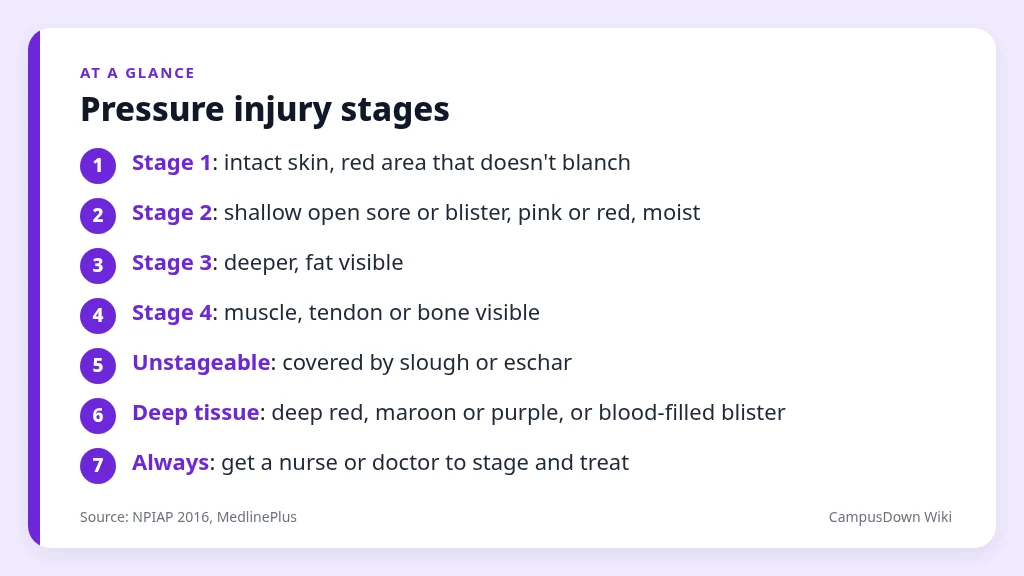
Stage 1. Intact skin with a localized area of non-blanchable redness (it stays red when pressed), which may look different on darker skin. Changes in sensation, temperature or firmness may come first. Purple or maroon discoloration isn't stage 1; it may be a deep tissue injury.
Stage 2. Partial-thickness skin loss with exposed dermis. The wound bed is pink or red and moist, and it may be an intact or ruptured serum-filled blister. Fat isn't visible, and there's no granulation tissue, slough or eschar. NPIAP says not to use this stage for moisture-associated skin damage, incontinence dermatitis, tape injuries or traumatic wounds such as skin tears and burns.
Stage 3. Full-thickness skin loss where fat is visible. Granulation tissue and rolled edges are common, and slough or eschar may show. Undermining and tunneling may occur. Fascia, muscle, tendon, ligament, cartilage and bone aren't exposed.
Stage 4. Full-thickness skin and tissue loss with exposed or directly palpable fascia, muscle, tendon, ligament, cartilage or bone.
Unstageable. Full-thickness loss where slough or eschar hides the depth. If it's removed, stage 3 or 4 will be revealed. NPIAP says stable eschar (dry, adherent, intact, without redness or fluctuance) on the heel or on an ischemic limb shouldn't be softened or removed.
Deep tissue pressure injury (DTPI). Intact or non-intact skin with a localized area of persistent non-blanchable deep red, maroon or purple discoloration, or a separation that reveals a dark wound bed or blood-filled blister. Pain and temperature change often come first. It results from intense or prolonged pressure and shear at the bone-muscle interface, and may evolve quickly or resolve without tissue loss.
What the stage means for you
Stage describes how deep the damage is, not how worried to be. MedlinePlus says advanced sores are slow to heal and early treatment is best, so call at the first sign. A nurse or wound specialist chooses the plan, which may include relieving pressure, cleaning, a suitable dressing and checking nutrition. You can learn more about dressing types in wound dressing types. Beds, mattresses and repositioning matter too; see hospital bed at home.
When to call
MedlinePlus says to contact your provider right away for a sore, redness or another skin change that lasts more than a few days, becomes painful or warm, or begins to drain pus.
Get help now if
Seek urgent care for fever, spreading redness, a foul smell, black or purple skin that's new, or confusion. Don't pop blisters, scrub the area or remove dry black tissue on a heel yourself.
Caregivers, take a breath
A new sore can bring guilt. Pressure injuries happen to careful families, especially after hospital stays or a hip fracture; see hip fracture recovery. Ask for help from home health nursing and look after yourself: caregiver burnout.
Example scenario: the purple spot that wasn't a bruise
- Who
- Casimir, 82, a retired grain elevator operator in Fargo, North Dakota, spent a week in bed with pneumonia. His daughter, Odalys, 55, a dental hygienist, noticed a deep purple area on his right heel that was tender when she touched it.
- What happened
- By the next morning it looked like a blood blister, and Casimir winced when the sheet brushed it.
- How it felt
- Casimir felt embarrassed and told her it was just a bruise. Odalys felt dread because she knew bruises don't hurt like that.
- What they did
- She called his doctor and sent a photo to the clinic portal. A wound nurse examined the heel, called it a deep tissue injury and explained that it could change over several days, and she showed Odalys how to keep the heel off the bed with pillows under the calf. The nurse set a plan to re-check and told them not to rub or massage the area.
- How it turned out
- Casimir said he'd never thought a heel could hurt that much. Odalys said she was glad she'd trusted her gut instead of waiting.
This is an illustrative example, not a real patient or a review.
Casimir's story is an illustrative example. Only a clinician can stage a pressure injury.
Most-asked questions about pressure injury stages
What are the pressure injury stages?
NPIAP describes stage 1 to 4, unstageable and deep tissue pressure injury, based on depth and appearance. A clinician must stage the wound.
Why people ask: "pressure injury stages" is #1 for "pressure injury stages" (US autocomplete, November 2026).
What are pressure injury stages 1-4?
Stage 1 is intact skin with non-blanchable redness, stage 2 is partial-thickness loss, stage 3 is full-thickness loss with visible fat, and stage 4 shows muscle, tendon, ligament, cartilage or bone.
Why people ask: "pressure injury stages 1-4" is #8 for "pressure injury stages" (US autocomplete, November 2026).
What is a stage 2 pressure ulcer?
Partial-thickness skin loss with exposed dermis, a pink or red moist wound bed, or a blister, with no visible fat. A nurse should assess it.
Why people ask: "stage 2 pressure ulcer" is #1 for "stage 2 pressure ulcer" (US autocomplete, November 2026).
How is a stage 2 pressure ulcer treated?
A clinician chooses care, such as relieving pressure and an appropriate dressing. Don't treat it alone.
Why people ask: "stage 2 pressure ulcer treatment" is #2 for "stage 2 pressure ulcer" (US autocomplete, November 2026).
What is an unstageable pressure injury?
A full-thickness wound whose depth can't be seen because slough or eschar covers it.
Why people ask: "unstageable pressure injury" is #1 for "unstageable pressure injury" (US autocomplete, November 2026).
What is the definition of an unstageable pressure injury?
Obscured full-thickness skin and tissue loss; removing slough or eschar would reveal stage 3 or 4, and stable eschar on a heel shouldn't be removed.
Why people ask: "unstageable pressure injury definition" is #2 for "unstageable pressure injury" (US autocomplete, November 2026).
Unstageable pressure injury vs stage 4?
Stage 4 shows exposed deep structures such as bone or tendon; unstageable means the depth can't be determined because slough or eschar covers it.
Why people ask: "unstageable pressure injury vs stage 4" is #7 for "unstageable pressure injury" (US autocomplete, November 2026).
Related on CampusDown
You can learn more in preventing pressure sores. If you need supplies, take a closer look at dressing types.
Frequently asked questions
- Can a stage 1 injury heal quickly?
- Relieving pressure early gives the best chance; tell a nurse right away.
- Is a purple spot always a deep tissue injury?
- Not always, but persistent deep red, maroon or purple discoloration should be examined.
- Are moisture rashes pressure injuries?
- NPIAP says stage 2 isn't used for moisture-associated skin damage; a clinician decides.
- Who stages the wound?
- A trained nurse, wound specialist or doctor. Check it for yourself only for early changes, then call.
Stages are a shared language for the care team. Your job is to notice early, relieve pressure and call, and let a clinician stage and treat the injury.
Browse more guides like this in the Nursing Student and NCLEX hub.
This article is for general education and does not replace advice from your own doctor, nurse or pharmacist.