
Is that low-cost "semaglutide" in a telehealth ad the same thing as Wegovy? According to the FDA, no. Compounded GLP-1s became widely sold during the drug shortages, and many people still use them. Understanding what they are, and aren't, can protect your health and your wallet.
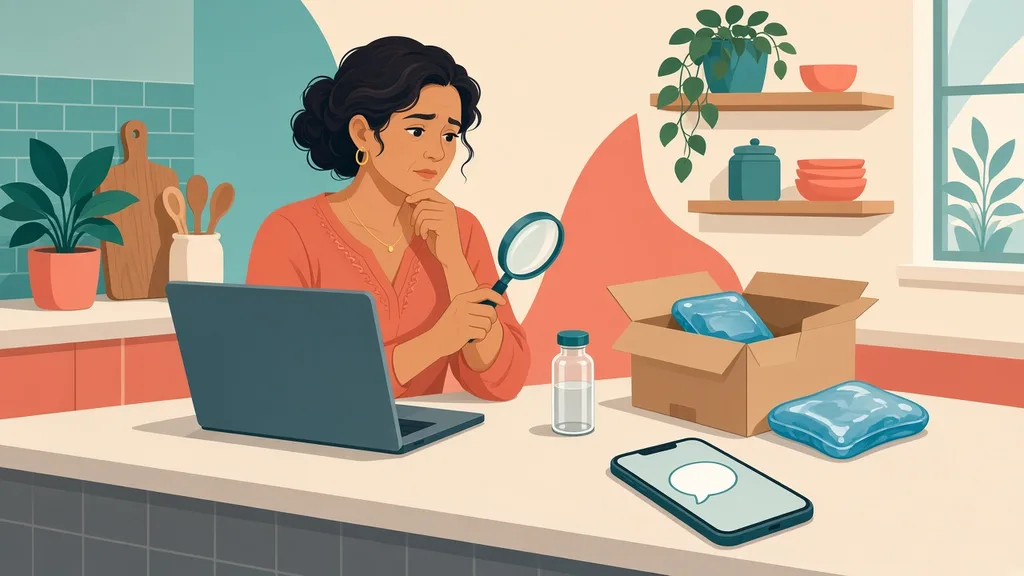
This guide is based on FDA's page "FDA's Concerns with Unapproved GLP-1 Drugs Used for Weight Loss" (content current as of October 1, 2026) and FDA press announcements. It explains in detail what the agency says. It doesn't judge any individual pharmacy, and it isn't medical advice.
What "compounded" means
Compounding is when a pharmacist combines or alters ingredients to make a drug for a patient's specific medical need. FDA's key points:
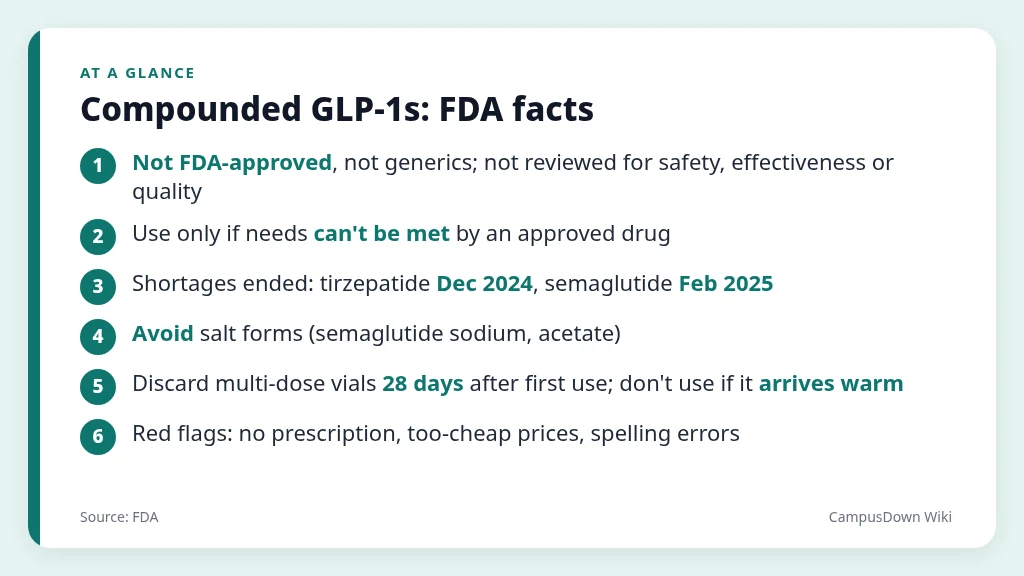
- Compounded drugs are not FDA-approved. FDA doesn't review them for safety, effectiveness or quality before they're marketed.
- They are not generics. A generic is FDA-approved; a compounded drug isn't.
- FDA says compounded drugs should only be used when a patient's medical needs can't be met by an FDA-approved drug.

The shortages are over
Compounders were allowed to make copies of semaglutide and tirzepatide largely because the brand drugs were in shortage. FDA declared the tirzepatide shortage resolved on December 19, 2024 and the semaglutide shortage resolved on February 21, 2025, then gave compounders transition periods that ended in early to mid 2025. Since then, compounders can't legally make copies that are essentially the same as approved drugs except in limited situations, such as a documented medical need for a change.
FDA's specific concerns
| Concern | What FDA says |
|---|---|
| Dosing errors | Reports of adverse events, some needing hospitalization, linked to patients measuring wrong doses and some clinicians miscalculating doses. |
| Doses beyond the label | Adverse events in patients prescribed compounded doses beyond the FDA-approved label. |
| Salt forms | Semaglutide sodium and semaglutide acetate are different active ingredients; FDA is not aware of any lawful basis for compounding with them. |
| Storage | Injectable GLP-1s need refrigeration. Don't use a product that arrives warm or with inadequate ice packs. |
| Multi-dose vials | Discard 28 days after first use, even if medicine remains, even if the label says longer. |
| Counterfeits | Counterfeit Ozempic has been found in the US; it may contain the wrong ingredient, the wrong amount or none at all. |
As of May 31, 2026, FDA had received 990 adverse event reports linked to compounded semaglutide and more than 730 linked to compounded tirzepatide. FDA notes these are likely underreported, and a report doesn't prove the drug caused the event.
Telehealth marketing crackdown
On March 3, 2026, FDA announced 30 warning letters to telehealth companies for false or misleading claims about compounded GLP-1s. FDA's guidance for telehealth firms says marketing shouldn't imply a compounded drug is the same as an approved drug, is "generic" or "FDA-approved," is "clinically proven" to give the same result, or comes from an "FDA-approved" pharmacy or outsourcing facility, since FDA doesn't approve or license any facility.
Red flags when buying online
FDA advises caution if a seller:
- doesn't require a prescription or screening by a licensed doctor;
- has no licensed doctor to answer questions;
- offers prices that seem too good to be true;
- sends a product that looks different from what you got before, or arrives broken, damaged or without instructions;
- has spelling errors on the label or a wrong pharmacy address.
FDA's BeSafeRx campaign has resources for buying medicines online safely.
Get help now if
If you use a compounded GLP-1, confirm the exact dose in mg and in mL or units with your prescriber and pharmacist, use a new sterile needle every time, and seek care for severe stomach pain, vomiting you can't stop, or signs of low blood sugar. Report problems to FDA MedWatch.
FDA-approved alternatives
Approved options now include the Wegovy pill and Lilly's Foundayo pill as well as injections, and the Medicare GLP-1 Bridge offers a $50 monthly copay for eligible people since July 1, 2026. Learn more in Wegovy vs Zepbound and GLP-1 pills.
Example scenario: the vial that arrived warm
- Who
- Prudence, 44, a dental office manager in Tucson, had been buying compounded semaglutide from a telehealth site for a year. Her insurance didn't cover weight drugs.
- What happened
- One July shipment arrived with melted ice packs, and a new vial looked different from her last one. The site's chat bot told her it was "the same FDA-approved ingredient."
- How it felt
- She felt torn: angry that she might have wasted money, scared she'd been injecting something unsafe, and ashamed to tell her doctor she'd gone around him.
- What they did
- She didn't use the warm vial. She called her primary care doctor, who reviewed FDA's concerns page with her and checked whether she qualified for an FDA-approved drug through her new employer plan. Her pharmacist helped her report the shipment problem.
- How it turned out
- Prudence switched to an FDA-approved option with prior authorization. She said the hardest part was making the call, and the relief afterward was worth it.
This is an illustrative example, not a real patient or a review.
Prudence is an illustrative example. Talk to your doctor before starting, stopping or switching any GLP-1.
Most-asked questions about compounded GLP-1s
Is compounded semaglutide safe to use for weight loss?
FDA says compounded drugs aren't reviewed for safety, effectiveness or quality, and it has flagged dosing errors, salt forms and storage problems. It recommends them only when an approved drug can't meet your medical need.
Why people ask: "is compounded semaglutide safe to use for weight loss" is #8 for "is compounded semaglutide safe" (US autocomplete, November 2026).
Compounded semaglutide vs Wegovy: what's the difference?
Wegovy is FDA-approved and made to approved quality standards; compounded semaglutide is not FDA-approved and not a generic.
Why people ask: "compounded semaglutide vs wegovy" is #4 for "compounded semaglutide" (US, November 2026).
What are compounded semaglutide side effects?
FDA says many reported events resemble those of approved versions, mainly GI effects, but also reports events tied to dosing errors, some requiring hospitalization.
Why people ask: "compounded semaglutide side effects" is #3 for "compounded semaglutide" (US, November 2026).
Is compounded semaglutide with glycine safer?
Added ingredients don't make a compounded product FDA-approved or reviewed. Ask your prescriber what you're getting and why.
Why people ask: "compounded semaglutide with glycine" is #8 for "compounded semaglutide" (US, November 2026).
Is compounded semaglutide safe if not refrigerated?
FDA recommends not using any injectable GLP-1 that arrives warm or without enough refrigeration.
Why people ask: "is compounded semaglutide safe if not refrigerated" is #4 for "is compounded semaglutide safe" (US, November 2026).
Compounded tirzepatide vs Zepbound: are they the same?
No. Zepbound is FDA-approved; compounded tirzepatide is not FDA-approved or reviewed.
Why people ask: "compounded tirzepatide vs zepbound" is #2 for "compounded tirzepatide" (US, November 2026).
Related on CampusDown
To take a closer look at the approved drugs, read semaglutide and tirzepatide, and check it for yourself in the first weeks on a GLP-1.
Frequently asked questions
- Is compounded semaglutide a generic?
- No. FDA says compounded drugs aren't FDA-approved, while generics are.
- Can a telehealth company say its product is "FDA-approved"?
- FDA has warned that calling compounded GLP-1s generic or FDA-approved, or citing an "FDA-approved pharmacy," is misleading.
- How do I report a problem?
- Tell your prescriber and report it to FDA MedWatch online or by calling 1-800-FDA-1088.
Compounded GLP-1s aren't FDA-approved copies of brand drugs, and FDA has documented real risks. Check the source, watch the red flags, and talk to your doctor or pharmacist about approved options before you buy.
Browse more guides like this in the U.S. Health Topics hub.
This article is for general education and does not replace advice from your own doctor, nurse or pharmacist.
References
- FDA: FDA's Concerns with Unapproved GLP-1 Drugs Used for Weight Loss
- FDA: FDA Warns 30 Telehealth Companies Against Illegal Marketing of Compounded GLP-1s (March 3, 2026)
- FDA: What telehealth companies need to know when promoting compounded drugs
- FDA: BeSafeRx: Your Source for Online Pharmacy Information