
Is Zepbound just Mounjaro with a different label? In a sense, yes: both contain tirzepatide, made by Eli Lilly. But they're approved for different conditions, come in different presentations, and insurance treats them very differently. Mixing them up can mean a denied claim or a dosing mistake.

This guide uses the Mounjaro and Zepbound prescribing information and Medication Guides on DailyMed (both updated November 2026), plus FDA communications. It explains in detail what the labels say. Your prescriber decides your dose; this page doesn't replace that conversation.
How tirzepatide works
Tirzepatide is a dual GIP and GLP-1 receptor agonist. It acts on two gut-hormone pathways that affect insulin release, blood sugar, appetite and how fast the stomach empties. The Zepbound label says tirzepatide lowers body weight with greater fat mass loss than lean mass loss and decreases calorie intake.

Mounjaro vs Zepbound
| Mounjaro | Zepbound | |
|---|---|---|
| Approved for | Type 2 diabetes blood sugar (adults and children 10+); reducing major cardiovascular events in adults with type 2 diabetes at high risk | Weight reduction in adults with obesity, or overweight with a weight-related condition; moderate to severe obstructive sleep apnea in adults with obesity |
| Starting dose | 2.5 mg weekly | 2.5 mg weekly for 4 weeks (not a maintenance dose) |
| Steps | +2.5 mg after at least 4 weeks if needed | +2.5 mg after at least 4 weeks |
| Maintenance / maximum | Up to 15 mg (adults), 10 mg (children) | Weight: 5, 10 or 15 mg; sleep apnea: 10 or 15 mg; maximum 15 mg |
| Presentations | Single-dose pens, single-dose vials, multi-dose vials (4 doses), KwikPen (4 doses) | Same four presentations |
Zepbound's sleep apnea approval is based on two 52-week trials in adults with obesity and moderate to severe OSA. It works alongside, not automatically instead of, CPAP; see obstructive sleep apnea and CPAP vs BiPAP.
Pens, vials and KwikPens
The Zepbound label tells providers to make sure patients know which presentation they will get and are trained on that exact one, and to retrain if it changes. Multi-dose vials and KwikPens each hold 4 doses, so measuring and storage instructions differ from single-dose pens. Never share a KwikPen between people, even with a new needle.
Missed doses
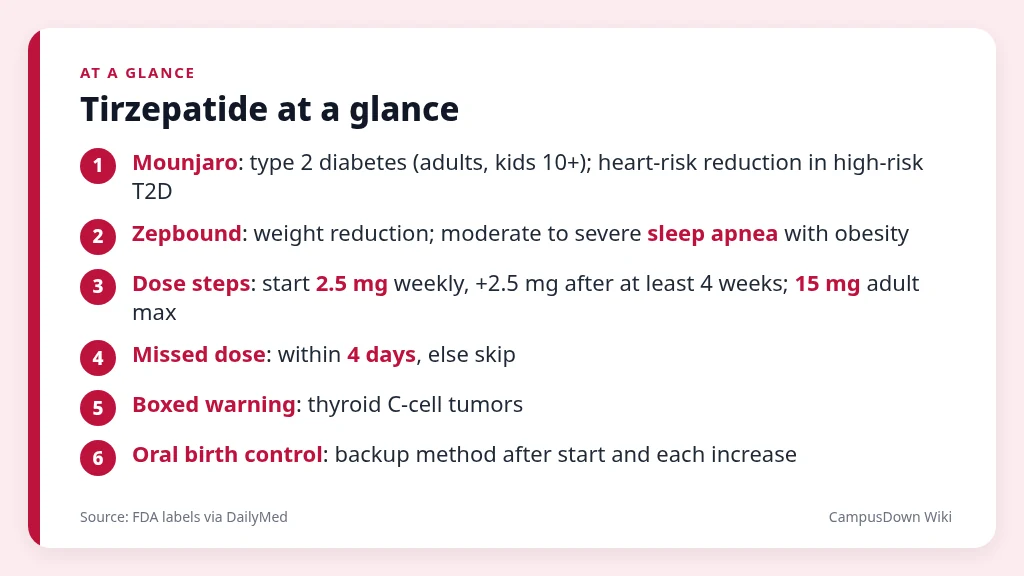
Both labels say: take a missed dose as soon as possible within 4 days (96 hours). If more than 4 days have passed, skip it and take the next dose on your usual day. You can change your injection day if doses are at least 3 days (72 hours) apart.
Boxed warning and contraindications
Tirzepatide carries a boxed warning for thyroid C-cell tumors seen in rodents; it is not known whether it causes them in people. Don't use it with a personal or family history of medullary thyroid carcinoma or with MEN 2, or after a serious allergic reaction to tirzepatide.
Side effects and warnings
Most common (Medication Guides): nausea, diarrhea, vomiting, constipation, stomach pain and indigestion; Mounjaro also lists decreased appetite; Zepbound adds injection site reactions, tiredness, allergic reactions, belching, hair loss and heartburn.
Label warnings include:
- Severe gastrointestinal reactions. In the Zepbound weight trials, severe GI reactions were reported in 1.7% (5 mg), 2.5% (10 mg) and 3.1% (15 mg) vs 1% on placebo. Not recommended with severe gastroparesis.
- Acute pancreatitis and gallbladder disease. See pancreatitis and gallstones.
- Kidney injury from dehydration.
- Hypoglycemia, especially with insulin or sulfonylureas.
- Diabetic retinopathy complications in people with type 2 diabetes.
- NAION: a rare condition causing sudden, painless vision loss in one eye, reported with GLP-1 receptor agonists. Report sudden vision changes right away.
- Aspiration during general anesthesia or deep sedation. Tell providers before any procedure.
Get help now if
Tirzepatide may make oral birth control pills less effective. The Zepbound label advises switching to a non-oral method or adding a barrier method for 4 weeks after starting and 4 weeks after each dose increase.
The FDA asked in January 2026 to remove the suicidal behavior and ideation warning from Zepbound after finding no increased risk; still tell your provider about new or worsening depression.
Example scenario: the snoring that sent him in
- Who
- Darnell, 52, a long-haul dispatcher in Memphis, was diagnosed with moderate obstructive sleep apnea and obesity. He struggled to keep his CPAP mask on all night.
- What happened
- His sleep doctor discussed Zepbound, which is approved for moderate to severe OSA in adults with obesity. Darnell's insurer, however, approved a different presentation than the one he'd watched videos about.
- How it felt
- He was nervous about needles and frustrated by the paperwork. He also worried he'd be told to give up the CPAP entirely, which he didn't want to fail at again.
- What they did
- His pharmacist walked him through the presentation he actually received and the 2.5 mg starting dose, explained the 4-day missed-dose rule, and asked about other medicines. His sleep doctor told him to keep using CPAP while they tracked his progress.
- How it turned out
- After the first weeks of nausea settled, Darnell stayed on schedule and kept his follow-up sleep visits. He said knowing exactly what was in his fridge, and why, took most of the fear away.
This is an illustrative example, not a real patient or a review.
Darnell is an illustrative example. Your prescriber decides your treatment.
Most-asked questions about tirzepatide
What is the difference between Mounjaro and Zepbound?
Both are tirzepatide. Mounjaro is approved for type 2 diabetes and heart-risk reduction in high-risk type 2 diabetes; Zepbound is approved for weight reduction and sleep apnea with obesity.
Why people ask: "mounjaro vs zepbound difference" is #3 for "mounjaro vs zepbound" (US autocomplete, November 2026).
What is the tirzepatide dosage schedule?
The labels start at 2.5 mg weekly and increase by 2.5 mg after at least 4 weeks, up to 15 mg in adults. Your prescriber chooses your maintenance dose.
Why people ask: "tirzepatide dosage" is #2 for "tirzepatide" (US, November 2026).
What are tirzepatide side effects when increasing the dose?
The labels use slow steps to reduce nausea, diarrhea, vomiting and constipation. Tell your prescriber if side effects are severe or don't go away.
Why people ask: "tirzepatide side effects when increasing dose" is #4 for "tirzepatide side effects" (US, November 2026).
Is Zepbound approved for sleep apnea?
Yes, for moderate to severe obstructive sleep apnea in adults with obesity, at a maintenance dose of 10 or 15 mg.
Why people ask: "zepbound for sleep apnea" is #9 for "zepbound" (US, November 2026).
What is the Zepbound KwikPen?
A single-patient-use pen that holds 4 doses. Get trained on it specifically and never share it.
Why people ask: "zepbound kwikpen" is #5 for "zepbound" (US, November 2026).
Related on CampusDown
To learn more about the other big GLP-1, read semaglutide, and take a closer look at the head-to-head in Wegovy vs Zepbound. Check it for yourself before buying a cheaper version in compounded GLP-1s and the FDA, and protect strength with GLP-1 muscle loss tips.
Frequently asked questions
- Can I use Mounjaro for weight loss?
- Mounjaro is approved for type 2 diabetes. Zepbound is the tirzepatide brand approved for weight reduction. Talk to your prescriber.
- Can I take tirzepatide with Ozempic?
- Labels advise against combining GLP-1 receptor agonist products. Tell your prescriber about every diabetes or weight medicine.
- Is 2.5 mg a maintenance dose?
- The Zepbound label says 2.5 mg is for starting treatment and is not approved as a maintenance dose.
Tirzepatide is one molecule with two brands and several presentations. Know which one you have, follow the label's step-up and missed-dose rules, use backup birth control if you take the pill, and talk to your doctor or pharmacist about any side effect that worries you.
Browse more guides like this in the Medicines hub.
This article is for general education and does not replace advice from your own doctor, nurse or pharmacist.