
Are you losing fat, or losing the muscle that keeps you strong and steady on your feet? It's a fair question for anyone on Ozempic, Wegovy, Mounjaro or Zepbound. Fast weight loss from any cause takes some muscle with it, and for older adults that can mean weaker legs and a higher fall risk.
This guide uses the Wegovy and Zepbound FDA labels and a 2025 joint advisory on nutrition and GLP-1 therapy from the American College of Lifestyle Medicine, the American Society for Nutrition, the Obesity Medicine Association and The Obesity Society. It explains in detail what they say. Your care team should tailor protein and exercise to you, especially if you have kidney disease.
What the labels say
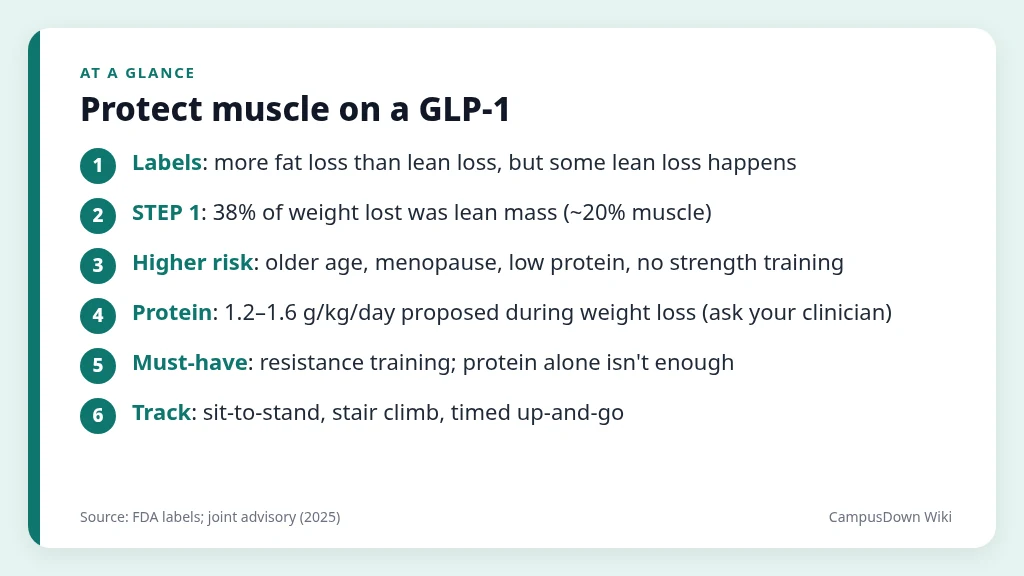
Both the Wegovy and Zepbound labels state that the drug "lowers body weight with greater fat mass loss than lean mass loss." That's reassuring, but it also confirms some lean tissue is lost.

How much is muscle?
The joint advisory summarizes body composition data:
- In the STEP 1 semaglutide trial, of an average 13.6 kg weight loss, 8.3 kg (62%) was fat and 5.3 kg (38%) was lean mass (muscle plus other non-fat tissue).
- Because muscle is about half of lean mass, that's roughly 20% of total weight loss as muscle.
- In SURMOUNT-1 (tirzepatide), total lean mass fell by 8.5 percentage points, pooling doses.
- Modeling suggests muscle loss may be 10% to 15% of weight lost in females and 20% to 25% in males, without structured strength training.
The advisory notes these losses are similar to other large weight-loss methods, such as bariatric surgery and very low-calorie diets, and depend on how fast weight comes off and whether you strength train.
Who's at higher risk
The advisory lists higher risk of muscle loss and sarcopenia with older age, perimenopause or menopause, lower testosterone, sedentary habits, low protein intake and no resistance training. It also warns that stopping and restarting GLP-1s with weight regain ("weight cycling") may worsen muscle and bone loss.
Bones count too
Rapid weight loss can lower bone density, with older adults and women losing more. In one randomized trial cited by the advisory, a year of GLP-1 therapy plus exercise preserved bone mineral density, while GLP-1 therapy alone decreased it.
What helps: strength training first
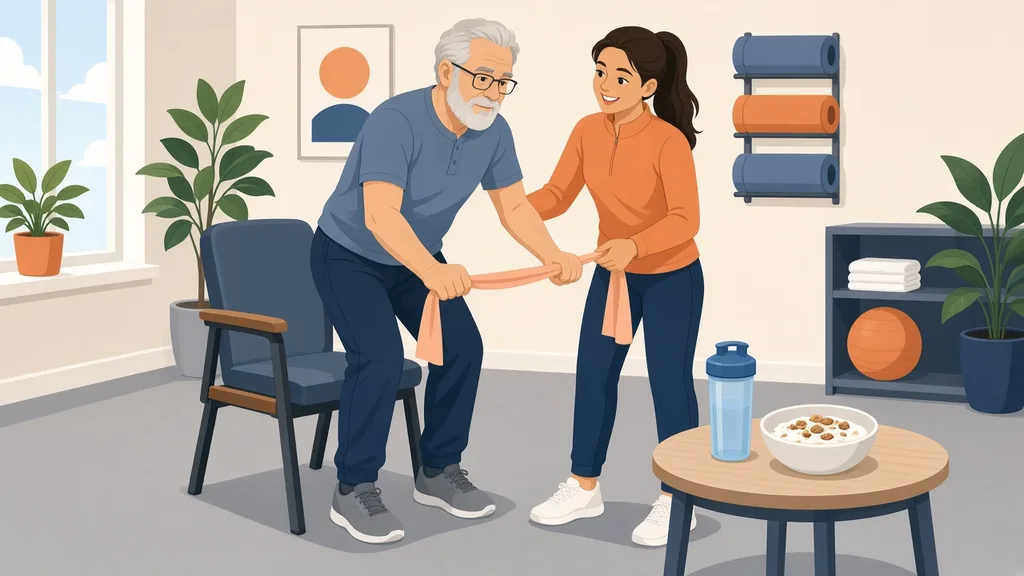
The advisory is clear: increased protein alone is likely not enough to preserve muscle without structured resistance or strength training. Start where you are, and check it for yourself with a simple routine of chair stands, wall push-ups, bands or machines, and progress safely. Pair it with balance exercises if falls are a concern. A physical therapist or exercise physiologist can design a plan.
Protein: how much?
- The general adult RDA is 0.8 g/kg/day, which is being reviewed.
- Higher targets of 1.2 to 1.6 g/kg/day have been proposed during active weight loss.
- It's unclear which body weight to base this on; actual weight can overestimate needs in people with obesity.
- Protein-rich foods such as fish, eggs, Greek yogurt, cottage cheese and nuts help; some people meet targets with high-protein shakes or bars.
If you have kidney disease, don't raise protein without your doctor's advice. Learn more in dietary protein.
Get help now if
Tell your doctor if you notice new weakness, trouble rising from a chair or climbing stairs, falls, or extreme fatigue while losing weight. The advisory also lists signs of nutrient deficiency such as unusual hair loss, poor wound healing and easy bruising.
Example scenario: losing weight, keeping his legs
- Who
- Leopold, 67, a retired mail carrier in Allentown, lost 30 pounds in seven months on Zepbound for obesity and sleep apnea.
- What happened
- He was thrilled with the scale but noticed he needed the railing to climb his basement stairs, and he'd stopped eating lunch because he wasn't hungry.
- How it felt
- He felt proud and uneasy at the same time. His older brother had broken a hip after a fall, and Leopold quietly worried he was "shrinking the wrong way."
- What they did
- At his next visit his doctor timed a chair-stand test and referred him to a physical therapist. With a dietitian, he planned a protein-rich breakfast and lunch he could tolerate and started twice-weekly strength sessions with bands.
- How it turned out
- Three months later, his chair-stand time had improved and he climbed the stairs without the railing. He said the therapist's simple test gave him a number to beat, which kept him going.
This is an illustrative example, not a real patient or a review.
Leopold is an illustrative example. Your care team can tailor a plan to you.
Most-asked questions about GLP-1 muscle loss
How can I prevent GLP-1 muscle loss?
The 2025 advisory emphasizes structured resistance training plus adequate protein, and slower weight loss may help. Protein alone likely isn't enough.
Why people ask: "glp-1 muscle loss prevention" is #2 for "glp-1 muscle loss" (US autocomplete, November 2026).
What percentage of GLP-1 weight loss is muscle?
In STEP 1, 38% of weight lost was lean mass, which the advisory estimates as about 20% muscle. Modeling suggests 10% to 25%, varying by sex, without strength training.
Why people ask: "glp 1 muscle loss percentage" is #8 for "glp-1 muscle loss" (US, November 2026).
What are symptoms of GLP-1 muscle loss?
Weakness or trouble with everyday tasks such as rising from a chair or climbing stairs. The advisory suggests tests like sit-to-stand, stair climb and timed up-and-go for older adults.
Why people ask: "glp-1 muscle loss symptoms" is #3 for "glp-1 muscle loss" (US, November 2026).
Which supplements help with GLP-1 muscle loss?
No supplement replaces strength training. The advisory says shakes or bars can help some people reach protein targets and suggests considering vitamin D, calcium or B12 based on individual needs.
Why people ask: "glp-1 muscle loss supplements" is #4 for "glp-1 muscle loss" (US, November 2026).
How much protein should I eat on a GLP-1?
Targets of 1.2 to 1.6 g/kg/day have been proposed during weight loss, but the right weight basis is unclear. Ask your clinician, especially with kidney disease.
Why people ask: "glp-1 protein intake" is #4 for "glp-1 protein" (US, November 2026).
Does Ozempic affect bone density?
Rapid weight loss can reduce bone density. In one trial, adding exercise to GLP-1 therapy preserved bone density, while GLP-1 alone lowered it.
Why people ask: "ozempic muscle loss bone density" is #8 for "ozempic muscle loss" (US, November 2026).
Related on CampusDown
To take a closer look at the drugs, read semaglutide and tirzepatide.
Frequently asked questions
- Is muscle loss a reason to stop a GLP-1?
- Not on its own. Talk to your doctor; strength training and nutrition changes are the first steps.
- Do I need a DEXA scan?
- Not always. Your doctor may use strength and function tests; ask if body composition testing makes sense for you.
- Can I build muscle while on Ozempic?
- Resistance training can help preserve and build strength during weight loss. Work with a professional to progress safely.
GLP-1 medicines mostly take fat, but not only fat. Lift something a few times a week, eat enough protein for your body and kidneys, check your strength, and talk to your doctor, dietitian or physical therapist about a plan that fits you.
Browse more guides like this in the U.S. Health Topics hub.
This article is for general education and does not replace advice from your own doctor, nurse or pharmacist.