
Did you feel queasy the day after your first shot and wonder if something was wrong? You're far from alone. Stomach side effects are the most common reason people struggle in the first weeks of Ozempic or Wegovy, and knowing what's expected and what's a warning sign makes those weeks much easier.

This guide uses the Ozempic and Wegovy FDA labels on DailyMed and a 2025 joint nutrition advisory on GLP-1 therapy from four US medical and nutrition societies. It explains in detail what they say. It isn't a substitute for your prescriber.
The most common side effects
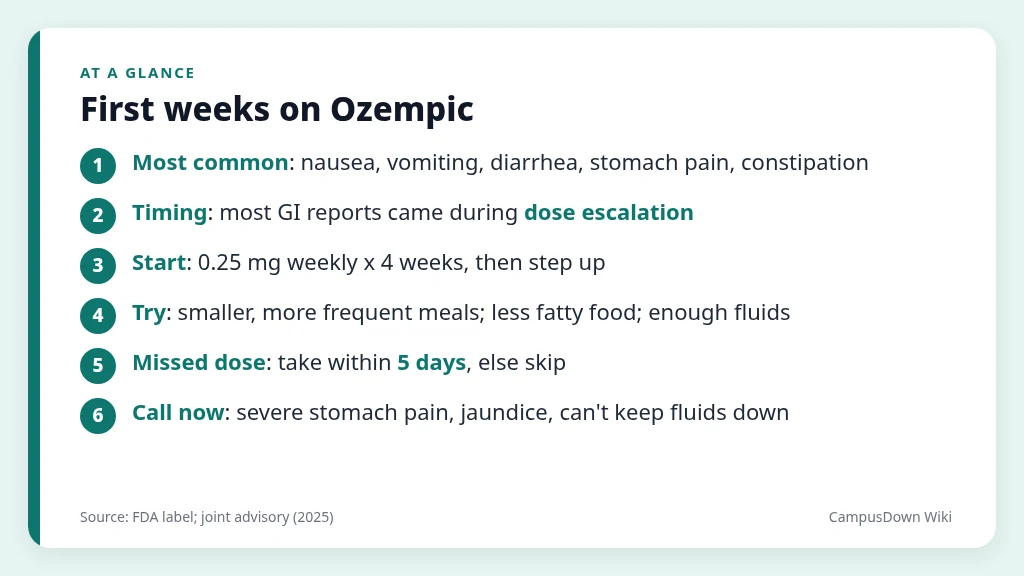
The Ozempic Medication Guide lists the most common side effects as nausea, vomiting, diarrhea, stomach (abdominal) pain and constipation. The Wegovy guide adds others such as dizziness, gas, bloating, headache, belching, tiredness and upset stomach.
In obesity trials summarized by the joint advisory, nausea was reported by 44% on semaglutide 2.4 mg vs 16% on placebo, and constipation by 24% vs 11%. The advisory notes that fewer than 10% of trial participants stopped because of GI side effects.

When do side effects start, and how long do they last?
The Ozempic label says most reports of nausea, vomiting and diarrhea occurred during dose escalation. The joint advisory says GI side effects are more likely at initiation or when the dose goes up, and nausea often shows up in the morning or after long periods without eating.
That's one reason the label starts low: 0.25 mg once weekly for 4 weeks, then 0.5 mg, with later increases only after at least 4 weeks. The labels don't give a fixed number of days that side effects last, and it varies by person. If they don't ease, or they get worse, call your prescriber; never skip ahead or double up to "get it working faster."
Eating strategies from the 2025 advisory
The joint advisory (published in the American Journal of Clinical Nutrition and other journals) suggests:
- Smaller, more frequent meals, and avoiding fatty foods early in treatment. It also mentions avoiding high-fiber foods in the first few days.
- A small breakfast, then small meals every 3 to 4 hours, while drinking enough fluids. Skipping meals because of nausea can make nausea worse.
- Avoiding large meals; vomiting is more likely after big meals.
- Ginger or peppermint tea may help some people.
- For constipation, fluids and fiber over time. See constipation.
Ask your doctor before using any anti-nausea medicine; the advisory notes some can worsen constipation.
Warning signs: don't wait
Get help now if
Call your provider right away, or get emergency care, for severe stomach pain that won't go away (sometimes spreading to the back), which can be a sign of pancreatitis; upper stomach pain, yellow skin or eyes, fever or clay-colored stools, which can mean gallbladder problems; vomiting or diarrhea so bad you can't keep fluids down, which can lead to kidney injury; or swelling of the face, lips or throat.
If you also take insulin or a sulfonylurea, it helps to learn in detail the signs of low blood sugar: shakiness, sweating, confusion, fast heartbeat.
What about vision?
The Ozempic label warns about diabetic retinopathy complications in people with a history of retinopathy. Rare cases of NAION, sudden vision loss in one eye, are listed in the labels of some other GLP-1 medicines as reported with the drug class. Report any sudden change in vision right away.
Missed a dose?
Ozempic: take it as soon as possible within 5 days of the missed dose. If more than 5 days have passed, skip it and take the next dose on your regular day. Wegovy's rules differ by form, so check it for yourself on your own label.
Example scenario: the cycle of not eating
- Who
- Celestine, 61, a school bus dispatcher in Columbus, Georgia, started Ozempic 0.25 mg for type 2 diabetes.
- What happened
- By day two she felt queasy each morning, so she skipped breakfast and ate one large dinner. That night she vomited and lay awake on the bathroom floor.
- How it felt
- She felt scared and defeated, convinced her body "couldn't handle it," and embarrassed to call because she'd waited so long to start.
- What they did
- She called her pharmacist, who asked how much she was drinking and how she was eating. He described the small-meals approach and told her what would need same-day care. She started a small breakfast, ate every few hours, sipped water and stopped late heavy dinners.
- How it turned out
- By week three, her morning nausea had faded. Her doctor kept her on the planned schedule and reviewed how she felt before each increase. She said "being told what was normal and what wasn't" took away most of the fear.
This is an illustrative example, not a real patient or a review.
Celestine is an illustrative example. Your experience may differ; talk to your doctor or pharmacist.
Most-asked questions about the first weeks
How long after taking Ozempic do side effects start?
The label doesn't give an exact time. It says most nausea, vomiting and diarrhea reports came during dose escalation, so the first weeks and the weeks after each increase are the common times.
Why people ask: "how long after taking ozempic do side effects start" is #8 for "ozempic side effects first week" (US autocomplete, November 2026).
How long do Ozempic side effects last?
It varies, and the label doesn't set a timeline. Many people find GI effects ease as they adjust; tell your prescriber if they don't.
Why people ask: "how long do side effects last from ozempic" is #9 for "ozempic side effects first week" (US, November 2026).
What are Ozempic side effects on the first day?
Nausea, vomiting, diarrhea, stomach pain and constipation are the most common at any point. Severe or persistent stomach pain needs prompt care.
Why people ask: "ozempic side effects first day" is #3 for "ozempic side effects first week" (US, November 2026).
How soon does Ozempic start working?
The first 4 weeks at 0.25 mg are for starting treatment; your dose then increases to reach blood sugar control. Your doctor will track progress with tests such as A1C.
Why people ask: "how soon does ozempic start working" is #10 for "ozempic side effects first week" (US, November 2026).
Can Ozempic cause blindness?
The label warns about diabetic retinopathy complications, and NAION is listed in some other GLP-1 labels. Report sudden vision changes right away.
Why people ask: "ozempic side effects blindness" is #5 for "ozempic side effects" (US, November 2026).
Related on CampusDown
Learn more about the drug itself in semaglutide (Ozempic, Wegovy) and how it compares in Wegovy vs Zepbound. Protein and strength work matter too; take a closer look at GLP-1s and muscle loss.
Frequently asked questions
- Should I stop Ozempic if I feel sick?
- Don't stop or change doses on your own. Call your prescriber; they may slow the increases. Seek care for warning signs.
- Is constipation normal on Ozempic?
- It's one of the most common side effects. Fluids and gradual fiber help many people; tell your provider if it's severe.
- Should I tell my surgeon I take Ozempic?
- Yes. The label warns about food or liquid getting into the lungs during anesthesia or deep sedation.
The first weeks are usually the hardest part. Start low as the label directs, eat small meals, drink enough fluids, know the warning signs, and talk to your doctor or pharmacist before changing anything.
Browse more guides like this in the U.S. Health Topics hub.
This article is for general education and does not replace advice from your own doctor, nurse or pharmacist.