
What if someone who qualifies for a nursing home could stay home instead, with a doctor, nurse, therapist and driver all on one team? That's the idea behind PACE, and many families have never heard of it.

This guide is based on Medicare.gov's PACE page, CMS, and the federal PACE rules in 42 CFR Part 460. It explains in detail who qualifies, what's covered and the trade-offs. PACE is available only in some areas; call your state Medicaid office or search on Medicare.gov to check yours.
What PACE is
Medicare.gov says the Program of All-inclusive Care for the Elderly (PACE) is a Medicare and/or Medicaid program that helps older adults who need nursing home-level care meet their needs in the community, with coordinated care from a team of health care professionals. CMS says most participants are dually eligible for Medicare and Medicaid.

Who can join: the 4 conditions
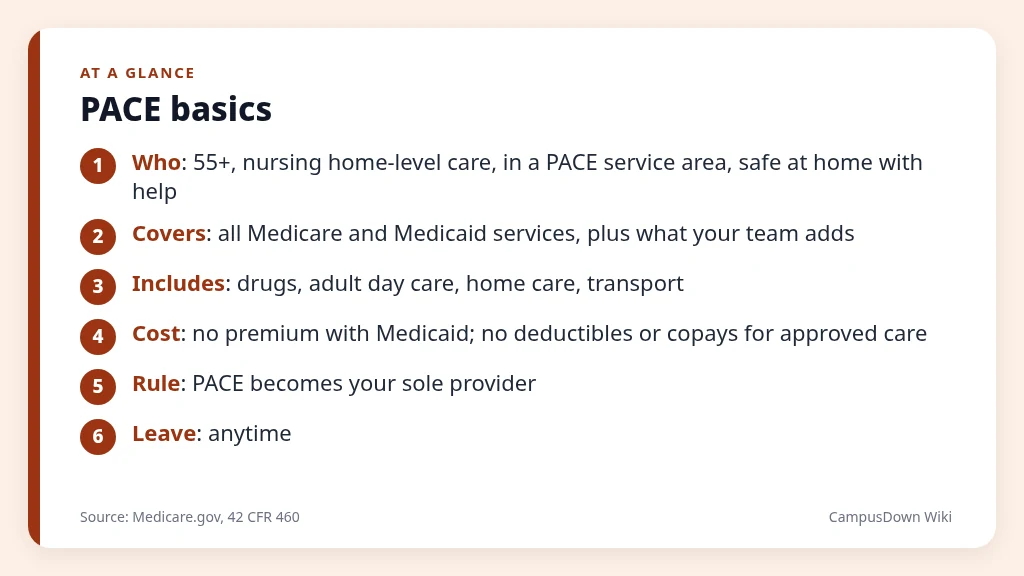
Medicare.gov says you can join if you:
- Are at least 55
2. Live in the service area of a PACE organization 3. Need a nursing home level of care, as certified by your state 4. Can live safely in the community with help from PACE
The federal rules add that you must be recertified each year. PACE is offered only in some states that include it in Medicaid.
What PACE covers
Federal rules say the PACE benefit must include all Medicare-covered services, all Medicaid-covered services in your state, and other services your interdisciplinary team decides you need. Medicare.gov lists services such as:
- Adult day primary care, meals and recreational therapy
- Primary care, specialists, lab and x-ray
- Home care and personal care
- Hospital care and nursing home care when medically necessary
- Prescription drugs, including Part D drugs
- Physical, occupational and speech therapy
- Dentistry, mental health counseling and nutritional counseling
- Social services and transportation to the PACE center and appointments
What PACE costs
Medicare.gov says:
- With Medicaid: no monthly premium.
- With Medicare but not Medicaid: you pay a monthly premium for the long-term care part, plus a Part D premium.
- No Medicare or Medicaid: you can pay the premium yourself.
- In every case, there are no deductibles, copays or coinsurance for any drug, service or care your PACE team approves.
Federal rules note that Medicaid participants may still owe any applicable spend-down or post-eligibility income amounts. You can take a closer look at Medicaid asset rules in our Medicaid look-back guide.
The trade-offs to know before joining
Get help now if
Under 42 CFR 460.154, the enrollment agreement says the PACE organization must be your sole service provider, apart from emergency and urgently needed out-of-network care. You'd generally use PACE's doctors and network. Medicare.gov adds that joining a separate Medicare drug plan disenrolls you from PACE, and the federal rules say electing the Medicare hospice benefit after enrolling counts as voluntary disenrollment.
The good news: federal rules say you can leave PACE without cause at any time; it takes effect the first day of the next month. You can't enroll or disenroll at a Social Security office; you work with the PACE organization.
PACE vs other options
| PACE | Nursing home | Home care on your own | |
|---|---|---|---|
| Where you live | Home | Facility | Home |
| Who coordinates | PACE team | Facility staff | You and your family |
| Day center | Yes | No | No |
| Drugs covered | Yes, through PACE | Depends on coverage | Your Part D plan |
Compare more in our assisted living vs nursing home guide and our in-home care costs guide.
How to apply
Medicare.gov says to search for PACE plans in your area on Medicare.gov or call your Medicaid office. The PACE organization helps with the state's level-of-care assessment and enrollment. Check it for yourself by asking for the center's address, the hours of its day program and how transportation works.
Example scenario: the van on Tuesday and Friday
- Who
- Severin, 81, a retired dairy truck driver in Rochester, New York, had diabetes, heart failure and two falls in six months. His daughter, Isolde, 50, worked full time and was driving him to five different specialists.
- What happened
- A hospital social worker said he might qualify for nursing home care. Severin refused to leave the house he had built.
- How it felt
- Isolde felt exhausted and guilty for missing work. Severin felt like a burden and was scared of losing his home.
- What they did
- The social worker mentioned PACE. A local PACE organization did a home visit, the state certified his level of care, and Severin had Medicaid, so there was no monthly premium. The PACE van picked him up for the day center twice a week, where the nurse checked his weight and the team adjusted his medicines. A home aide came on other days.
- How it turned out
- Within months, Severin's clinic trips were coordinated in one place, and he said the card games at the center were "the best part of the week." Isolde said she went from being his scheduler to being his daughter again.
This is an illustrative example, not a real patient or a review.
Severin's story is an illustrative example. PACE services, centers and costs vary by organization and state.
Most-asked questions about PACE
Who is the PACE program for?
People 55 and older who need nursing home-level care but can live safely in the community with PACE's help.
Why people ask: "pace program for elderly" is #4 for "pace program" (US autocomplete, November 2026).
What are the PACE program eligibility rules?
Be at least 55, live in a PACE service area, need nursing home-level care as certified by your state, and be able to live safely in the community with help.
Why people ask: "pace program eligibility" is #1 for "pace program eligibility" (US autocomplete, November 2026).
What are the PACE program requirements after joining?
PACE becomes your sole provider except for emergencies, and you're recertified each year.
Why people ask: "pace program requirements" is #2 for "pace program eligibility" (US autocomplete, November 2026).
How do I apply for the PACE program?
Search for PACE plans on Medicare.gov or call your state Medicaid office; the PACE organization helps with enrollment.
Why people ask: "pace program application" is #3 for "pace program eligibility" (US autocomplete, November 2026).
Is there a PACE program in California?
Availability depends on PACE service areas. Search on Medicare.gov or contact your state Medicaid office.
Why people ask: "pace program california" is #3 for "pace program" (US autocomplete, November 2026).
Is there a PACE program in Florida?
Check Medicare.gov's PACE search or Florida's Medicaid office for service areas near you.
Why people ask: "pace program florida" is #2 for "pace program" (US autocomplete, November 2026).
Related on CampusDown
Caring for a parent at home? You can learn more about respite care and caregiver burnout.
Frequently asked questions
- Do I need Medicaid to join PACE?
- No. Medicare.gov says you can join with Medicare only or pay privately, but premiums apply without Medicaid.
- Can I keep my own doctor in PACE?
- Generally no. The PACE organization becomes your sole service provider except for emergencies.
- Can I leave PACE?
- Yes. Federal rules let you leave without cause at any time, effective the next month.
- Does PACE cover hospice?
- Federal rules say electing Medicare hospice after enrolling counts as leaving PACE, so ask your team how they handle end-of-life care.
PACE can turn a list of scattered appointments into one team that helps someone stay home. If a loved one needs nursing home-level care, check whether a PACE program serves your area.
Browse more guides like this in the Senior Health and Medicare hub.
This article is for general education and does not replace advice from your own doctor, nurse or pharmacist.