
How do you know whether Mom needs assisted living or a nursing home? The difference isn't just the price. It's how much medical care, supervision and daily help someone needs, and getting it wrong can mean a second move a few months later.

This guide is based on the National Institute on Aging (NIA) page on long-term care facilities and Medicare's nursing home guide. It explains in detail what each option provides and who pays. Talk with your loved one's doctor about the level of care they need.
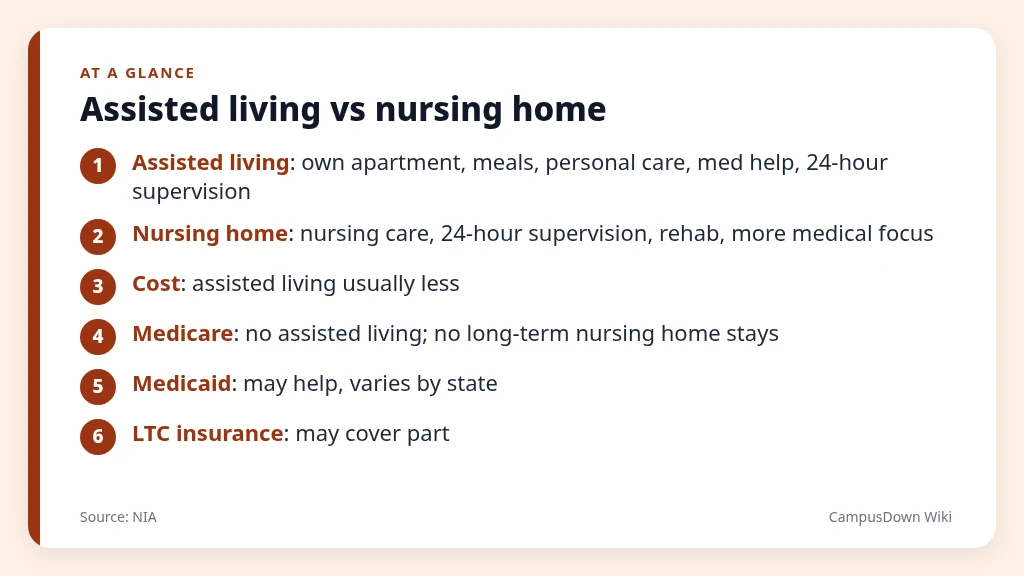
Side by side
| Assisted living | Nursing home | |
|---|---|---|
| Who it's for | Needs help with daily care, but less than a nursing home | Needs ongoing nursing or medical care |
| Living space | Own apartment or room, shared common areas | A room, private or shared |
| Services | Up to three meals, personal care, medication help, housekeeping, laundry, 24-hour supervision, activities | Nursing care, 24-hour supervision, three meals, help with daily activities, rehab therapy |
| Medical focus | Lower | Higher |
| Typical cost | Usually less than a nursing home | Usually more |
| Medicare | Doesn't pay | Short-term skilled care only |
Source: NIA, Medicare.

Other residential options
- Board and care homes: small homes, usually 20 or fewer residents, with personal care, meals and round-the-clock staff, but usually no nursing or medical care.
- Continuing care retirement communities (CCRCs): independent living, assisted living and skilled nursing on one campus, usually with an entrance fee plus monthly fees.
- Memory care: many facilities offer special programs for dementia; see memory care units.
Who pays
- Medicare doesn't pay for assisted living and generally doesn't cover long-term nursing home stays. Part A covers short-term skilled nursing or rehab (up to 100 days) after a hospital stay.
- Medicaid may cover some nursing home costs for eligible people and some aspects of assisted living depending on the state. See the Medicaid look-back.
- Long-term care insurance may cover part of either; see long-term care insurance.
- Most people pay assisted living costs themselves, NIA notes.
If staying home is still possible, compare in-home care costs.
Choosing for dementia
Someone with mild dementia who's physically healthy may do well in assisted living with memory care. Someone with advanced dementia, frequent falls, feeding problems or complex medical needs may need a nursing home's skilled care. Ask the doctor and the facility how they handle changing needs.
Get help now if
Ask every facility in writing what happens if care needs increase: when they'd require a move, and what notice they give. Knowing this up front lets you plan ahead and check it for yourself in the contract.
Checking quality
Use Medicare Care Compare for nursing homes; see nursing home star ratings. Assisted living is licensed by states, so check your state's licensing reports. The Eldercare Locator (800-677-1116) can help you find options.
Easing the move
NIA suggests getting to know staff before the move, advocating for your loved one's preferences, listening to their concerns without arguing, checking in regularly, and getting support for your own feelings of loss, guilt or relief.
Example scenario: two moves or one?
- Who
- Isadora, 81, a retired seamstress in Tulsa, Oklahoma, had Parkinson's disease. Her husband, Winslow, 84, had cared for her at home for six years.
- What happened
- After two falls in a month, their son suggested the assisted living near his house. Her neurologist warned she'd soon need help transferring and might need skilled nursing.
- How it felt
- Winslow felt he was abandoning her; Isadora was afraid of losing her sewing room and her husband's company.
- What they did
- They chose a CCRC-style campus with assisted living and a nursing wing, asked in writing how transfers worked, and brought her sewing table. Winslow moved into an independent apartment on the same campus.
- How it turned out
- When Isadora needed skilled care a year later, she moved down the hall instead of across town. Winslow still ate lunch with her every day. He said asking "what happens next?" up front spared them a second upheaval.
This is an illustrative example, not a real patient or a review.
Isadora's story is an illustrative example. Every family's needs and budget differ.
Most-asked questions
How does care differ in assisted living vs a nursing home?
Assisted living offers daily help and supervision; nursing homes add nursing and more medical care.
Why people ask: "assisted living vs nursing home care" is #2 for "assisted living vs nursing home" (US autocomplete, November 2026).
Does Medicaid pay for assisted living or nursing homes?
Medicaid may cover nursing home care for eligible people, and some aspects of assisted living depending on the state.
Why people ask: "assisted living vs nursing home medicaid" is #3 for "assisted living vs nursing home" (US, November 2026).
Which costs more, assisted living or a nursing home?
NIA says assisted living tends to cost less than a nursing home but more than living independently.
Why people ask: "assisted living vs nursing home cost" is #4 for "assisted living vs nursing home" (US, November 2026).
Does Medicare pay for assisted living or nursing homes?
Medicare doesn't pay for assisted living and generally doesn't cover long-term nursing home stays.
Why people ask: "assisted living vs nursing home medicare" is #5 for "assisted living vs nursing home" (US, November 2026).
What's the difference between a nursing home and a skilled nursing facility?
NIA notes nursing homes are also called skilled nursing facilities; many offer both long-term care and short-term rehab.
Why people ask: "assisted living vs nursing home vs skilled nursing facility" is #6 for "assisted living vs nursing home" (US, November 2026).
Is assisted living or a nursing home better for dementia?
It depends on the stage and medical needs; memory care programs exist in both settings.
Why people ask: "assisted living vs nursing home for dementia" is #8 for "assisted living vs nursing home" (US, November 2026).
Related on CampusDown
To take a closer look at dementia-specific settings, read memory care units.
Frequently asked questions
- Can someone move from assisted living to a nursing home?
- Yes. Ask facilities in advance how and when that happens.
- Does Medicare cover rehab in a nursing home?
- Part A covers short-term skilled care (up to 100 days) after a hospital stay, if you qualify.
- Who licenses assisted living?
- States do. Check it for yourself with your state's licensing agency.
Assisted living offers daily help with independence; nursing homes offer medical care around the clock. Match the setting to current and future needs, plan how you'll pay, and ask what happens when needs change.
Browse more guides like this in the Senior Health and Medicare hub.
This article is for general education and does not replace advice from your own doctor, nurse or pharmacist.