
A wellness video says it "melts stress," your friend takes it every night, and the bottle has a leaf on it. Before you add ashwagandha to your cart, what do the scientists actually say?

This guide uses the National Center for Complementary and Integrative Health (NCCIH) "Ashwagandha: Usefulness and Safety" page (last updated March 2023) and NIH Office of Dietary Supplements guidance on using supplements. It is general information, not medical advice; your doctor or pharmacist can say whether it is safe for you. If you want to learn more about another supplement that has clearer limits, take a closer look at vitamin D3 supplements.
What it is
NCCIH says ashwagandha (Withania somnifera, also called Indian ginseng) is an evergreen shrub found in parts of India, Africa and the Middle East containing withanolides, which have been associated with anti-inflammatory and antioxidant effects. It has been used for thousands of years in traditional Ayurvedic medicine. Today supplements are promoted for stress and anxiety, sleep, male infertility and athletic performance, usually made from root, leaf or root-and-leaf extracts.

What studies suggest
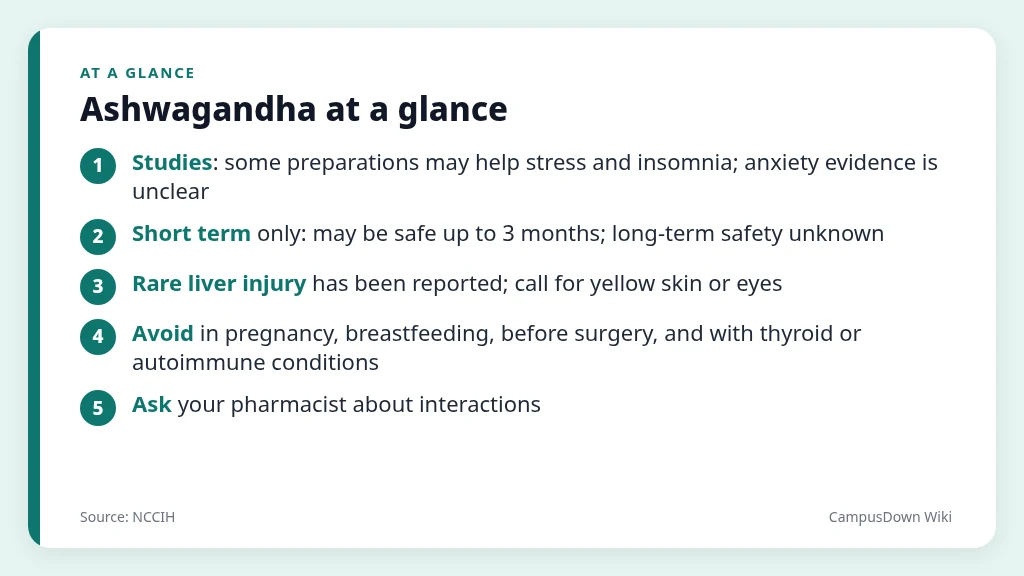
NCCIH says many studies have small sample sizes and different preparations, so conclusions are limited:
- Insomnia and stress: some preparations may be effective.
- Anxiety: evidence is unclear.
- Testosterone and sperm quality: limited evidence that taking it for 2 to 4 months may increase levels.
- Asthma, athletic performance, cognition, diabetes, menopause and female infertility: not enough evidence.
- COVID-19: not enough high-quality evidence.
Safety (NCCIH)
- It may be safe in the short term (up to 3 months); there is not enough information on long-term safety.
- Side effects in some people: drowsiness, stomach upset, diarrhea and vomiting.
- Liver injury is rare, but several cases have been linked to ashwagandha supplements.
- Avoid during pregnancy; don't use while breastfeeding.
- Not recommended before surgery or for people with autoimmune or thyroid disorders.
- People with hormone-sensitive prostate cancer should avoid it, because it may raise testosterone.
Get help now if
Yellow skin or eyes, dark urine, severe stomach pain, extreme tiredness or nausea after starting a supplement may signal liver trouble. Stop it and call your clinician right away, or go to urgent care.
Medicine interactions
NCCIH says it might interact with medicines for diabetes and high blood pressure, immunosuppressants, sedatives, anti-seizure medicines and thyroid hormone medicines. If you take any of these, ask your pharmacist before starting. See the brown bag medication review and polypharmacy and the Beers Criteria.
Supplements are regulated differently
NCCIH says dietary supplements are not approved by the FDA before they are sold, and that manufacturers are responsible for evaluating safety and labeling. NCCIH advises you to talk with your health care providers about any complementary health approach you use.
Questions for your clinician or pharmacist
- Is ashwagandha safe with my medicines or conditions?
- Do I have thyroid, liver or autoimmune issues that make it a poor fit?
- What else could I try for stress or sleep first?
- How long, if at all, should I use it?
- Which symptoms mean I should stop and call?
Example scenario: the thyroid pill
- Who
- Tristan, 34, a software tester in Raleigh, North Carolina, started ashwagandha for stress at work while taking a daily thyroid medicine.
- What happened
- He had read glowing posts and didn't think of it as a "real" medicine.
- How it felt
- He felt wound up and hopeful.
- What they did
- At a checkup he mentioned the capsules, and his clinician and pharmacist said NCCIH lists thyroid conditions and thyroid hormone medicines as cautions and suggested he not continue without guidance. Tristan stopped the capsule, tried a walk after dinner, a fixed bedtime and a conversation with his clinician about stress support.
- How it turned out
- Tristan said telling his clinician took five minutes and answered months of guessing.
This is an illustrative example, not a real patient or a review.
Tristan's story is an illustrative example. Talk to your clinician before starting any supplement, especially with thyroid, liver or immune conditions.
Most-asked questions about ashwagandha
What are ashwagandha benefits for women?
NCCIH doesn't separate by sex; some preparations may help stress and insomnia, and evidence for menopause and female infertility is insufficient.
Why people ask: "ashwagandha benefits for women" is #2 for "ashwagandha benefits" (US autocomplete, November 2026).
What are ashwagandha benefits for men?
NCCIH says limited evidence suggests 2 to 4 months of use may increase testosterone and sperm quality; people with hormone-sensitive prostate cancer should avoid it.
Why people ask: "ashwagandha benefits for men" is #3 for "ashwagandha benefits" (US autocomplete, November 2026).
What are ashwagandha benefits and side effects?
Possible help for stress and insomnia; side effects include drowsiness, stomach upset, diarrhea, vomiting and rare liver injury.
Why people ask: "ashwagandha benefits and side effects" is #4 for "ashwagandha benefits" (US autocomplete, November 2026).
Does ashwagandha help skin?
NCCIH doesn't discuss skin; the evidence summarized there covers stress, sleep, anxiety and male hormones.
Why people ask: "ashwagandha benefits for skin" is #5 for "ashwagandha benefits" (US autocomplete, November 2026).
Does ashwagandha help hair growth?
NCCIH doesn't list hair growth among conditions with evidence.
Why people ask: "ashwagandha benefits for hair growth" is #10 for "ashwagandha benefits" (US autocomplete, November 2026).
What are ashwagandha side effects in women?
NCCIH lists the same side effects for everyone and says to avoid it in pregnancy and while breastfeeding.
Why people ask: "ashwagandha side effects women" is #2 for "ashwagandha side effects" (US autocomplete, November 2026).
What are ashwagandha side effects in men?
Drowsiness, stomach upset, diarrhea and vomiting; it may raise testosterone, so hormone-sensitive prostate cancer is a reason to avoid it.
Why people ask: "ashwagandha side effects for men" is #3 for "ashwagandha side effects" (US autocomplete, November 2026).
Can ashwagandha cause mental side effects?
NCCIH lists drowsiness; it doesn't describe other mental effects, so tell your clinician about mood changes.
Why people ask: "ashwagandha side effects mental" is #4 for "ashwagandha side effects" (US autocomplete, November 2026).
Does ashwagandha affect the heart?
NCCIH doesn't list heart effects, but it may interact with blood pressure medicines; ask your pharmacist.
Why people ask: "ashwagandha side effects heart" is #6 for "ashwagandha side effects" (US autocomplete, November 2026).
Can ashwagandha harm the liver?
Rarely; NCCIH says several cases of liver injury have been linked to ashwagandha supplements.
Why people ask: "ashwagandha side effects liver" is #7 for "ashwagandha side effects" (US autocomplete, November 2026).
Does ashwagandha affect emotions?
NCCIH doesn't describe emotional effects; some preparations may help stress and insomnia, but anxiety evidence is unclear.
Why people ask: "ashwagandha side effects emotions" is #8 for "ashwagandha side effects" (US autocomplete, November 2026).
What are the long-term side effects of ashwagandha?
NCCIH says there isn't enough information to draw conclusions about long-term safety; it may be safe up to 3 months.
Why people ask: "ashwagandha side effects long term" is #9 for "ashwagandha side effects" (US autocomplete, November 2026).
Related on CampusDown
You can learn more about the health topics hub and check it for yourself in the brown bag medication review. For a supplement with clear upper limits in detail, see vitamin D3 supplements, and for liver risk context see cirrhosis and hepatic encephalopathy.
Frequently asked questions
- Is ashwagandha proven for stress?
- NCCIH says some preparations may be effective for stress and insomnia, but many studies are small and use different products.
- How long can I take it?
- NCCIH says it may be safe up to 3 months; long-term safety is unknown.
- Who should avoid it?
- People who are pregnant or breastfeeding, about to have surgery, or who have autoimmune or thyroid disorders, and people with hormone-sensitive prostate cancer.
- Can it hurt the liver?
- Rarely; NCCIH reports several cases of liver injury linked to it.
- Does it interact with medicines?
- Possibly with diabetes, blood pressure, immunosuppressant, sedative, anti-seizure and thyroid medicines.
Ashwagandha may help some people with stress or sleep, but studies are small, long-term safety is unknown and rare liver injury has been reported. Avoid it in pregnancy and with thyroid or autoimmune conditions, check for interactions, and tell your clinician about any supplement.
Browse more guides like this in the U.S. Health Topics hub.
This article is for general education and does not replace advice from your own doctor, nurse or pharmacist.