
You've been "a little backed up" for days, a new pill was added last month, and a friend swears by prune juice. Is this normal with age, or a sign it's time to call someone?

This guide uses NIDDK's constipation pages (symptoms and causes, eating and diet, and treatment; last reviewed May 2018) and MedlinePlus's constipation topic. It is general information, not a diagnosis; your clinician decides what is right for you. If you want to learn more about how a medicine list can contribute, take a closer look at polypharmacy and the Beers Criteria.
What counts as constipation
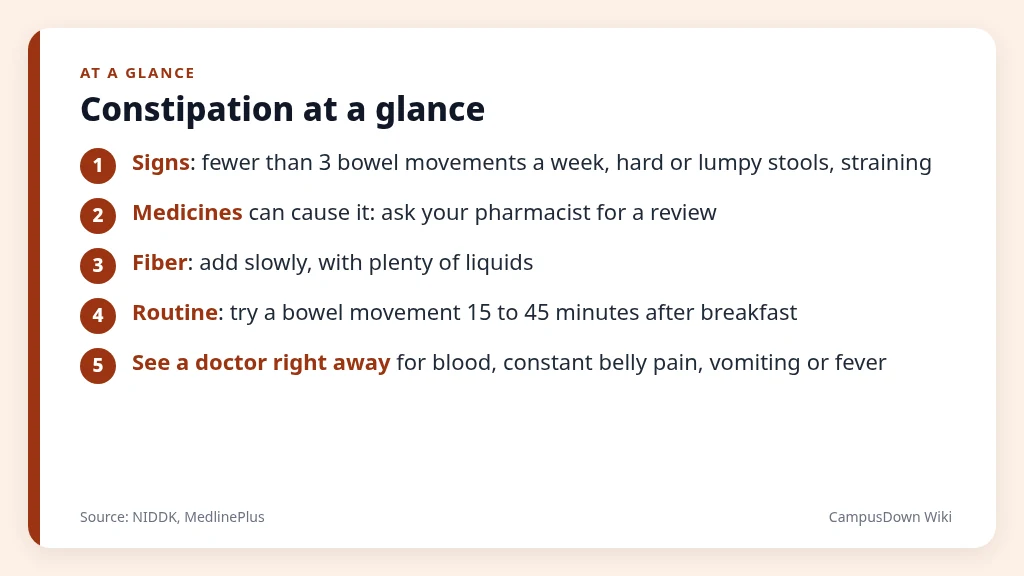
NIDDK lists these symptoms:
- Fewer than three bowel movements a week
- Stools that are hard, dry or lumpy
- Stools that are difficult or painful to pass
- A feeling that not all stool has passed

When to see a doctor
NIDDK says to see a doctor if symptoms don't go away with self-care or you have a family history of colon or rectal cancer. It says to see a doctor right away if constipation comes with bleeding from the rectum, blood in the stool, constant pain in the abdomen, inability to pass gas, vomiting, fever, lower back pain or losing weight without trying. See colorectal cancer for background on why blood and weight loss matter.
Get help now if
Constant belly pain, vomiting, not being able to pass gas, rectal bleeding or fever with constipation needs prompt care. Call your clinician right away or go to urgent or emergency care.
Why it happens
NIDDK says you may be constipated for many reasons, sometimes more than one at a time. Causes include slow movement of stool through the colon, delayed emptying of the colon from pelvic floor disorders (especially in women) and colon surgery, and functional gastrointestinal disorders such as irritable bowel syndrome. It also notes that bowel movements can change as you get older or when your daily routine changes. See irritable bowel syndrome.
NIDDK also says older adults sometimes don't get enough fiber because they may lose interest in food.
Medicines and supplements that can make it worse
NIDDK lists:
- Antacids that contain aluminum and calcium
- Anticholinergics and antispasmodics
- Anticonvulsants (seizure medicines)
- Calcium channel blockers
- Diuretics
- Iron supplements
- Medicines used to treat Parkinson's disease
- Narcotic pain medicines
- Some medicines used to treat depression
NIDDK says to talk to your doctor if you think a medicine or supplement is causing constipation and not to change or stop any medicine without talking to a health care professional. For how clinicians review risky combinations, see the brown bag medication review and anticholinergic drugs and memory.
Fiber and fluids
NIDDK says adults should get 22 to 34 grams of fiber a day depending on age and sex. Add fiber a little at a time so your body adjusts, and drink plenty of liquids to help the fiber work. Good sources it lists:
- Whole grains: whole wheat bread and pasta, oatmeal, bran flake cereals
- Legumes: lentils, black beans, kidney beans, soybeans, chickpeas
- Fruits: berries, apples with the skin on, oranges, pears
- Vegetables: carrots, broccoli, green peas, collard greens
- Nuts: almonds, peanuts, pecans
Liquids include water, naturally sweetened fruit and vegetable juices and clear soups. NIDDK says to ask a health care professional how much liquid you should drink each day based on your size, health, activity level and where you live; if you have heart or kidney conditions your limit may differ. Foods with little to no fiber to limit: chips, fast food, meat, and prepared or processed foods such as some frozen meals and hot dogs. See dehydration in older adults.
Routine, activity and bowel training
NIDDK suggests:
- Regular physical activity may help relieve symptoms.
- Bowel training: your doctor may suggest trying to have a bowel movement at the same time each day; 15 to 45 minutes after breakfast may help because eating helps the colon move stool.
- Take enough time, use the bathroom as soon as you feel the need, and relax your muscles or put your feet on a footstool.
Laxatives: short term and with guidance
NIDDK says a health care professional may recommend a laxative for a short time and will tell you which type. It lists fiber supplements, osmotic agents, stool softeners, lubricants such as mineral oil, and stimulants, and says stimulants should only be used if constipation is severe or other treatments haven't worked. If you've used laxatives for a long time and can't go without them, talk to your doctor about how to slowly stop; NIDDK says that over time the colon should start moving stool normally. For the difference between a stool softener and a stimulant, see docusate and senna.
Questions for your clinician or pharmacist
- Could any of my medicines or supplements be causing this?
- How much fiber and how much liquid is right for me, given my heart and kidneys?
- Which laxative, if any, and for how many days?
- What symptoms mean I should call right away?
- Do I need any tests?
Example scenario: the new iron pill
- Who
- Wilfred, 78, a retired postal clerk in Rochester, New York, was started on an iron supplement and, a few weeks later, was going only twice a week and straining.
- What happened
- He assumed it was just "getting older" and didn't want to bother the doctor.
- How it felt
- He felt resigned and a little embarrassed.
- What they did
- His daughter helped him write down his medicines and symptoms and call the pharmacist, who said iron can make constipation worse and suggested he ask his doctor before changing anything. Wilfred added oatmeal, pears and extra water slowly, tried a short walk after breakfast and kept his follow-up.
- How it turned out
- Wilfred said a phone call beat weeks of guessing.
This is an illustrative example, not a real patient or a review.
Wilfred's story is an illustrative example. Call your clinician for new constipation, and seek care right away for bleeding, constant pain, vomiting or fever.
Most-asked questions about constipation in older adults
What commonly causes constipation in older adults?
NIDDK lists slow stool movement, pelvic floor problems, irritable bowel syndrome, certain medicines and supplements, and life or routine changes, including getting older.
Why people ask: "constipation in older adults is commonly caused by" is #2 for "constipation in older adults" (US autocomplete, November 2026).
How is constipation treated in older adults?
Usually with more fiber and fluids, activity, a regular bowel routine, a review of medicines and a short course of laxative if a clinician recommends one.
Why people ask: "constipation in older adults treatment" is #3 for "constipation in older adults" (US autocomplete, November 2026).
What are the causes of constipation in older adults?
Medicines and supplements, low fiber, low fluids, slow colon movement, pelvic floor disorders, irritable bowel syndrome and routine changes, per NIDDK.
Why people ask: "constipation in older adults causes" is #4 for "constipation in older adults" (US autocomplete, November 2026).
What about chronic constipation in older adults?
If symptoms don't go away with self-care, NIDDK says to see a doctor; ongoing constipation deserves an evaluation.
Why people ask: "chronic constipation in older adults" is #6 for "constipation in older adults" (US autocomplete, November 2026).
What is the best way to treat constipation in older adults?
NIDDK recommends fiber with plenty of liquids, regular physical activity, bowel training and short-term laxatives guided by a professional; ask which fits you.
Why people ask: "treating constipation in older adults" is #7 for "constipation in older adults" (US autocomplete, November 2026).
How can I prevent constipation in older adults?
Get enough fiber a little at a time, drink liquids, stay active, use the bathroom when you feel the urge and ask about medicines that may cause it.
Why people ask: "preventing constipation in older adults" is #9 for "constipation in older adults" (US autocomplete, November 2026).
What are the symptoms of constipation in older adults?
Fewer than three bowel movements a week, hard or lumpy stools, straining and the feeling of incomplete emptying; NIDDK lists the same for all adults.
Why people ask: "constipation symptoms in older adults" is #10 for "constipation in older adults" (US autocomplete, November 2026).
What causes constipation in old age?
NIDDK says bowel movements can change as you get older, and it names medicines, low fiber, pelvic floor problems and other causes.
Why people ask: "constipation old age causes" is #1 for "constipation older adults causes" (US autocomplete, November 2026).
Is constipation common in older adults?
NIDDK says bowel habits can change with age and that older adults sometimes don't get enough fiber; it doesn't give a percentage.
Why people ask: "is constipation common in older adults" is #3 for "constipation older adults causes" (US autocomplete, November 2026).
What causes sudden constipation in adults?
NIDDK lists new medicines, routine changes and other causes; see a doctor if it doesn't improve with self-care or if you have blood, vomiting, fever or constant pain.
Why people ask: "causes of sudden constipation in adults" is #5 for "constipation older adults causes" (US autocomplete, November 2026).
Related on CampusDown
You can learn more about the senior health hub and check it for yourself in the brown bag medication review. For laxative choices in detail, see docusate and senna, and for a liver condition where bowel habits matter for confusion, see cirrhosis and hepatic encephalopathy.
Frequently asked questions
- How much fiber do adults need?
- NIDDK says 22 to 34 grams a day, depending on age and sex; add it slowly with plenty of liquids.
- Can my medicines cause constipation?
- Yes; NIDDK lists antacids, anticholinergics, iron, diuretics, narcotics and some antidepressants among them; don't change medicines without talking to your clinician.
- Is a daily laxative okay?
- NIDDK says laxatives are for short-term use under professional guidance and that long-term users should ask how to taper.
- When should I call right away?
- For rectal bleeding, blood in stool, constant abdominal pain, inability to pass gas, vomiting, fever, lower back pain or unintended weight loss.
- Does timing help?
- NIDDK says trying to go 15 to 45 minutes after breakfast may help.
Constipation is common but worth taking seriously. Add fiber slowly with fluids, stay active, build a routine after breakfast, ask for a medicine review, use laxatives only short term with guidance, and call right away for bleeding, constant pain, vomiting, fever or weight loss.
Browse more guides like this in the Senior Health and Medicare hub.
This article is for general education and does not replace advice from your own doctor, nurse or pharmacist.