
Your patient with cirrhosis was chatty at breakfast and, by lunch, is calling you by the wrong name and flapping his hands when he holds them out. Is this just tiredness, or a sign you need to report right now?

This guide uses OpenStax's Medical-Surgical Nursing (19.6 Hepatic and Biliary Disorders) and MedlinePlus's "Loss of brain function - liver disease" (reviewed July 2025) and lactulose drug information. It is a study aid, not orders; your instructor, facility policy and the provider decide care. If you want to learn more about another cause of confusion that looks similar, take a closer look at alcohol withdrawal and the CIWA scale.
What it is
MedlinePlus says hepatic encephalopathy (HE) is loss of full brain function that occurs when the liver is unable to remove toxins from the blood. The liver normally makes harmful substances, such as ammonia, harmless; with liver damage, these poisons build up in the bloodstream and affect the nervous system. HE may occur suddenly or develop slowly over time and is often reversible with prompt treatment. MedlinePlus says people with severe liver damage often have HE, and cirrhosis is the end result of chronic liver damage. Common causes of chronic liver disease include severe hepatitis B or C, alcohol use disorder, autoimmune hepatitis, bile duct disorders, some medicines and fatty liver disease (MAFLD and MASH).

Cues to recognize
MedlinePlus lists early symptoms: a musty or sweet odor to the breath, changes in sleep patterns, changes in thinking, mild confusion, forgetfulness, personality or mood changes, poor concentration and judgment, and worsening handwriting or loss of small hand movements. Severe symptoms include abnormal movements or shaking of the hands or arms, agitation, excitement or seizures (rare), disorientation, drowsiness or confusion, behavior changes, slurred speech and slowed movement. People can become unconscious and enter a coma. MedlinePlus says HE is graded 1 to 4, with stages 1 and 2 having a good prognosis and stages 3 and 4 a poor one.
OpenStax's table of HE findings lists:
- Asterixis (flapping movements) when the patient holds out the arms
- Hyperreflexia
- Muscle twitching
- Cognitive impairment
- Anxiety or irritability
- Balance or coordination problems
MedlinePlus describes the exam finding as a flapping tremor when the patient tries to hold the arms in front and lift the hands, along with signs of liver disease such as jaundice and ascites and a musty odor of the breath and urine.
What can trigger an episode
MedlinePlus lists triggers once liver damage exists: dehydration, eating too much protein, low blood potassium or sodium, bleeding in the intestines, stomach or esophagus, infections, kidney problems, low oxygen, shunt placement or complications, surgery, and narcotic pain or sedative medicines. Other causes of sudden HE include constipation, upper GI bleeding and infections such as pneumonia, urinary tract infection or gastroenteritis. This is why nurses watch bowel patterns, vital signs, intake and output, labs and medications. See constipation in older adults, low sodium, potassium problems and fluid volume excess and deficit.
Look-alikes to rule out
OpenStax says diagnosis involves confirming liver disease and ruling out other causes such as alcohol withdrawal syndrome, stroke, intracranial lesions, masses or infection, or postseizure encephalopathy. MedlinePlus lists alcohol intoxication, alcohol withdrawal, bleeding inside the skull (such as a subdural hematoma) and Wernicke-Korsakoff syndrome as disorders that can appear similar. For delirium in general, see delirium in the hospital.
Tests
MedlinePlus lists a complete blood count, head CT or MRI, EEG, liver function tests, prothrombin time, serum ammonia, sodium and potassium, BUN and creatinine. OpenStax says serum ammonia levels are often increased and that liver function tests may show raised ALT and AST and bilirubin and prolonged prothrombin time with decreased albumin.
Treatment (what the providers order)
MedlinePlus says treatment depends on the cause; a hospital stay may be needed if brain function changes are severe. It says to stop bleeding in the digestive tract, treat infections, kidney failure and sodium and potassium changes, and use medicines to lower ammonia and improve brain function:
- Lactulose to prevent bacteria in the intestines from creating ammonia; it may cause diarrhea
- Neomycin and rifaximin, which also reduce the amount of ammonia made in the intestines
- If HE improves on lactulose or rifaximin, they should be continued long term, per MedlinePlus
OpenStax lists treatment as identifying and treating the underlying cause, and says options may include antibiotics, lactulose, L-ornithine and L-aspartate, zinc and prophylactic intubation to protect from aspiration or respiratory compromise in severe cases.
MedlinePlus says to avoid sedatives, tranquilizers and other medicines the liver breaks down, and medicines containing ammonium (including some antacids). Discuss any new medicine with the provider and pharmacist.
About lactulose
MedlinePlus says lactulose is a synthetic sugar that is broken down in the colon into products that pull water into the colon. For liver disease it reduces the amount of ammonia in the blood by drawing ammonia from the blood into the colon where it is removed from the body. It comes as a liquid taken by mouth, usually three or four times a day for liver disease (the label states the exact amount). Possible side effects include diarrhea, gas and nausea; stomach pain, cramps or vomiting need a call. Tell your doctor if you have diabetes or need a low-lactose diet, and about antacids, neomycin and other laxatives. MedlinePlus does not list enema use, so ask your provider about any other form your patient receives.
Nursing care
OpenStax's nursing care for liver disease focuses on supporting body systems, reducing injury risk, monitoring and managing complications, improving nutrition, providing skin care and education.
- Keep the head of the bed elevated. OpenStax says this helps venous drainage from the head, reducing intracranial pressure, and helps prevent aspiration during meals.
- Keep skin clean and dry, and apply lotion to prevent itch.
- Watch for cues: a decline in mental status, bleeding from old venipuncture sites and orifices, or a reduction in urine output. OpenStax says a mental status decline with a rising ammonia level may indicate HE, widespread oozing could signal a clotting problem such as DIC, and a drop in urine output could mean kidney function is compromised.
- Educate the patient and family about a healthy diet, medicines and early signs.
Document mental status in plain words, report changes with SBAR, and keep a safe environment; see sepsis recognition when infection is a suspected trigger.
Get help now if
A patient who is increasingly drowsy, hard to arouse, vomiting blood, bleeding from several sites or not making urine needs immediate escalation per facility protocol. Call for help.
Teaching points for patients and families
- Take the medicines as prescribed; don't stop lactulose because of diarrhea without talking to the provider.
- Report confusion, sleep reversal, new drowsiness, hand tremor or personality change early.
- Avoid alcohol, sedatives and over-the-counter products without checking with the provider; MedlinePlus says avoiding alcohol and intravenous drugs can prevent many liver disorders.
- Call for black stools, vomiting blood, fever, constipation or low intake.
- Know who to call 24 hours a day.
Questions for your instructor or preceptor
- What assessment tool does our unit use for mental status?
- How do we track bowel movements for patients on lactulose?
- Which medications do we hold or question in liver disease?
- What triggers an urgent call to the provider or rapid response?
- How do we teach families about early cues?
Example scenario: the quiet husband
- Who
- Dorothea, 67, a retired school librarian in Cedar Rapids, Iowa, cared for her husband, who has cirrhosis, and noticed he was sleepy by day and restless at night.
- What happened
- She had been skipping his lactulose when he had loose stools and wasn't sure if it mattered.
- How it felt
- She felt frightened and guilty.
- What they did
- She called the clinic, described the sleep change and the skipped doses, and followed the nurse's advice to come in that day. The care team checked for triggers and reviewed how to take lactulose and what to do about diarrhea. Dorothea started a simple log of doses, bowel movements and his alertness.
- How it turned out
- Dorothea said the nurse made her feel she'd done the right thing by calling.
This is an illustrative example, not a real patient or a review.
Dorothea's story is an illustrative example. Call the provider for new confusion in a person with liver disease, and call 911 for hard-to-wake, vomiting blood or seizures.
Most-asked questions about hepatic encephalopathy
What are the nursing interventions for hepatic encephalopathy?
Monitor mental status, keep the head of the bed elevated, watch for bleeding and urine output changes, protect skin, give ordered lactulose or rifaximin, and teach.
Why people ask: "hepatic encephalopathy nursing interventions" is #1 for "hepatic encephalopathy nursing" (US autocomplete, November 2026).
What are nursing diagnoses for hepatic encephalopathy?
Diagnoses come from your program's resources and the patient's assessment; OpenStax's nursing focus includes risk of injury, complications, nutrition and skin integrity.
Why people ask: "hepatic encephalopathy nursing diagnosis" is #2 for "hepatic encephalopathy nursing" (US autocomplete, November 2026).
What is in a hepatic encephalopathy nursing care plan?
Cue recognition, trigger review, ordered medicines, safety, skin and nutrition, and teaching; follow your facility's plan.
Why people ask: "hepatic encephalopathy nursing care plan" is #3 for "hepatic encephalopathy nursing" (US autocomplete, November 2026).
How is hepatic encephalopathy managed in nursing?
Find and treat the trigger, support the body systems, keep the head of the bed up and monitor mental status, bleeding and urine output.
Why people ask: "hepatic encephalopathy nursing management" is #5 for "hepatic encephalopathy nursing" (US autocomplete, November 2026).
What does a nursing assessment of hepatic encephalopathy include?
Mental status, asterixis, reflexes, twitching, balance, jaundice and ascites, medications, bowel pattern and labs including ammonia.
Why people ask: "hepatic encephalopathy nursing assessment" is #8 for "hepatic encephalopathy nursing" (US autocomplete, November 2026).
What is the lactulose dose for hepatic encephalopathy?
MedlinePlus says it is usually taken three or four times a day for liver disease; the exact amount is on the prescription label and set by the provider.
Why people ask: "hepatic encephalopathy lactulose dose" is #2 for "hepatic encephalopathy lactulose" (US autocomplete, November 2026).
How does lactulose work for hepatic encephalopathy?
It is broken down in the colon and draws ammonia from the blood into the colon, where it is removed.
Why people ask: "hepatic encephalopathy lactulose mechanism" is #3 for "hepatic encephalopathy lactulose" (US autocomplete, November 2026).
Are lactulose and rifaximin used together?
MedlinePlus lists lactulose and rifaximin as medicines used to reduce ammonia made in the gut and says to continue them long term if HE improves; the provider decides the combination.
Why people ask: "hepatic encephalopathy lactulose and rifaximin" is #4 for "hepatic encephalopathy lactulose" (US autocomplete, November 2026).
Is a lactulose enema used for hepatic encephalopathy?
MedlinePlus and OpenStax don't describe enemas; ask the provider or facility protocol for any rectal form.
Why people ask: "hepatic encephalopathy lactulose enema" is #5 for "hepatic encephalopathy lactulose" (US autocomplete, November 2026).
What if lactulose isn't working?
Tell the provider; the trigger (infection, bleeding, constipation, dehydration, sedatives) may still be active, and the plan may change.
Why people ask: "hepatic encephalopathy lactulose not working" is #9 for "hepatic encephalopathy lactulose" (US autocomplete, November 2026).
Related on CampusDown
You can learn more about the nursing student hub and check it for yourself in the lab values cheat sheet. For a related alertness problem in detail, see delirium in the hospital, and for the framework behind care plans see the nursing process.
Frequently asked questions
- Why is the head of the bed raised?
- OpenStax says it helps venous drainage from the head, reducing intracranial pressure, and helps prevent aspiration.
- What is asterixis?
- A flapping tremor of the hands when the arms are held out, listed as a sign of HE.
- Is lactulose a laxative?
- MedlinePlus says it treats constipation and, for liver disease, reduces ammonia; it may cause diarrhea.
- Can HE be reversed?
- MedlinePlus says it is often reversible with prompt treatment, though chronic forms can come back.
- Which medicines should be avoided?
- Sedatives, tranquilizers and ammonium-containing medicines, per MedlinePlus; check with the provider first.
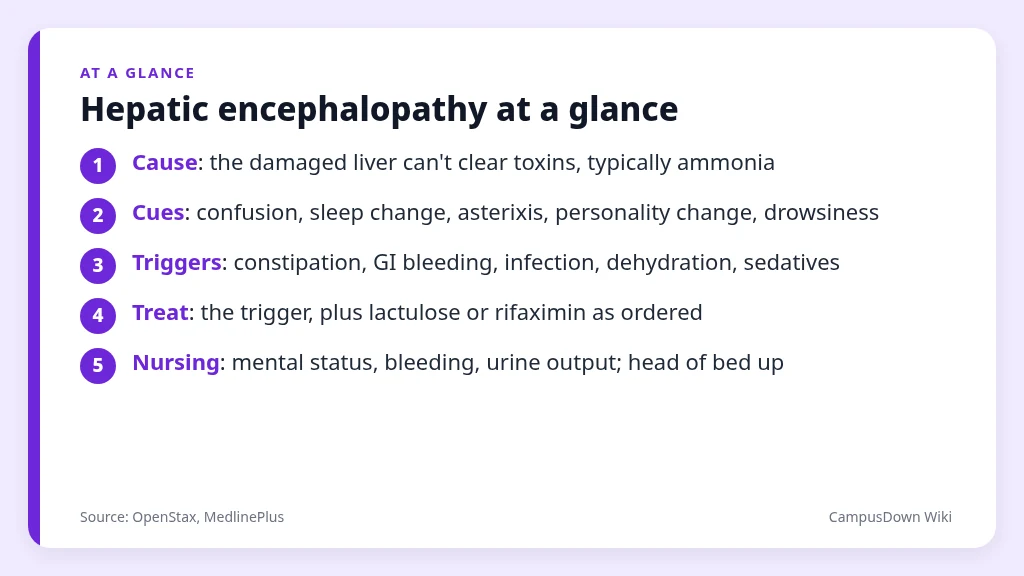
Hepatic encephalopathy is a reversible brain effect of liver failure when ammonia and other toxins build up. Watch for sleep changes, confusion and asterixis, find and treat triggers like bleeding, infection, constipation and sedatives, give ordered lactulose or rifaximin, keep the head of the bed up, monitor mental status, bleeding and urine output, and escalate quickly.
Browse more guides like this in the Nursing Student and NCLEX hub.
This article is for general education and does not replace advice from your own doctor, nurse or pharmacist.