
The bottle says "125 mcg (5,000 IU)." Your doctor said "800." A friend takes "2,000." Are those numbers all talking about the same vitamin, and which one is yours?

This guide uses the NIH Office of Dietary Supplements (ODS) vitamin D fact sheets for consumers and health professionals (updated November 2022). It is general information, not a prescription; your clinician and pharmacist decide what is right for you. If you want to learn more about the bone minerals that work with vitamin D, take a closer look at calcium and magnesium for nursing.
What vitamin D does
ODS says vitamin D helps your body absorb calcium, and together with calcium helps protect against osteoporosis. Muscles, nerves and the immune system also need it. Your skin makes it from sunlight, but ODS notes that clouds, smog, old age and dark skin reduce how much your skin makes, and that skin doesn't make it through a window. See osteoporosis and sarcopenia.

Reading the label: mcg versus IU
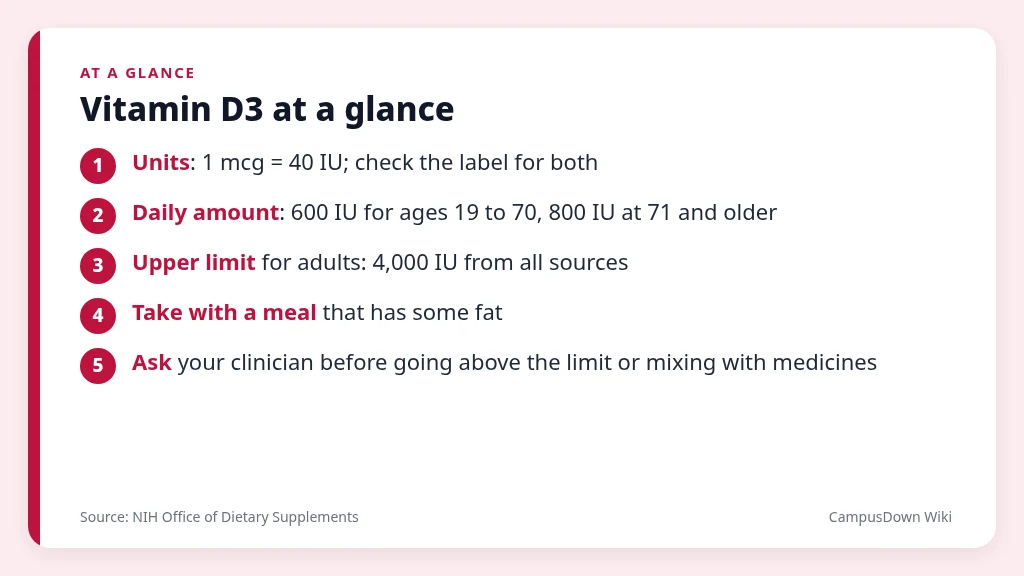
ODS lists amounts in micrograms (mcg) and International Units (IU), and the health professional sheet says 1 mcg of vitamin D equals 40 IU. For example, 15 mcg is 600 IU. The ODS consumer sheet gives these average daily recommended amounts:
| Life stage | Amount |
|---|---|
| Birth to 12 months | 10 mcg (400 IU) |
| Children 1 to 13 years | 15 mcg (600 IU) |
| Teens 14 to 18 years | 15 mcg (600 IU) |
| Adults 19 to 70 years | 15 mcg (600 IU) |
| Adults 71 years and older | 20 mcg (800 IU) |
| Pregnant and breastfeeding | 15 mcg (600 IU) |
ODS says FDA requires food labels to list vitamin D in mcg, with IU optionally in parentheses. Check which unit a product uses before you compare.
Upper limits
ODS says the daily upper limits include intakes from all sources: food, drinks and supplements. For adults 19 and older and for pregnant and breastfeeding women, it is 100 mcg (4,000 IU); for children 1 to 3 years, 63 mcg (2,500 IU), and for 4 to 8 years, 75 mcg (3,000 IU). ODS adds that your health care provider might recommend doses above these limits for a period of time to treat a vitamin D deficiency. Don't self-prescribe that.
D2 versus D3
ODS says supplements contain D2 (ergocalciferol) or D3 (cholecalciferol). Both raise blood levels, but D3 might raise it higher and for longer. Because vitamin D is fat soluble, it is best absorbed with a meal or snack that includes some fat.
Blood levels
A blood test measures 25-hydroxyvitamin D, in nmol/L or ng/mL (1 nmol/L is 0.4 ng/mL). ODS says 50 nmol/L (20 ng/mL) or above is adequate for most people, below 30 nmol/L (12 ng/mL) is too low and above 125 nmol/L (50 ng/mL) is too high. It notes almost 1 in 4 people in the United States have levels that are too low or inadequate. Those more likely to struggle include older adults, people with dark skin, people who seldom expose their skin to sun, people with conditions that limit fat absorption (Crohn's disease, celiac disease, ulcerative colitis), and people with obesity or gastric bypass.
What the evidence says (ODS)
- Bones: getting recommended amounts with calcium helps maintain healthy bones; supplements slightly increase bone strength in older adults, but it isn't clear they reduce falls or fractures.
- Cancer, heart disease, depression, diabetes, weight: ODS says trials don't show that vitamin D supplements prevent these, reduce heart disease risk, ease depression, improve blood sugar or help weight loss.
- Blood pressure: in people with overweight or obesity, doses above 20 mcg (800 IU) a day plus calcium might actually raise blood pressure.
Too much
ODS says very high blood levels (above 375 nmol/L or 150 ng/mL) can cause nausea, vomiting, muscle weakness, confusion, pain, loss of appetite, dehydration, frequent urination, thirst and kidney stones, and extremely high levels can cause kidney failure, irregular heartbeat and death. It says this is almost always from taking too much in supplements, not from sunshine. The professional sheet explains toxicity raises calcium (hypercalcemia).
Get help now if
Nausea, vomiting, new confusion, severe weakness, extreme thirst or frequent urination while taking high-dose vitamin D need prompt medical advice. Call your clinician or go to urgent care, and call 911 for confusion with an irregular heartbeat.
Medicine and supplement interactions
ODS says:
- Orlistat can reduce vitamin D absorption.
- Cholesterol-lowering statins (atorvastatin, lovastatin, simvastatin) might not work as well with high-dose vitamin D.
- Steroids such as prednisone can lower vitamin D levels.
- Thiazide diuretics may raise calcium too high with vitamin D supplements, especially in older adults.
Tell your pharmacist about everything you take. See the brown bag medication review and polypharmacy and the Beers Criteria.
Questions for your clinician or pharmacist
- Should my vitamin D blood level be tested?
- What total daily amount is right for me, from food, sun and supplements?
- Is my multivitamin already adding vitamin D?
- Do my medicines change what I should take?
- If I'm low, how long will I take a higher dose?
Example scenario: two bottles, one total
- Who
- Clementina, 73, a retired seamstress in Spokane, Washington, took a calcium-and-vitamin-D pill, a multivitamin and a separate vitamin D3 capsule because a neighbor recommended it.
- What happened
- She hadn't added up the totals and noticed more thirst and nausea.
- How it felt
- She felt worried and embarrassed.
- What they did
- She brought all her bottles to her pharmacist, who added the amounts, explained the label units and told her to call her clinician before continuing. Her clinician checked a blood level and calcium, then simplified her plan. Clementina kept one list in her wallet.
- How it turned out
- Clementina said adding up the bottles was a revelation.
This is an illustrative example, not a real patient or a review.
Clementina's story is an illustrative example. Ask your clinician before taking more than the upper limit, and call right away for confusion, severe weakness or a racing or irregular heartbeat.
Most-asked questions about vitamin D3
What are the benefits of vitamin D3?
ODS says vitamin D helps absorb calcium and supports bones, muscles, nerves and immunity; trials haven't shown that supplements prevent cancer, heart disease, depression or diabetes.
Why people ask: "vitamin d3 benefits" is #3 for "vitamin d3" (US autocomplete, November 2026).
Is vitamin D3 5000 IU too much?
The adult upper limit is 4,000 IU from all sources, so 5,000 IU is above it; ODS says a clinician may recommend more for a period to treat deficiency.
Why people ask: "vitamin d3 5000 iu" is #4 for "vitamin d3" (US autocomplete, November 2026).
Is vitamin D3 2000 IU okay?
It is below the 4,000 IU adult upper limit and above the 600 to 800 IU recommended amounts; ask your clinician what total is right for you.
Why people ask: "vitamin d3 2000 iu" is #5 for "vitamin d3" (US autocomplete, November 2026).
What are the benefits of vitamin D3 and K2?
The ODS sheets used here don't cover combining vitamin K2 with D3, so ask your clinician or pharmacist.
Why people ask: "vitamin d3 and k2 benefits" is #6 for "vitamin d3" (US autocomplete, November 2026).
What are vitamin D3 side effects?
Taking too much can raise calcium and cause nausea, vomiting, weakness, confusion, thirst, frequent urination and kidney stones.
Why people ask: "vitamin d3 side effects" is #7 for "vitamin d3" (US autocomplete, November 2026).
What are vitamin D3 deficiency symptoms?
ODS says deficiency causes rickets in children and osteomalacia in adults, with bone pain and muscle weakness; a blood test shows your level.
Why people ask: "vitamin d3 deficiency symptoms" is #9 for "vitamin d3" (US autocomplete, November 2026).
What is the vitamin D3 dosage for seniors over 70?
ODS lists 20 mcg (800 IU) a day for adults 71 and older as the average recommended amount, with a 4,000 IU upper limit.
Why people ask: "vitamin d3 dosage for seniors over 70" is #2 for "vitamin d3 dosage" (US autocomplete, November 2026).
What is the vitamin D3 dosage for adults?
600 IU (15 mcg) for ages 19 to 70, with a 4,000 IU upper limit; your clinician may adjust it.
Why people ask: "vitamin d3 dosage for adults" is #4 for "vitamin d3 dosage" (US autocomplete, November 2026).
What is the vitamin D3 dosage for seniors over 80?
ODS doesn't separate over 80; 800 IU (20 mcg) applies to adults 71 and older.
Why people ask: "vitamin d3 dosage for seniors over 80" is #5 for "vitamin d3 dosage" (US autocomplete, November 2026).
Is there a vitamin D3 dosage per month?
ODS gives daily amounts only; ask your clinician before using any monthly or weekly schedule.
Why people ask: "vitamin d3 dosage for adults per month" is #6 for "vitamin d3 dosage" (US autocomplete, November 2026).
What about vitamin D3 50,000 IU?
That is far above the 4,000 IU adult upper limit; ODS says only a clinician may recommend higher doses for a period to treat deficiency, so don't start it on your own.
Why people ask: "vitamin d3 dosage 50 000 iu" is #7 for "vitamin d3 dosage" (US autocomplete, November 2026).
Related on CampusDown
You can learn more about the medicines hub and check it for yourself in the brown bag medication review. For bones and falls in detail, see osteoporosis and the fall prevention checklist, and for home changes see aging in place.
Frequently asked questions
- How many IU are in a microgram?
- 1 mcg equals 40 IU, per ODS.
- What is the upper limit for adults?
- 100 mcg (4,000 IU) a day from all sources, unless a clinician advises otherwise for a deficiency.
- D2 or D3?
- Both raise blood levels; ODS says D3 might raise it higher and for longer.
- When should I take it?
- With a meal or snack that includes some fat, per ODS.
- Can vitamin D interact with medicines?
- Yes: orlistat, statins at high doses, steroids and thiazide diuretics are examples; ask your pharmacist.
Vitamin D3 is helpful in the right amount. Compare mcg and IU carefully, add up food, sun and all supplements, stay under the upper limit unless a clinician directs otherwise, take it with a meal, and ask your pharmacist about interactions.
Browse more guides like this in the Medicines hub.
This article is for general education and does not replace advice from your own doctor, nurse or pharmacist.