
You love your kitchen, your garden and your own front door. Could you still manage them in five years, and what would need to change first?
This guide uses the National Institute on Aging (NIA) pages "Aging in Place: Growing Older at Home" and "Home Safety Tips for Older Adults" (updated June 2025). It is general information, not medical or legal advice. A doctor, an occupational therapist or your local Area Agency on Aging can tailor it to you. If you want to learn more about preventing falls, take a closer look at the fall prevention checklist.
What aging in place means
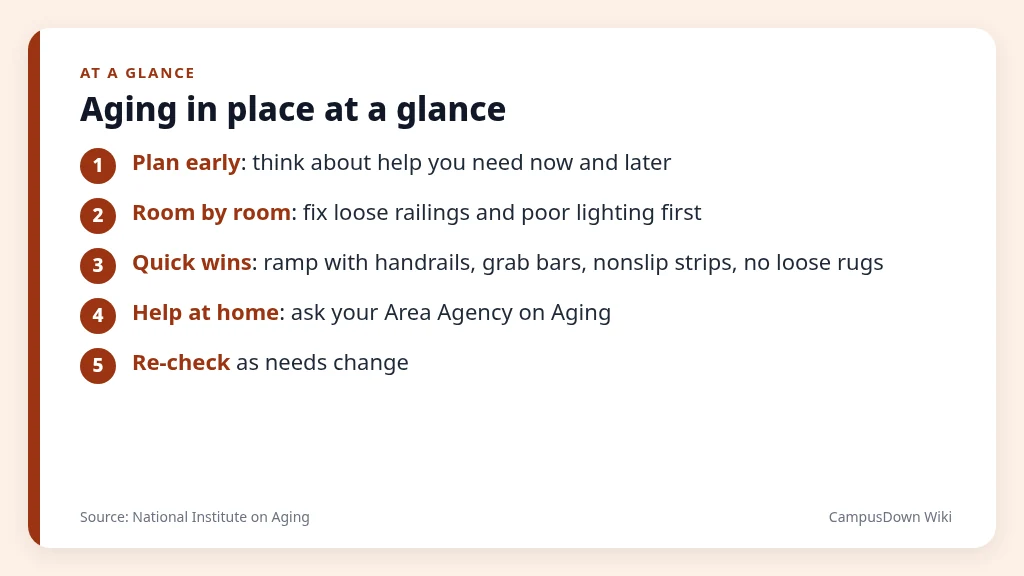
NIA says aging in place means staying in your own home as you get older. It suggests planning before you need a lot of care: think about the help you may need now and later, including how conditions such as diabetes or heart disease could affect you. Talk with family and caregivers, and revisit the decision as your needs change.

Go room by room
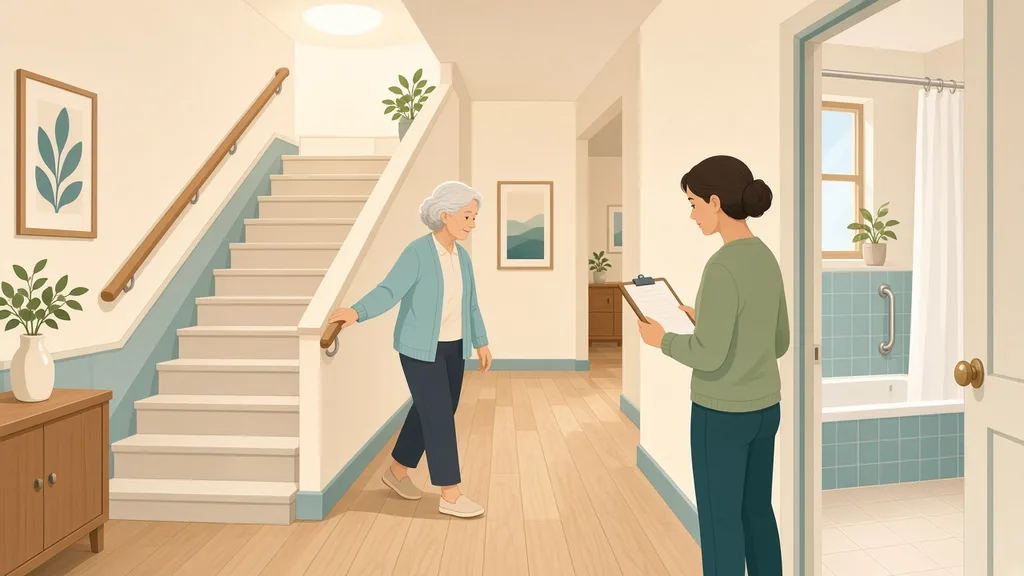
NIA says to go through your home room by room to identify potential problems and safety issues. First, correct any immediate dangers, such as loose stair railings and poor lighting, then work on other improvements. NIA offers a Home Safety Checklist worksheet (PDF) and adds that you may not need every suggested change, but you should re-evaluate home safety every so often as your needs change.
Simple changes that NIA highlights
| Where | Change |
|---|---|
| Front door | Ramp with handrails |
| Floors | Remove area rugs and fix all carpets firmly in place |
| Stairs | Good lighting, particularly at the top and bottom |
| Bathroom | Grab bars near toilets and in the tub or shower |
| Wet surfaces | Nonslip strips |
Falls are the main hazard these changes aim at; see the fall prevention checklist, and a doctor can check whether low blood pressure on standing contributes (orthostatic hypotension).
Help that can keep you at home
NIA lists ways to build a support system:
- Reach out to people you know: family, friends and neighbors are the biggest source of help for many older people; consider trading services.
- Community resources: your local Area Agency on Aging, state or local offices on aging or social services, or a tribal organization may have lists of services.
- Daytime help: volunteer visitors, adult day care or respite services if a regular caregiver isn't available.
- Medical emergencies: ask your doctor about a medical alert ID, and consider an emergency medical alert system that alerts responders when a person falls or needs urgent help.
- Geriatric care managers: specially trained professionals who can help form a care plan, especially if family members live far apart.
- Government programs: federal, state and local resources exist for older adults and caregivers.
Paying for it
NIA says home-based services can be expensive, but may cost less than moving into a residential facility such as assisted living or a nursing home, and how people pay depends on finances, eligibility for assistance programs and the services used. It also says you may be able to get help paying for repairs and safety updates; check with your state housing finance agency, social services department, community development groups or federal programs, and the Administration for Community Living (ACL) at 202-401-4634. The pages don't promise any particular program will cover your project, so ask each agency about its rules.
Questions for your clinician or therapist
- Could an occupational therapist visit my home and suggest changes?
- Do my medicines raise my risk of dizziness or falls?
- Do I need a vision or hearing check? See cataract surgery recovery.
- What would I do after a fall? See concussion symptoms if you hit your head.
- Who can I call for help during the day?
Example scenario: the bathroom first
- Who
- Florentina, 82, a widow in Duluth, Minnesota, wanted to stay in the house where she raised her children.
- What happened
- Her daughter noticed a loose stair railing, throw rugs in the hall and a slippery tub.
- How it felt
- Florentina felt proud and a bit defensive.
- What they did
- They walked through the house room by room with a checklist, fixed the railing and lighting first, removed the rugs, and asked her Area Agency on Aging about help with a grab bar and nonslip strips. Her doctor reviewed her medicines for dizziness, and the family wrote down who to call during the day.
- How it turned out
- Florentina said she liked making the list herself.
This is an illustrative example, not a real patient or a review.
Florentina's story is an illustrative example. A doctor or occupational therapist can tailor changes to a person's health.
Most-asked questions about aging in place
Is there an aging in place checklist PDF?
NIA offers a Home Safety Checklist worksheet as a PDF on its aging in place page; this guide doesn't reproduce it.
Why people ask: "aging in place checklist pdf" is #2 for "aging in place checklist" (US autocomplete, November 2026).
Is there a printable aging in place checklist?
Yes; NIA's Home Safety Checklist is a worksheet you can print, and you can adapt it room by room.
Why people ask: "aging in place checklist printable" is #3 for "aging in place checklist" (US autocomplete, November 2026).
Is there an aging in place checklist template?
NIA's worksheet works as a template; it says you may not need every change and should re-check as needs change.
Why people ask: "aging in place checklist template" is #4 for "aging in place checklist" (US autocomplete, November 2026).
What is in an aging in place remodeling checklist?
NIA's published list covers ramps with handrails, no loose rugs, lighting, grab bars and nonslip strips; the sources here don't cover larger remodels, so ask an occupational therapist or contractor.
Why people ask: "aging in place remodeling checklist" is #7 for "aging in place checklist" (US autocomplete, November 2026).
What is an aging in place home checklist?
A room-by-room walk-through that fixes urgent hazards such as loose railings and poor lighting first.
Why people ask: "aging in place home checklist" is #9 for "aging in place checklist" (US autocomplete, November 2026).
Is there an aging in place home modification program?
NIA says help may come from state housing finance agencies, social services departments and community groups; ask your Area Agency on Aging about specific programs.
Why people ask: "aging in place home modification program" is #4 for "aging in place home modifications" (US autocomplete, November 2026).
What home modifications help elderly or disabled people?
NIA highlights ramps with handrails, grab bars, better lighting, nonslip strips and removing rugs; an occupational therapist can tailor others.
Why people ask: "home modifications for elderly or disabled" is #5 for "aging in place home modifications" (US autocomplete, November 2026).
Related on CampusDown
You can learn more about the senior health hub and check it for yourself in the fall prevention checklist. For medicine safety in detail, see the brown bag medication review, and for staying connected see loneliness in older adults.
Frequently asked questions
- What does aging in place mean?
- Staying in your own home as you get older, per NIA.
- What should I fix first?
- Immediate dangers such as loose stair railings and poor lighting.
- Which changes does NIA highlight?
- A ramp with handrails, no loose rugs, good stair lighting, grab bars and nonslip strips.
- Can I get help paying for repairs?
- Possibly; check your state housing finance agency, social services department, community groups and federal programs.
- Who can list local services?
- Your Area Agency on Aging, local or state aging offices, or a tribal organization.
Aging in place works best with an early plan. Walk through your home room by room, fix urgent hazards first, add simple safety features, build a support network, and re-check as your needs change.
Browse more guides like this in the Senior Health and Medicare hub.
This article is for general education and does not replace advice from your own doctor, nurse or pharmacist.