
The surgery was quick, the patch is on and you can't wait to see clearly. But what can you do tomorrow, and when should a "weird" feeling make you call?

This guide uses the National Eye Institute (NEI) pages on cataracts (updated August 2026) and cataract surgery (updated December 2024), the MedlinePlus cataract removal page (review date July 2025) and the American Academy of Ophthalmology (AAO) lens-implant page (November 2026). It is general information, not a substitute for your surgeon's instructions. If you want to learn more about the eye condition itself, take a closer look at cataracts.
Why surgery
NEI says a cataract is a cloudy area in the eye's lens that causes cloudy or blurry vision, faded colors, poor night vision, glare or halos, double vision or frequent prescription changes. Surgery is the only way to remove a cataract, but there's no need to rush. NEI says about 9 in 10 people see better afterward. MedlinePlus adds that glaucoma or macular degeneration may make surgery harder or the outcome less good; see glaucoma and macular degeneration.

Before surgery
NEI says to expect tests about a week before to measure your eye and choose the lens implant, protective eye drops, fasting hours before, and a driver. Ask your doctor before stopping any medicine.
What happens
- NEI says surgery takes about an hour and is almost painless; you're usually awake. MedlinePlus says it is outpatient and lasts less than half an hour. Sources and surgeons differ, so ask how long yours will take.
- The surgeon replaces the cloudy lens with a clear intraocular lens (IOL).
- The AAO describes monofocal lenses (most common; one focusing distance, usually distance, often with reading glasses), presbyopia-correcting lenses, a light-adjustable lens adjusted with UV light after surgery, and toric lenses for astigmatism. Ask which fits your lifestyle and costs.
Right after
- MedlinePlus says you may get a patch to wear until the follow-up exam, usually the next day, plus eye drops to prevent infection, treat inflammation and help with healing. NEI says you'll get drops and a shield or glasses.
- Someone must drive you home.
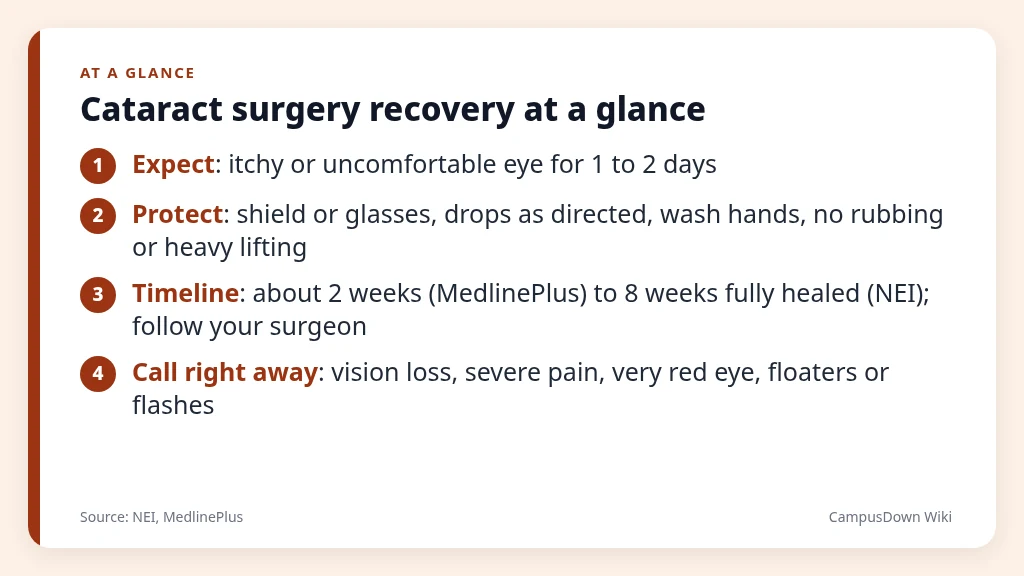
- NEI says the eye may be itchy, uncomfortable or sensitive for 1 to 2 days.
Recovery do's and don'ts
- Wear dark sunglasses outside after the patch comes off (MedlinePlus).
- Wash your hands well before and after using eye drops and touching your eye; try not to get soap and water in the eye for the first few days.
- NEI says avoid touching the eye, bending over and lifting heavy things for a few weeks.
- MedlinePlus says light activities are best; check with your doctor before strenuous activity, sexual activity or driving.
- The sources here don't give a return-to-work date; ask your surgeon.
How long?
Sources differ. MedlinePlus says recovery takes about 2 weeks and that new glasses or contacts can usually be fitted then. NEI says most people are completely healed by 8 weeks. Colors may look brighter because the new lens lacks the yellow-brown tint.
The second eye
NEI says if both eyes need surgery, they are done at separate times, usually about a month apart. MedlinePlus says to wait at least 1 to 2 weeks between eyes (some systems do both within minutes). Your surgeon decides.
Get help now if
Call your eye doctor right away for vision loss, severe pain that doesn't go away with medicine, a very red eye, or new floaters or flashes of light. Don't wait for the next appointment.
Risks to know about
NEI lists swelling, bleeding, infection, vision loss or double vision, eye pressure changes and retinal detachment. A secondary cataract (posterior capsule opacification) can develop weeks, months or years later and laser treatment can fix it.
Home safety while your vision adjusts
Blurry depth perception can lead to trips; see the fall prevention checklist and home safety changes. Medicines affecting the eyes, like hydroxychloroquine, also need eye follow-up, so tell your eye doctor everything you take.
Questions for your surgeon
- Which lens suits me, and do I still need glasses?
- Which drops, how often and for how long?
- When can I drive, work, exercise and travel?
- When is the second eye?
- Which symptoms mean I should call even at night?
Example scenario: the itchy morning
- Who
- Evelina, 76, a retired librarian in Madison, Wisconsin, had her first cataract surgery on a Tuesday.
- What happened
- The next morning her eye felt itchy and she wanted to rub it.
- How it felt
- She felt anxious and impatient.
- What they did
- She remembered the instruction not to touch the eye, used her drops after washing her hands and attended the next-day check. She called the office when she noticed a few new floaters later that week and was seen the same day. She kept the sunglasses on outside and asked about the second eye.
- How it turned out
- Evelina said knowing which symptoms to call about helped her relax.
This is an illustrative example, not a real patient or a review.
Evelina's story is an illustrative example. Always follow your surgeon's aftercare plan and call right away for warning signs.
Most-asked questions about cataract surgery recovery
How much time off work after cataract surgery?
The sources here don't give a work timeline; ask your surgeon, who knows your job and your eye.
Why people ask: "cataract surgery recovery time off work" is #3 for "cataract surgery recovery" (US autocomplete, November 2026).
When can I drive after cataract surgery?
MedlinePlus says to check with your doctor before driving; you also need a driver on surgery day.
Why people ask: "cataract surgery recovery time for driving" is #4 for "cataract surgery recovery" (US autocomplete, November 2026).
What are cataract surgery recovery restrictions?
Avoid touching the eye, bending over and lifting heavy things for a few weeks, avoid strenuous activity until cleared, and keep soap and water out of the eye for the first few days.
Why people ask: "cataract surgery recovery restrictions" is #6 for "cataract surgery recovery" (US autocomplete, November 2026).
How do I use eye drops after cataract surgery?
Wash hands before and after, follow the schedule your surgeon gives you; MedlinePlus says drops prevent infection, treat inflammation and help healing.
Why people ask: "cataract surgery recovery eye drops" is #9 for "cataract surgery recovery" (US autocomplete, November 2026).
How long between cataract surgery on both eyes?
NEI says usually about a month apart; MedlinePlus says at least 1 to 2 weeks; your surgeon decides.
Why people ask: "cataract surgery recovery time between both eyes" is #5 for "cataract surgery recovery time" (US autocomplete, November 2026).
Is cataract surgery recovery different with diabetes?
The sources here don't cover recovery differences; NEI lists diabetes as a cataract risk factor, so ask your eye doctor.
Why people ask: "cataract surgery recovery time for diabetes" is #6 for "cataract surgery recovery time" (US autocomplete, November 2026).
Related on CampusDown
You can learn more about the senior health hub and check it for yourself in cataracts. For eye pressure in detail, see glaucoma, and for dizziness on standing see orthostatic hypotension.
Frequently asked questions
- How long does cataract surgery take?
- NEI says about an hour; MedlinePlus says under half an hour; ask your surgeon.
- When am I healed?
- MedlinePlus says about 2 weeks; NEI says most people are completely healed by 8 weeks.
- What are the warning signs?
- Vision loss, severe pain, a very red eye, floaters or flashes of light.
- Can I rub my eye?
- No; avoid touching it, and avoid bending and heavy lifting for a few weeks.
- Will I need new glasses?
- Possibly; MedlinePlus says fitting usually happens around 2 weeks.
Most people do well after cataract surgery. Use your drops, protect the eye, avoid rubbing and heavy lifting, expect different timelines from different sources, and call right away for pain, vision loss, redness, floaters or flashes.
Browse more guides like this in the Senior Health and Medicare hub.
This article is for general education and does not replace advice from your own doctor, nurse or pharmacist.