
Your rheumatologist starts a lupus medicine and, in the same breath, mentions an eye exam. Why would a tablet for joints and skin need a visit to the eye doctor?

This guide uses MedlinePlus's drug information on hydroxychloroquine (revised January 2025) to explain the basics. It is general information, not a prescription; your doctor and pharmacist decide whether this medicine is right for you and how much to take. If you want to learn more about another long-term medicine that needs monitoring, take a closer look at allopurinol for gout.
What it is and what it treats
MedlinePlus says hydroxychloroquine is used to prevent and treat acute attacks of malaria in adults and children weighing more than 31 kg (68 lbs). It is also used to treat discoid lupus erythematosus (a chronic inflammatory skin condition), systemic lupus erythematosus (an autoimmune disease) and rheumatoid arthritis. It is in a class of drugs called antimalarials and is also an antirheumatic drug. It kills the organisms that cause malaria, and may work for rheumatoid arthritis and lupus by decreasing the activity of the immune system. It is sometimes used for porphyria cutanea tarda. Brand names listed are Plaquenil and Sovuna.

How it is taken
MedlinePlus says hydroxychloroquine comes as a tablet to take by mouth, with food or milk.
- Malaria prevention: usually once a week on exactly the same day each week, starting 1 to 2 weeks before travel, continuing during your stay and for 4 weeks after you return.
- Malaria treatment: a schedule of doses over the first two days; your prescriber gives the plan.
- Lupus or rheumatoid arthritis: usually once or twice a day.
- Swallow tablets whole; don't split, chew or crush.
- Take exactly as directed.
For rheumatoid arthritis, MedlinePlus says symptoms should improve within several weeks to months; if they don't, or they worsen, call your doctor. Once you and your doctor are sure it works for you, don't stop without talking to your doctor, because symptoms will return if you stop.
MedlinePlus doesn't list tablet strengths such as 200 mg or describe the "sulfate" form, so this article doesn't either. Your label shows the strength and how often to take it.
Eye exams
MedlinePlus says hydroxychloroquine may cause serious and potentially irreversible eye problems, and that you will probably need regular eye exams during treatment. Tell your doctor if you have blurred vision, floaters in the eye, seeing flashes of light or other changes in vision. Tell your doctor too if you've had vision problems such as macular degeneration. Ask your doctor how often you need an exam and who should do it; MedlinePlus doesn't give a schedule.
Heart rhythm and blood sugar
MedlinePlus says to tell your doctor if you or a family member has a prolonged QT interval (a rare heart problem that can cause irregular heartbeat, fainting or sudden death), if you are of Asian descent, or if you have or had heart failure, a heart attack, an irregular heartbeat or other heart problems, or low magnesium or potassium. Your doctor may order lab tests and electrocardiograms (EKGs) to check your response. For related background see skipped heartbeats (PVCs) and the QT note in azithromycin.
It also says hydroxychloroquine can cause hypoglycemia (low blood sugar), and your doctor may tell you to monitor your blood sugar. Call your doctor or get emergency treatment for symptoms such as dizziness, weakness, tiredness, sweating, nausea, rapid or irregular heartbeat, confusion, fainting or loss of consciousness. See hypoglycemia in older adults.
Other things to tell your doctor and pharmacist
- Allergies to hydroxychloroquine, chloroquine, primaquine, quinine or any ingredient
- All medicines, vitamins, supplements and herbals; MedlinePlus names cimetidine (Tagamet HB) as a possible interaction
- Antacids: take them 4 hours before or 4 hours after hydroxychloroquine
- Psoriasis, porphyria, G-6-PD deficiency or other blood disorders, dermatitis, seizures, diabetes, kidney or liver problems, or heavy alcohol use
- Pregnancy, plans for pregnancy or breastfeeding
Side effects
MedlinePlus says to tell your doctor if these are severe or don't go away: headache, loss of appetite, nausea, diarrhea, stomach pain, vomiting, difficulty hearing, ringing in the ears, hair loss and hair color changes.
Call your doctor immediately for:
- Hives, rash, swelling of the face, eyes, mouth, throat, tongue, lips, hands, feet, ankles or lower legs, or trouble breathing or swallowing
- Blisters on the skin, eyes, lips or mouth, or itching or burning skin
- Muscle weakness; burning, numbness or tingling in the hands or feet
- Excessive tiredness, loss of appetite, nausea, yellow skin or eyes, dark urine or upper-right stomach pain
- Unusual bleeding or bruising; cough, fever, sore throat or other signs of infection
- Mood or mental changes, new or worsening depression, or thinking about harming or killing yourself
- Fast or irregular heartbeat, lightheadedness, dizziness or fainting; seizures
- Passing less urine, swelling in the legs, feet or ankles, shortness of breath, confusion and other signs of kidney trouble
You or your doctor may report side effects to the FDA's MedWatch program.
Get help now if
If you have thoughts of harming yourself, call or text 988 in the United States, or call 911. Fainting, seizures, trouble breathing or swelling of the face or throat also need emergency care.
Missed doses and overdose
MedlinePlus says to take a missed dose when you remember unless it is almost time for the next one; don't double up. In case of overdose, call poison control at 1-800-222-1222 or 911 if someone collapses, has a seizure or trouble breathing. The page also lists keeping appointments, lab tests and EKGs as part of treatment.
Questions for your doctor or pharmacist
- Why am I taking it, and when should I expect to notice a difference?
- How often do I need eye exams, and who should do them?
- Do I need an EKG or blood sugar checks?
- How far apart should I take my antacid?
- Which of my other medicines interact?
- Which side effects mean I should call the same day?
Example scenario: the eye appointment she almost skipped
- Who
- Eleanora, 49, a high school librarian in Burlington, Vermont, started hydroxychloroquine for lupus and noticed the instruction to get regular eye exams.
- What happened
- She felt fine and thought she could skip the visit until her joints flared again.
- How it felt
- She felt busy and a little defensive.
- What they did
- She called her rheumatology nurse, who explained why the eye exam is part of this medicine and helped her book an optometrist visit; she added blurred vision, floaters and flashes of light to her list of symptoms to report. Eleanora also separated her antacid from her tablet by several hours.
- How it turned out
- Eleanora said she'd rather schedule it than guess about her eyes.
This is an illustrative example, not a real patient or a review.
Eleanora's story is an illustrative example. Call your doctor for vision changes or mood changes, and call 911 for fainting, seizures or thoughts of self-harm.
Most-asked questions about hydroxychloroquine
What is hydroxychloroquine used for?
Malaria prevention and treatment, discoid and systemic lupus erythematosus and rheumatoid arthritis, per MedlinePlus.
Why people ask: "hydroxychloroquine uses" is #3 for "hydroxychloroquine" (US autocomplete, November 2026).
What does hydroxychloroquine 200 mg mean?
MedlinePlus doesn't list tablet strengths; your prescription label shows the strength and schedule.
Why people ask: "hydroxychloroquine 200 mg" is #4 for "hydroxychloroquine" (US autocomplete, November 2026).
What is hydroxychloroquine sulfate?
MedlinePlus describes the medicine as hydroxychloroquine without explaining the salt form; ask your pharmacist about your product.
Why people ask: "hydroxychloroquine sulfate" is #5 for "hydroxychloroquine" (US autocomplete, November 2026).
What drug class is hydroxychloroquine?
An antimalarial and an antirheumatic drug.
Why people ask: "hydroxychloroquine drug class" is #7 for "hydroxychloroquine" (US autocomplete, November 2026).
Is hydroxychloroquine used for lupus?
Yes; MedlinePlus lists discoid lupus erythematosus and systemic lupus erythematosus among its uses.
Why people ask: "hydroxychloroquine for lupus" is #8 for "hydroxychloroquine" (US autocomplete, November 2026).
How does hydroxychloroquine work?
It kills the organisms that cause malaria and may work for lupus and rheumatoid arthritis by decreasing immune system activity.
Why people ask: "hydroxychloroquine moa" is #9 for "hydroxychloroquine" (US autocomplete, November 2026).
What are the side effects of hydroxychloroquine in women?
MedlinePlus lists the same side effects for everyone and doesn't separate them by sex; it asks you to tell your doctor about pregnancy or plans for pregnancy.
Why people ask: "hydroxychloroquine side effects in women" is #2 for "hydroxychloroquine side effects" (US autocomplete, November 2026).
What are the long-term side effects of hydroxychloroquine?
MedlinePlus warns of serious and potentially irreversible eye problems and says to expect regular eye exams, labs and EKGs; it doesn't list other long-term effects separately.
Why people ask: "hydroxychloroquine side effects long-term" is #3 for "hydroxychloroquine side effects" (US autocomplete, November 2026).
What are the eye side effects of hydroxychloroquine?
Serious and potentially irreversible eye problems; report blurred vision, floaters, flashes of light or other vision changes, and have regular exams.
Why people ask: "hydroxychloroquine side effects eyes" is #4 for "hydroxychloroquine side effects" (US autocomplete, November 2026).
Does hydroxychloroquine cause weight gain?
Weight gain isn't listed on the MedlinePlus page; tell your doctor about changes that worry you.
Why people ask: "hydroxychloroquine side effects weight gain" is #6 for "hydroxychloroquine side effects" (US autocomplete, November 2026).
Does hydroxychloroquine cause skin rash?
MedlinePlus says to call your doctor immediately for hives, rash, blisters or itching or burning skin.
Why people ask: "hydroxychloroquine side effects skin rash" is #9 for "hydroxychloroquine side effects" (US autocomplete, November 2026).
Does hydroxychloroquine cause hair loss?
Yes; MedlinePlus lists hair loss and hair color changes among side effects to tell your doctor about if severe or persistent.
Why people ask: "hydroxychloroquine side effects hair loss" is #10 for "hydroxychloroquine side effects" (US autocomplete, November 2026).
Related on CampusDown
You can learn more about the medicines hub and check it for yourself in the brown bag medication review. For another medicine that needs regular monitoring in detail, see the Beers Criteria guide, and for joint health see osteoarthritis.
Frequently asked questions
- Should I take it with food?
- Yes; MedlinePlus says tablets should be taken with food or milk.
- Do I need eye exams?
- MedlinePlus says you will probably need regular eye exams because of possible serious and irreversible eye problems.
- When should I take my antacid?
- 4 hours before or 4 hours after hydroxychloroquine.
- Can it lower blood sugar?
- Yes; know the symptoms and call or seek emergency care if they occur.
- How long does it take to work for arthritis?
- MedlinePlus says several weeks to months; call your doctor if there's no improvement.
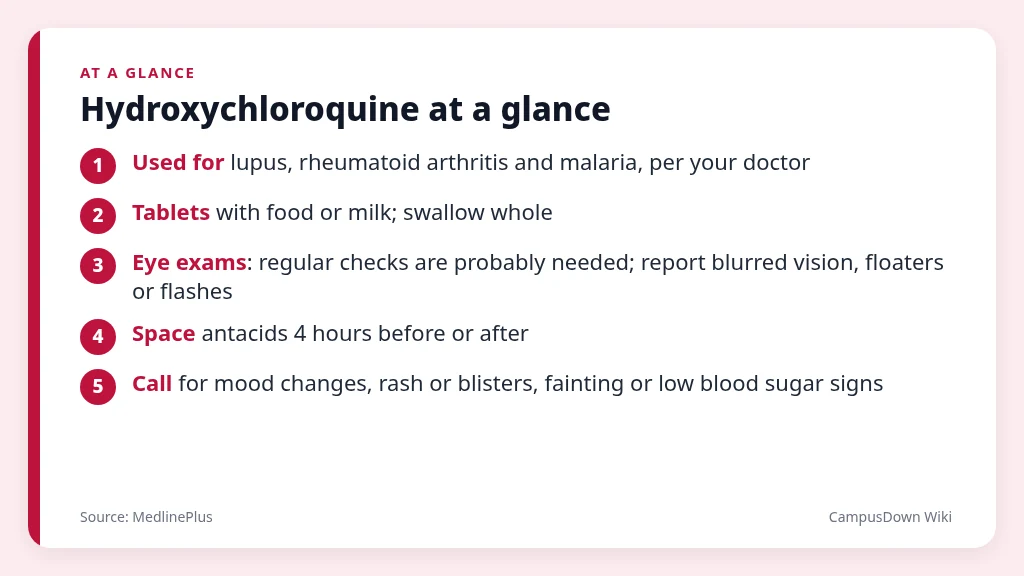
Hydroxychloroquine treats lupus, rheumatoid arthritis and malaria. Take tablets with food or milk, keep regular eye exams, space antacids by 4 hours, know the signs of low blood sugar and heart rhythm trouble, and call promptly for vision changes, mood changes, severe skin reactions or fainting.
Browse more guides like this in the Medicines hub.
This article is for general education and does not replace advice from your own doctor, nurse or pharmacist.