
You started allopurinol to stop gout attacks, and a few weeks later your toe flares up again. Is the medicine failing, or is this part of the plan?
This guide uses MedlinePlus's drug information on allopurinol (revised September 2023) and its gout health topic. It is general information, not a prescription; your doctor and pharmacist decide whether allopurinol is right for you and how much to take. If you want to learn more about another medicine that needs monitoring, take a closer look at hydroxychloroquine.
What it is and what it treats
MedlinePlus says allopurinol is used to treat gout (arthritis in which uric acid builds up in the joints and causes sudden attacks of redness, swelling, pain and heat). It is also used for high uric acid levels in people with certain cancers being treated with chemotherapy and for recurring kidney stones made of uric acid. It is in a class of medications called xanthine oxidase inhibitors, and it works by reducing the amount of uric acid the body makes. MedlinePlus lists the brand names Lopurin and Zyloprim. Learn more about gout itself.
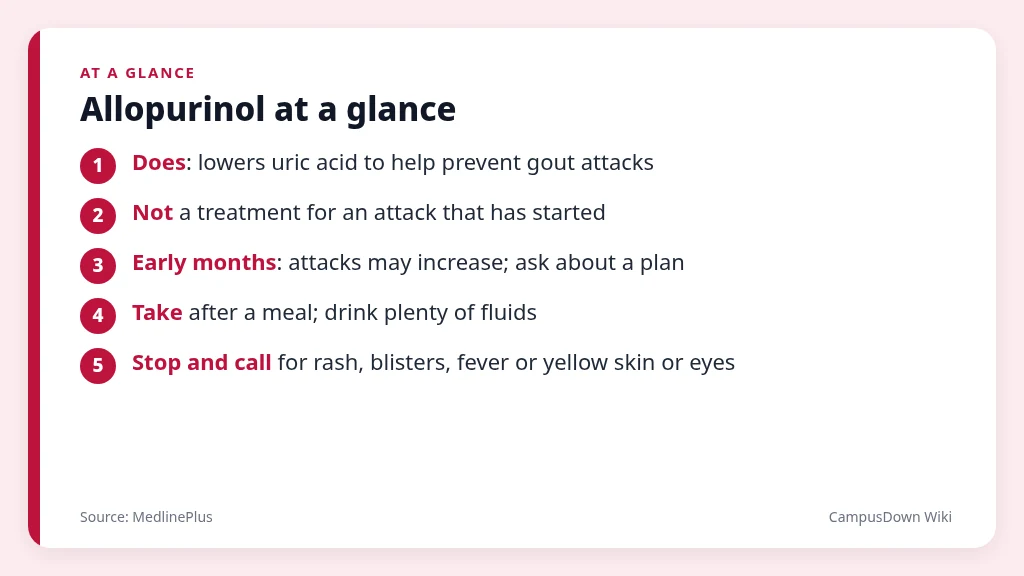
An important point: MedlinePlus says allopurinol prevents gout attacks but will not relieve an attack that has already started.

How it is taken
- It comes as a tablet to take by mouth, usually once or twice a day, preferably after a meal.
- Take it around the same time every day.
- Take exactly as directed; your doctor may start with a low dose and increase it gradually, no more than once a week, according to MedlinePlus.
- Continue even if you feel well; don't stop without talking to your doctor.
MedlinePlus says drink at least 8 (8-ounce) cups of liquid a day (unless your doctor tells you otherwise). See dehydration in older adults.
MedlinePlus doesn't list tablet strengths such as 100 mg or 300 mg, or an average dose, so this article doesn't either. Your label shows what your doctor chose for you.
The early months
MedlinePlus says it may take several months or longer before you feel the full benefit. Gout attacks may increase during the first few months, although the drug will eventually help prevent them. Your doctor may prescribe another medication, such as colchicine, to prevent attacks during the first few months. Ask what to do if you have an attack while on allopurinol so you aren't caught off guard.
Tell your doctor and pharmacist
- Allergies to allopurinol or anything else
- All your medicines, vitamins and supplements
- High blood pressure, diabetes, kidney or liver disease, or heart failure (per MedlinePlus's list of conditions to mention)
- Pregnancy, plans to become pregnant or breastfeeding
- Alcohol: MedlinePlus says to ask your doctor about the safe use of alcoholic beverages while taking allopurinol
- Drowsiness: MedlinePlus says it may make you drowsy, so don't drive or operate machinery until you know how it affects you
For kidney function background see eGFR and kidney function, and for blood pressure see high blood pressure.
Side effects
MedlinePlus lists nausea, diarrhea and drowsiness as side effects to mention if severe or persistent.
Stop taking allopurinol and call your doctor immediately if you notice:
- Rash, itching, hives, peeling or blistering skin, or red or purple spots
- Fever or flu-like symptoms; swollen glands
- Painful urination or blood in the urine
- Eye irritation; swelling of the lips or mouth
- Yellow skin or eyes, upper-right stomach pain, nausea, vomiting, itching or extreme tiredness
You or your doctor may report side effects to the FDA's MedWatch program.
Get help now if
A new rash, blisters or peeling skin, fever, swelling of the lips or mouth, or trouble breathing needs urgent care. Stop the medicine and call your doctor or 911.
Missed doses and storage
MedlinePlus says to take a missed dose as soon as you remember unless it is almost time for the next one; don't double up. Store at room temperature away from heat and moisture; in overdose call poison control at 1-800-222-1222.
Questions for your doctor or pharmacist
- How long until I should expect fewer attacks?
- Should I have a plan or colchicine for the first months?
- How much should I drink each day?
- Does my kidney function change what I should take?
- Which of my other medicines interact?
- Which rash or skin changes mean I should call right away?
Example scenario: the early flare
- Who
- Solomon, 58, a bus mechanic in Dayton, Ohio, started allopurinol and, six weeks later, had another painful flare in his big toe.
- What happened
- He assumed the pills weren't working and considered quitting.
- How it felt
- He felt discouraged and a little angry.
- What they did
- He called his doctor's office and learned that attacks can increase in the early months and that a medicine such as colchicine can be used to help prevent them. His doctor kept the plan and asked about his fluids, so Solomon filled a big water bottle each morning, took his tablet after dinner and made a note to report any rash.
- How it turned out
- Solomon said the early flare was easier to handle when he knew it might happen.
This is an illustrative example, not a real patient or a review.
Solomon's story is an illustrative example. Ask your doctor before stopping or changing allopurinol, and call right away for rash, fever or yellow skin or eyes.
Most-asked questions about allopurinol
What is allopurinol used for?
Gout, high uric acid during chemotherapy and recurring uric acid kidney stones, per MedlinePlus.
Why people ask: "allopurinol uses" is #3 for "allopurinol" (US autocomplete, November 2026).
What does allopurinol 100mg mean?
MedlinePlus doesn't list strengths; your label shows the strength and how often to take it, and your doctor may adjust gradually.
Why people ask: "allopurinol 100mg" is #4 for "allopurinol" (US autocomplete, November 2026).
Is allopurinol used for gout?
Yes; it helps prevent gout attacks by lowering uric acid but does not treat an attack that has already started.
Why people ask: "allopurinol for gout" is #5 for "allopurinol" (US autocomplete, November 2026).
What does allopurinol 300 mg mean?
Strengths aren't listed in MedlinePlus; your prescriber chooses the amount and adjusts it; follow your label.
Why people ask: "allopurinol 300 mg" is #6 for "allopurinol" (US autocomplete, November 2026).
What is the brand name for allopurinol?
MedlinePlus lists Lopurin and Zyloprim.
Why people ask: "allopurinol brand name" is #7 for "allopurinol" (US autocomplete, November 2026).
What drug class is allopurinol?
A xanthine oxidase inhibitor.
Why people ask: "allopurinol drug class" is #8 for "allopurinol" (US autocomplete, November 2026).
What is the dosage of allopurinol?
MedlinePlus says it is usually taken once or twice a day after a meal and starts low with increases no more than once a week; follow your label.
Why people ask: "allopurinol dosage" is #9 for "allopurinol" (US autocomplete, November 2026).
What are the side effects of allopurinol in the elderly?
MedlinePlus doesn't separate side effects by age; it lists the same warning signs and asks you to mention kidney, liver and heart conditions to your doctor.
Why people ask: "allopurinol side effects in elderly" is #2 for "allopurinol side effects" (US autocomplete, November 2026).
How does allopurinol affect the kidneys?
MedlinePlus asks you to tell your doctor about kidney disease and to drink plenty of fluids; it also lists painful urination and blood in urine as reasons to call.
Why people ask: "allopurinol side effects kidney" is #3 for "allopurinol side effects" (US autocomplete, November 2026).
What are the long-term side effects of allopurinol?
MedlinePlus doesn't describe long-term effects separately; keep your appointments and report new symptoms.
Why people ask: "allopurinol side effects long term" is #4 for "allopurinol side effects" (US autocomplete, November 2026).
Are there allopurinol side effects in men?
MedlinePlus doesn't list sex-specific effects.
Why people ask: "allopurinol side effects in men" is #5 for "allopurinol side effects" (US autocomplete, November 2026).
Does allopurinol affect blood pressure?
MedlinePlus asks you to tell your doctor about high blood pressure but doesn't list a blood pressure effect; ask your pharmacist about your other medicines.
Why people ask: "allopurinol side effects blood pressure" is #8 for "allopurinol side effects" (US autocomplete, November 2026).
Can allopurinol cause a rash?
Yes; stop taking it and call your doctor immediately for rash, hives, peeling or blistering skin.
Why people ask: "allopurinol side effects rash" is #10 for "allopurinol side effects" (US autocomplete, November 2026).
Related on CampusDown
You can learn more about the medicines hub and check it for yourself in the brown bag medication review. For how kidney function changes medicine choices in detail, see eGFR and kidney function, and for the full medicine list review see the Beers Criteria guide.
Frequently asked questions
- Does allopurinol treat a gout attack?
- No; MedlinePlus says it prevents attacks but does not relieve one that has started.
- Why might I have more attacks at first?
- MedlinePlus says attacks may increase in the first months; your doctor may add colchicine to help prevent them.
- How much should I drink?
- MedlinePlus says at least eight 8-ounce cups of liquid daily unless your doctor says otherwise.
- Can I drink alcohol?
- Ask your doctor, as MedlinePlus advises.
- When do I stop and call?
- For rash, hives, blisters, fever, swollen glands, blood in urine, yellow skin or eyes, or swelling of the lips or mouth.
Allopurinol lowers uric acid to help prevent gout attacks over time. It takes months, attacks may flare early, take it after a meal, drink plenty of fluids, don't stop on your own, and stop and call right away for rash, blisters, fever or yellow skin or eyes.
Browse more guides like this in the Medicines hub.
This article is for general education and does not replace advice from your own doctor, nurse or pharmacist.