
Your blood pressure monitor just flashed 130/80. Is that high, or is it "basically normal"? The answer changed in 2017, and the 2025 guideline from the American Heart Association (AHA) and American College of Cardiology (ACC) kept the same line. A reading of 130/80 mm Hg sits at the start of stage 1 hypertension.
That label sounds heavier than it is. Stage 1 is not an emergency, and one number on one evening is not a diagnosis. It is a signal to measure carefully, look at your overall heart risk, and make a plan with your clinician. If you have been staring at that number and wondering whether to worry, the next few minutes of reading will help you take a closer look at what it really says about you.
What the two numbers mean
The top number is systolic pressure, the force against your artery walls when the heart beats. The bottom number is diastolic pressure, the force while the heart rests between beats. Either one can place you in a higher category.
The AHA uses these adult categories:
- Normal: below 120 and below 80
- Elevated: 120–129 and below 80
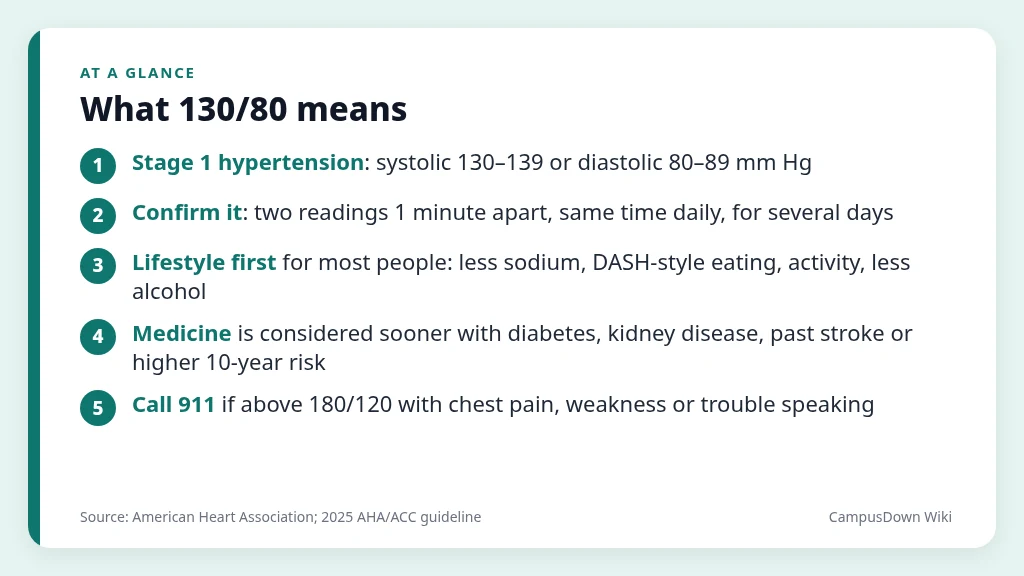
- Stage 1 hypertension: 130–139 or 80–89
- Stage 2 hypertension: 140 or higher, or 90 or higher
- Severe hypertension: higher than 180 and/or higher than 120
So 130/80 is stage 1 because both numbers touch the stage 1 range. A reading of 128/82 would also count as stage 1 because of the diastolic number alone. The AHA notes that after age 50, the systolic number tells more about heart disease risk, as large arteries stiffen with age.
Key point
One high reading is a snapshot. The AHA says only a doctor or other medical professional can confirm high blood pressure, usually from an average of readings taken on different days.

Example scenario: a number at the pharmacy kiosk
- Who
- Dana, 46, an office manager in Ohio who rarely sees a doctor.
- What happened
- While waiting for a prescription, she used the free kiosk and saw 134/84. She had rushed in from the parking lot with a coffee in her hand.
- How it felt
- Her stomach dropped. Her father had a stroke at 70, and she spent the drive home imagining the worst.
- What they did
- She bought an upper-arm monitor, sat quietly for five minutes each morning and evening, took two readings one minute apart, and wrote them down for a week. Then she booked a visit and brought the log.
- How it turned out
- Her home average was 131/81. Her doctor confirmed stage 1 hypertension, checked her labs, and started with sodium reduction, a walking plan and a recheck in three months. Dana said the log turned a frightening number into a plan she could follow.
This is an illustrative example, not a real patient or a review.
Stories like Dana's are common because the first reading usually happens somewhere rushed. Coffee, a full bladder, talking, or a cuff over a sleeve can push a number up, so the useful move is to build a calm, repeatable routine before you judge the result. If you want to see how to set that routine up, the steps below explain it in detail.
How doctors decide what to do at 130/80
The 2025 AHA/ACC guideline sets an overall treatment goal below 130/80 for most adults. What happens next depends on your risk, not only the reading.
- Lifestyle changes for everyone: reaching or keeping a healthy weight, a DASH-style eating pattern, less sodium, more dietary potassium (unless your clinician says otherwise), regular moderate activity, stress management and less alcohol.
- Medicine plus lifestyle is recommended for stage 1 when a person has clinical cardiovascular disease, a previous stroke, diabetes, chronic kidney disease, or a 10-year cardiovascular risk of 7.5% or more on the AHA's PREVENT calculator.
- Lower-risk adults usually try 3 to 6 months of lifestyle changes first. If the average stays at 130/80 or higher, the guideline recommends adding medicine.
This is why two people with the same 130/80 can leave the office with different plans. Your age, cholesterol, kidney function, smoking and diabetes all feed into the risk estimate.
How to confirm the reading at home
The US Preventive Services Task Force recommends confirming high readings outside the clinic before starting treatment. Home monitoring helps catch white coat hypertension, where office numbers run higher than daily life.
- Use a validated, automatic upper-arm monitor with the right cuff size. See how to choose a cuff size.
2. Avoid caffeine, smoking and exercise for 30 minutes before. Empty your bladder. 3. Sit with your back supported, feet flat, and your bare arm resting at heart level. 4. Rest quietly for five minutes. Do not talk or scroll. 5. Take two readings one minute apart, at the same times each day, and record them.
The full routine is in how to take blood pressure at home. If you are deciding between devices, upper arm vs wrist monitors explains why the AHA prefers the upper arm. Before you buy anything, it is worth checking that the model is on a validated device list; the guide on choosing a monitor lets you check it for yourself.
When 130/80 needs faster action
Stage 1 readings are not urgent by themselves. Faster action is needed in these situations:
Get help now if
Your reading is higher than 180/120 after waiting one minute and measuring again: contact your healthcare professional right away. If you also have chest pain, shortness of breath, back pain, numbness, weakness, vision changes or difficulty speaking, call 911.
Also talk to a clinician soon if you are pregnant, if readings keep climbing, or if you have kidney disease or diabetes. Never stop a prescribed blood pressure medicine because one home reading looks good.
Related on CampusDown
For the bigger picture, read High Blood Pressure (Hypertension). If your doctor mentions medicine, the guides to lisinopril and amlodipine explain how two common first-line drugs work. Older adults can compare goals in blood pressure targets after 65, and anyone using a specific monitor can start with the Omron Platinum BP5450 guide.
Frequently asked questions
- Is 130/80 considered high blood pressure?
- Yes. Under AHA/ACC categories, 130–139 systolic or 80–89 diastolic is stage 1 hypertension. A clinician confirms it with repeated readings before calling it a diagnosis.
- Do I need medication for 130/80?
- Not always. Medicine plus lifestyle changes is recommended when you have conditions such as diabetes, kidney disease or past stroke, or a 10-year risk of 7.5% or more. Lower-risk adults usually try lifestyle changes for 3 to 6 months first.
- Can stress or coffee cause a 130/80 reading?
- Short-term factors such as caffeine, exercise, smoking, a full bladder or talking can raise a reading. That is why the AHA asks you to avoid them for 30 minutes and rest five minutes before measuring.
- How often should I check my blood pressure at 130/80?
- Ask your clinician. A common approach is two readings one minute apart at the same times each day for about a week before a visit, then as directed.
Most people who see 130/80 for the first time feel a jolt of worry, and that worry is useful when it turns into a week of careful readings and one good conversation. Bring your log, your monitor and your questions to your next visit, and learn more about the exact steps that make home numbers trustworthy before you change anything on your own.
Browse more guides like this in the U.S. Health Topics hub.
This article is for general education and does not replace advice from your own doctor, nurse or pharmacist.