
What if your blood pressure monitor is accurate, but the cuff is simply the wrong size? It happens more than people think. The cuff is the part that squeezes your artery, and if it does not fit, the number on the screen can be off before any other mistake is made.
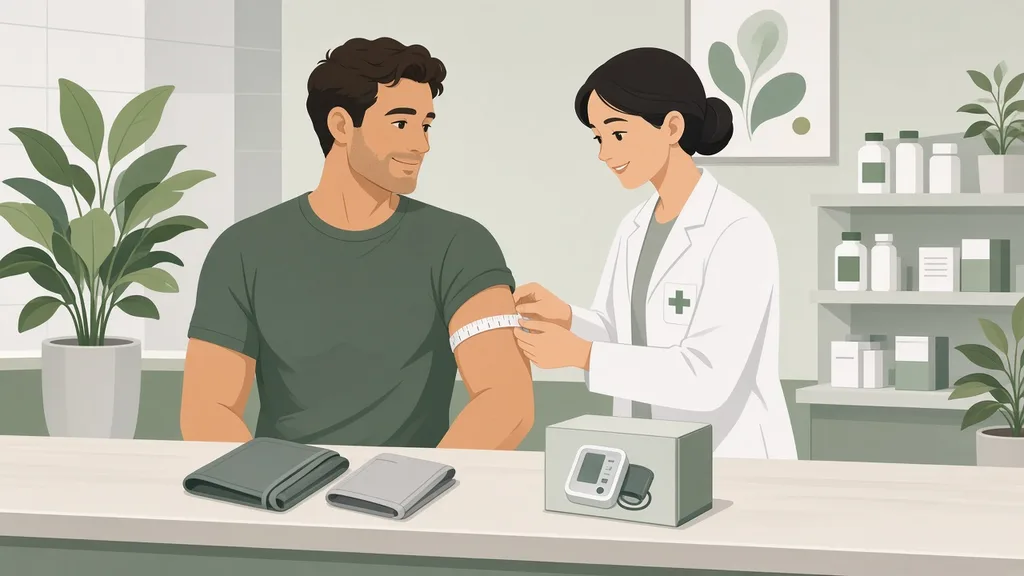
The American Heart Association (AHA) says a cuff of the incorrect size will cause an inaccurate reading, and it asks people to measure their upper arm before buying a home monitor. This guide shows how to do that and how to read the size ranges, so you can check it for yourself in a couple of minutes with a tape measure.
Why cuff size changes the number
A blood pressure cuff contains an inflatable bladder. To compress the artery evenly, the bladder needs to wrap most of the way around the arm. The AHA scientific statement on measurement says the bladder should encircle 75% to 100% of the arm's circumference.
A cuff that is too small for the arm tends to read too high, because it has to squeeze harder to close the artery. A cuff that is too large can read too low. Either way, the error comes from fit, not from your heart.
Key point
If you have ever been told your readings "jump around," ask whether anyone has measured your arm. Fit is one of the easiest sources of error to fix.

Example scenario: the cuff that never closed right
- Who
- Luis, 39, a warehouse supervisor who lifts weights.
- What happened
- His sister lent him her monitor after his clinic reading came back high. At home his numbers looked even worse, around 150/95, and the cuff's fabric barely reached the hook-and-loop strip.
- How it felt
- He felt angry at first, then scared. He trained hard and ate well, and the numbers felt like a verdict on everything he was doing.
- What they did
- A pharmacist measured his mid-upper arm at 37 cm and showed him that the borrowed cuff was meant for smaller arms. He bought a monitor that came with a wide-range cuff covering his size and followed the AHA routine for a week.
- How it turned out
- His home average came down to the mid-130s over the mid-80s. That was still worth discussing, and his doctor took it seriously, but the plan was now based on honest numbers. Luis said measuring his arm felt silly for about ten seconds and then felt like the most useful thing he had done.
This is an illustrative example, not a real patient or a review.
Luis's numbers were not invented by the cuff, but they were exaggerated by it. When readings feel wrong, start with the simplest checks: cuff size, cuff on bare skin, arm at heart level. The steps below go through cuff fit in detail.
How to measure your arm
- Sit or stand with your arm relaxed at your side.
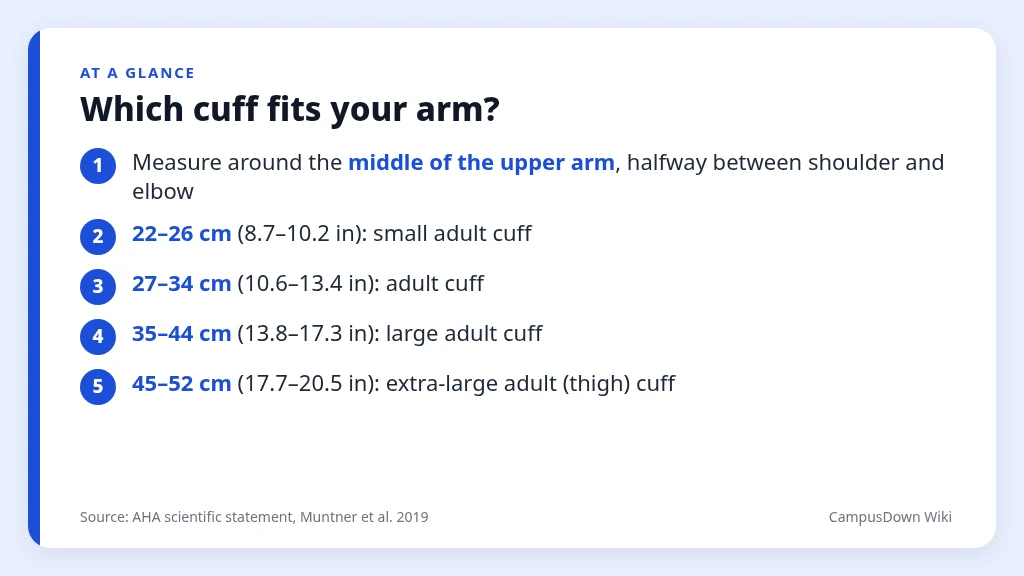
2. Find the midpoint between the bony tip of the shoulder and the elbow. 3. Wrap a soft tape measure around the arm at that point. Keep it snug, not tight. 4. Write the number down in centimeters and inches. 5. Compare it with the cuff range printed on the cuff or the monitor's box.
The AHA statement lists these adult ranges:
- 22–26 cm: small adult cuff
- 27–34 cm: adult cuff
- 35–44 cm: large adult cuff
- 45–52 cm: extra-large adult cuff (often called an adult thigh cuff)
Many home monitors sell a "wide-range" cuff that spans several of these sizes. For example, the Omron Platinum BP5450 manual lists an arm range of 9 to 17 inches (22–42 cm). If your arm falls outside the included range, look for a separately sold cuff made for that monitor, and confirm on the manufacturer page that it is compatible.
Getting the fit right at home
- Place the cuff on bare skin, never over a sleeve.
- Put the bottom edge just above the bend of the elbow.
- Line up the artery marker on the cuff with the inside of your arm, as the manual shows.
- Fasten it snugly and evenly, following the tightness check described in your monitor's manual.
Then follow the full home measurement routine. Before buying, it is worth using the validated device list to make sure both the monitor and its cuff sizes were tested.
When to ask for help
Ask your clinician or pharmacist to check your fit if your arm is near the edge of a range, if your arm is cone-shaped and the cuff slides, or if your home and office readings differ widely. Bring the monitor to a visit so staff can compare it with their device.
Get help now if
A reading higher than 180/120 that stays high on a second try needs a call to your healthcare professional. With chest pain, shortness of breath, back pain, numbness, weakness, vision changes or difficulty speaking, call 911.
Related on CampusDown
For what your readings mean, see blood pressure of 130/80 and High Blood Pressure (Hypertension). Device shoppers can compare upper arm vs wrist monitors, and nursing students practicing manual readings will find related bedside math in mean arterial pressure.
Frequently asked questions
- What happens if my blood pressure cuff is too small?
- A cuff that is too small for your arm tends to give falsely high readings. Measure your mid-upper arm and choose a cuff whose range includes that number.
- What size blood pressure cuff do I need for a large arm?
- The AHA statement lists a large adult cuff for 35–44 cm and an extra-large adult cuff for 45–52 cm. Check that your monitor offers a compatible cuff in your range.
- Can I use a wrist monitor if no arm cuff fits?
- Talk to your clinician. The AHA generally prefers upper-arm monitors, but a clinician may suggest an alternative when a proper upper-arm cuff truly cannot be fitted.
- Where do I measure my arm for a cuff?
- Around the middle of the upper arm, halfway between the tip of the shoulder and the elbow, with the arm relaxed.
It takes one tape measure and one minute to rule out the most common hidden error in home blood pressure. Measure your arm today, write the number on the monitor box, and take a closer look at the cuff range before you trust or worry about the next reading.
Browse more guides like this in the Home Medical Devices hub.
This article is for general education and does not replace advice from your own doctor, nurse or pharmacist.