
You're holding two boxes that both say "clinically validated." Are they? That phrase on a package can mean almost anything. There's a free US list that checks it for you, and it takes about two minutes.
This guide uses the US Blood Pressure Validated Device Listing (VDL) at validatebp.org, created by the American Medical Association (AMA), and the AMA's own description of how it works. We cover in detail how to check. Ask your doctor or pharmacist which monitor suits your arm and health.
What "validated" means here
The VDL says its criteria apply to automated devices used in clinical, community or home settings. To be listed, a device must meet these:
- Part I: an automated device with cuff sizes tested with and available for the intended population
- Part II: an active FDA 510(k) pre-market clearance record, plus documentation of independent validation testing (by a qualified third party or a peer-reviewed publication) following an accepted protocol, such as ISO 81060-2:2018/AMD 1:2020 or ANSI/AAMI/ISO 81060-2 versions
- Part III: documentation if a device is an equivalent model variant
The final decision is made by an Independent Review Committee, and the AMA says it doesn't receive funding from device makers. The AMA says devices are submitted voluntarily by manufacturers, with reviews held quarterly.

FDA cleared vs validated
FDA clearance is one requirement for the list, not the whole story. The list also asks for independent testing of accuracy. A box that says "FDA cleared" doesn't tell you whether independent validation testing exists, so look up the model.
How to check your monitor
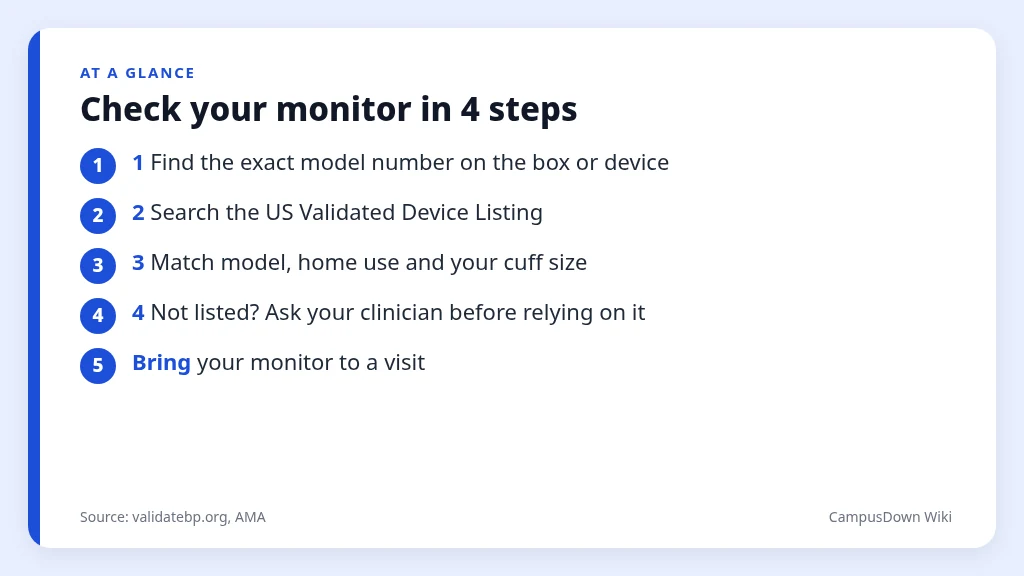
- Find the exact model number on the box or device (not just the brand or series name).
2. Go to validatebp.org, open the device list and search that model (choose home use if the site lets you filter). 3. Open the matching entry and confirm the details: the model, home use, the population it was validated for and the cuff size range. 4. Match the cuff to your arm. See the cuff size guide to measure.
If your exact model isn't there, it isn't confirmed as validated on this list. That doesn't prove the monitor is inaccurate, since listing is voluntary, but you can't rely on the list for it.
An example listing
Our guide to the Omron Platinum BP5450 notes the Validate BP listing shows "Platinum Upper Arm (HEM-7311) (BP5450)" for general adults with a 22-42 cm cuff, validated to the ANSI/AAMI/ISO 81060-2:2009 protocol. It's an example of the details to look for, not an endorsement. Also see the Omron Silver BP5250 guide.
Upper arm or wrist
The VDL includes upper-arm devices, wrist devices, kiosks and 24-hour ambulatory monitors, so a wrist device can be validated too. Our guide to upper arm vs wrist monitors explains why upper-arm monitors are usually preferred, and home measurement steps covers technique, which matters as much as the device.
Bring your monitor to your visit
A validated model can still read differently on your arm, or be used incorrectly. Bring your monitor to an appointment and have staff compare it with their device while you take a reading. Home readings help confirm patterns like white coat hypertension, and they're discussed against goals like those in blood pressure 130/80.
Using the list safely
- Use the list for which device, not for what your numbers mean; that's your clinician's role.
- Re-check the listing if you replace a monitor, even with the same brand.
- Keep the box, since the model number is on it.
- If readings seem off, call your doctor rather than adjusting medicines yourself.
Get help now if
Call 911 for chest pain, trouble breathing, sudden weakness, trouble speaking or severe headache with very high readings. Don't wait for a second reading or call a monitor accurate before getting help.
Example scenario: two boxes in the aisle
- Who
- Konstantin, 72, a retired bus mechanic in Buffalo, New York, stood in a pharmacy aisle with two boxes, one wrist monitor on sale and one upper-arm monitor. His wife, Zelda, 70, a retired hospital cafeteria manager, opened her phone to search.
- What happened
- His doctor wanted home readings for a month, and he had a stack of loose numbers from a neighbor's cuff that didn't match the clinic.
- How it felt
- Konstantin felt overwhelmed by the choices and annoyed that "validated" was printed on everything. Zelda felt she should be able to figure it out.
- What they did
- Zelda typed the model number from each box into the validatebp.org list. They found that one model was listed and the other wasn't. She measured his arm, checked the cuff range in the listing, and asked the pharmacist to confirm it fit. He later brought the monitor to his appointment and compared a reading with the nurse's.
- How it turned out
- Konstantin said the list turned a guessing game into a quick check. Zelda said she was glad they asked the pharmacist about the cuff.
This is an illustrative example, not a real patient or a review.
Konstantin's story is an illustrative example. Ask your clinician about the best device for you.
Most-asked questions about validated monitors
What are validated blood pressure monitors?
Devices listed after independent review as meeting criteria that include independent validation testing, an active FDA 510(k) clearance and tested cuff sizes.
Why people ask: "validated blood pressure monitors" is #1 for "validated blood pressure monitors" (US autocomplete, November 2026).
Where is a list of validated blood pressure monitors?
The US Validated Device Listing at validatebp.org, created by the AMA.
Why people ask: "validated blood pressure monitors list" is #2 for "validated blood pressure monitors" (US autocomplete, November 2026).
Are there validated blood pressure monitors for home use?
Yes; the listing includes home upper-arm and wrist devices. Check the exact model and cuff size.
Why people ask: "validated blood pressure monitors for home use" is #3 for "validated blood pressure monitors" (US autocomplete, November 2026).
Is there a validated blood pressure monitor list?
Yes, the VDL. Search by exact model number.
Why people ask: "validated blood pressure monitor list" is #1 for "validated blood pressure monitor list" (US autocomplete, November 2026).
Is there an FDA-approved blood pressure monitor list?
The VDL requires an active FDA 510(k) clearance, plus independent validation testing.
Why people ask: "fda approved blood pressure monitor list" is #3 for "validated blood pressure monitor list" (US autocomplete, November 2026).
What's the best validated blood pressure monitor?
There's no single best; it depends on your arm size and needs. Ask your clinician or pharmacist, and check the list.
Why people ask: "best validated blood pressure monitor" is #2 for "best blood pressure monitor validated" (US autocomplete, November 2026).
How do I know if my blood pressure monitor is validated?
Search your exact model number on validatebp.org and match the cuff range.
Why people ask: "how do i know if my blood pressure monitor is validated" is #10 for "validated blood pressure monitor list" (US autocomplete, November 2026).
Related on CampusDown
You can learn more about upper arm vs wrist monitors and check it for yourself with the cuff size guide.
Frequently asked questions
- Who runs the list?
- The AMA created it; an independent review committee decides which devices qualify.
- Does it cost anything?
- The AMA says there's no cost to submit devices or for the review, and the list is free to use.
- Is an unlisted monitor inaccurate?
- Not necessarily; listing is voluntary. Ask your clinician before relying on it.
- How many devices are listed?
- The AMA said 57 in 2023; check the site for the current count.
A two-minute lookup of your exact model and cuff size beats trusting a box. Then compare your monitor at a visit.
Browse more guides like this in the Home Medical Devices hub.
This article is for general education and does not replace advice from your own doctor, nurse or pharmacist.