
Wrist monitors are small, quick and easy to pack, so why do doctors keep telling people to buy the bulky arm cuff instead? The short answer is reliability. The longer answer explains why a wrist reading can change just by moving your hand a few inches.
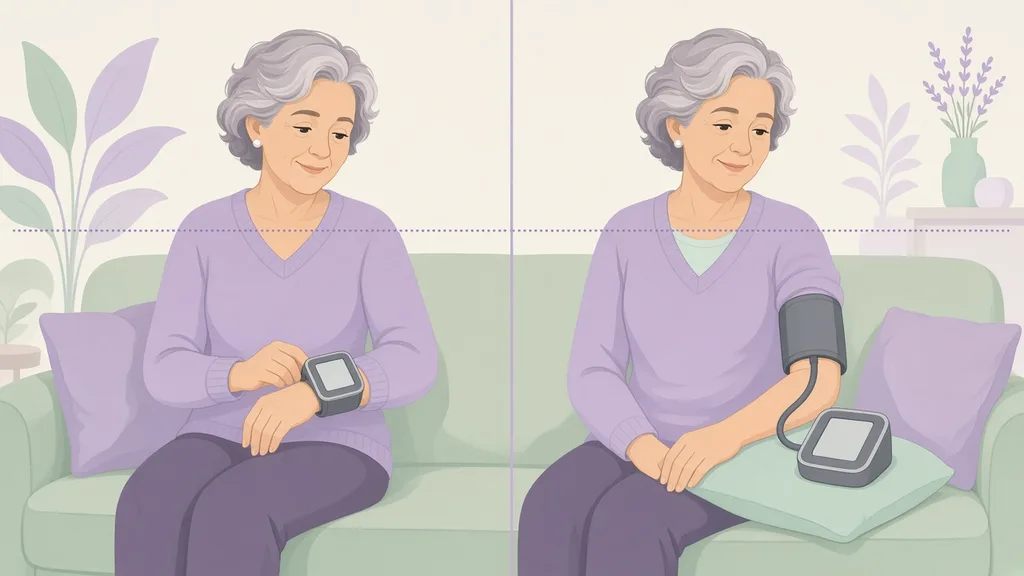
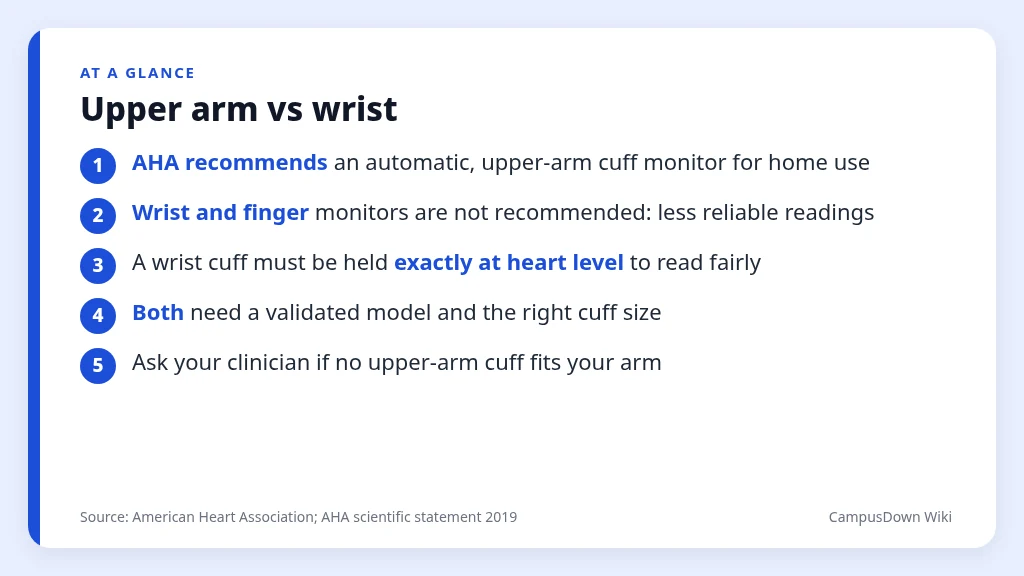
The American Heart Association (AHA) recommends an automatic, cuff-style, upper-arm (biceps) monitor for home use and says wrist and finger monitors are not recommended because they give less reliable readings. If you already own a wrist monitor, this guide will help you take a closer look at what that means for the numbers you have been writing down.
How the two types differ
An upper-arm monitor squeezes the brachial artery, the same place clinics usually measure. A wrist monitor squeezes the smaller arteries of the wrist. Both use automatic sensors to estimate pressure as the cuff deflates.
The biggest practical difference is position. Blood pressure readings change with the height of the cuff relative to the heart. An upper-arm cuff resting on a table sits close to heart level almost automatically. A wrist cuff needs the wrist held up at heart level every single time, and many people rest it on their lap instead. The AHA's scientific statement on measurement explains that a cuff below heart level reads higher than one at heart level.
Key point
The best monitor is the one that measures where your heart is. For most people that is an upper-arm cuff resting on a table, which is why it is the AHA's choice.

Example scenario: the wrist cuff in the purse
- Who
- Angela, 55, a real estate agent who drives between showings all day.
- What happened
- She bought a wrist monitor because it fit in her purse, and she checked it in the car with her hand in her lap. Her readings ran in the 150s, while her doctor's office kept getting the low 130s.
- How it felt
- She felt anxious and distrustful, unsure whether the office was rushing her or her body was failing during the workday.
- What they did
- At her next visit, a nurse watched her measure and showed her how far below heart level her wrist had been. Angela brought both her wrist monitor and a borrowed upper-arm monitor home and compared them correctly for a week.
- How it turned out
- Her upper-arm readings matched the clinic within a few points. She kept the upper-arm monitor at home for her log and stopped measuring in the car. Angela said she felt relieved that the scary numbers were a positioning problem, while still taking her borderline readings seriously.
This is an illustrative example, not a real patient or a review.
Angela's story is not that wrist monitors are useless. It is that they are easy to use wrong. Before you trust any number, set up a routine you can repeat exactly, as described in detail below.
When an upper-arm monitor is the right choice
For most adults, choose an upper-arm monitor when:
- You are tracking a diagnosis or a medicine change and your clinician will make decisions from the log.
- Your arm fits a cuff range. See the cuff size guide.
- You want readings that compare well with office measurements.
Look for a model on the validated device list. The Omron Platinum BP5450 is one example of a validated upper-arm home monitor.
If you use a wrist monitor anyway
Some people have arms that no available cuff fits, or physical reasons that make an arm cuff hard to use. Talk to your clinician first. If a wrist monitor is the agreed option:
- Choose a validated wrist model.
2. Sit with your back supported and feet flat; rest five minutes. 3. Hold or prop the wrist so the cuff is at heart level, exactly as the manual shows. 4. Keep the same arm, the same posture and the same times each day. 5. Bring the monitor to a visit so staff can compare it with an upper-arm reading.
The general routine is the same as in how to take blood pressure at home. If you are unsure which readings to trust, check it for yourself by comparing devices side by side at a clinic visit.
Most-asked questions about wrist monitors
Wrist vs upper arm: which is more accurate?
The American Heart Association recommends an automatic, cuff-style upper-arm monitor for home use and says wrist and finger monitors are not recommended because they give less reliable readings. A wrist monitor is a fallback for people whose arms cannot fit an upper-arm cuff, and only when a clinician agrees.
Why people ask: "wrist blood pressure monitor vs arm" is the #1 Google suggestion for "wrist blood pressure monitor vs", and "omron wrist vs upper arm" is #1 for "omron wrist vs" (US autocomplete, November 2026).
How do you use a wrist blood pressure monitor correctly?
Position is everything: the 2019 AHA scientific statement notes that a wrist device must be held at heart level to read correctly. Sit with your back supported and feet flat, rest your elbow on a table, and raise your wrist to the middle of your chest. Follow the same rest and timing routine you would use with an upper-arm cuff.
Why people ask: "wrist blood pressure monitor how to use" is the #1 suggestion for "wrist blood pressure monitor how to" (US, November 2026).
Are Omron wrist monitors accurate?
Accuracy depends on the exact model and on how you hold it. Look up your model number on the US Validate BP list, then bring the monitor to an appointment so your clinician can compare it with office readings. Our Omron Gold wrist BP4350 guide looks at one popular model in detail.
Why people ask: "omron wrist accuracy" is the #1 suggestion for "omron wrist review" (US, November 2026).
What does an error code on my wrist monitor mean?
Codes differ by brand, so the manual for your model is the only reliable decoder. Across home monitors, the usual causes are moving or talking during the reading, a loose cuff, or the wrist not held still at heart level. Rewrap, sit still and silent, and repeat. See blood pressure monitor error messages.
Why people ask: "wrist blood pressure monitor error 2" is the #1 suggestion for "wrist blood pressure monitor error" (US, November 2026).
If your wrist readings jump around, the fix is usually position, not a new device. Check it for yourself with one week of careful readings before deciding whether to switch to an upper-arm model.
When to call your clinician
Call if home readings and office readings disagree a lot, if readings are consistently above your target, or if you feel dizzy with low readings.
Get help now if
A reading higher than 180/120 that stays high after a second measurement needs a prompt call to your healthcare professional. With chest pain, shortness of breath, back pain, numbness, weakness, vision changes or difficulty speaking, call 911.
Related on CampusDown
Learn what readings mean in blood pressure of 130/80 and High Blood Pressure (Hypertension). If clinic and home readings never match, white coat hypertension explains one common reason.
Frequently asked questions
- Are wrist blood pressure monitors accurate?
- They can be accurate only when validated and used exactly at heart level. The AHA does not recommend them because readings are less reliable in everyday use.
- Why is my wrist reading higher than my arm reading?
- The most common cause is position. A wrist below heart level tends to read higher. Cuff fit and movement also matter.
- Is an upper-arm monitor better for seniors?
- The AHA recommends upper-arm monitors for adults generally, and advises choosing a device validated for older adults. Ask a pharmacist for help with fit and setup.
- Can I use either arm?
- Yes, the AHA says either arm can be used and the difference is usually small. Use the same arm consistently.
If you own a wrist monitor, you do not have to throw it away today, but your clinician's decisions deserve readings you can repeat exactly. Compare it against an upper-arm cuff at your next visit and learn more about validated models before you replace anything.
Browse more guides like this in the Home Medical Devices hub.
This article is for general education and does not replace advice from your own doctor, nurse or pharmacist.