
Does your blood pressure jump the moment someone in scrubs wraps the cuff around your arm? You are not imagining it. Many people read higher in a clinic than they do at home, and doctors have a name for it: white coat hypertension.
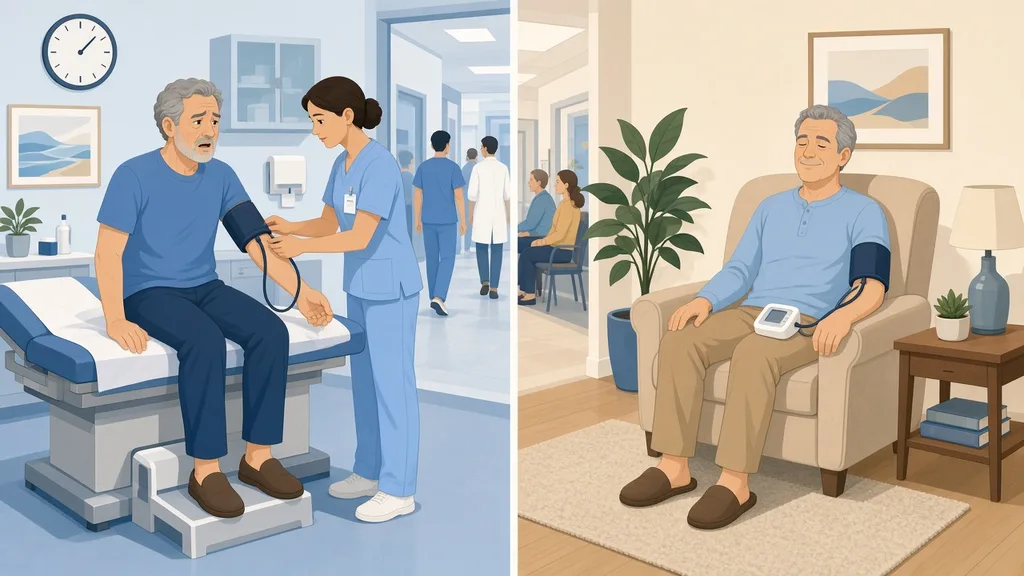
The term sounds like a diagnosis to brush off, but it is really a measurement question. Which number reflects your arteries on an ordinary Tuesday? US guidance now says the answer should come from readings taken outside the clinic. If your office and home numbers never seem to agree, this guide will help you take a closer look at why.
What white coat hypertension means
White coat hypertension is when blood pressure is high in a medical setting but normal when measured at home or during daily life. The opposite pattern also exists. Masked hypertension is when office readings look normal but home or ambulatory readings are high.
Both patterns matter because they change decisions. The US Preventive Services Task Force (USPSTF) recommends confirming high office readings with measurements outside the clinic before starting treatment. It names two methods: ambulatory blood pressure monitoring (ABPM), a cuff worn for 24 hours that measures automatically, and home blood pressure monitoring with a validated device.
Key point
The goal is not to prove the clinic wrong. It is to find the reading that matches your real daily life, so treatment is neither started too early nor missed.

Example scenario: the readings that never matched
- Who
- Marcus, 58, a bus driver who had skipped checkups for years.
- What happened
- At his annual physical the nurse measured 152/94 while he was still talking about traffic. His doctor mentioned medicine. At home that weekend, his wife's monitor showed 124/78.
- How it felt
- He felt confused and a little embarrassed, as if he had failed a test he did not understand. He also worried that the home monitor was the one telling the truth only because he wanted it to.
- What they did
- He brought both his home log and the monitor to a follow-up. His doctor checked the home device against the office one and ordered a 24-hour ambulatory monitor.
- How it turned out
- The 24-hour average was in the normal range, consistent with white coat hypertension. His doctor held off on medicine, asked him to keep checking at home, and scheduled regular rechecks. Marcus said that seeing the full day's numbers made him calmer at every later visit.
This is an illustrative example, not a real patient or a review.
The emotional part of Marcus's story is the most common one. People feel judged by a number taken in a rushed moment. Bringing your own monitor and log gives the conversation solid ground, and the steps further down show what makes a home log worth bringing in detail.
Why readings run higher in a clinic
Several everyday things raise a single reading:
- Hurrying from the parking lot or climbing stairs right before the measurement
- Talking during the reading, or sitting on an exam table with feet dangling
- An arm hanging down instead of supported at heart level
- A cuff placed over a sleeve, or the wrong cuff size
- Anxiety about the visit itself
Some of these are technique problems that a careful clinic avoids by letting you rest for five minutes first. Others are your body's real stress response, which is why the AHA categories are applied to averages, not single numbers.
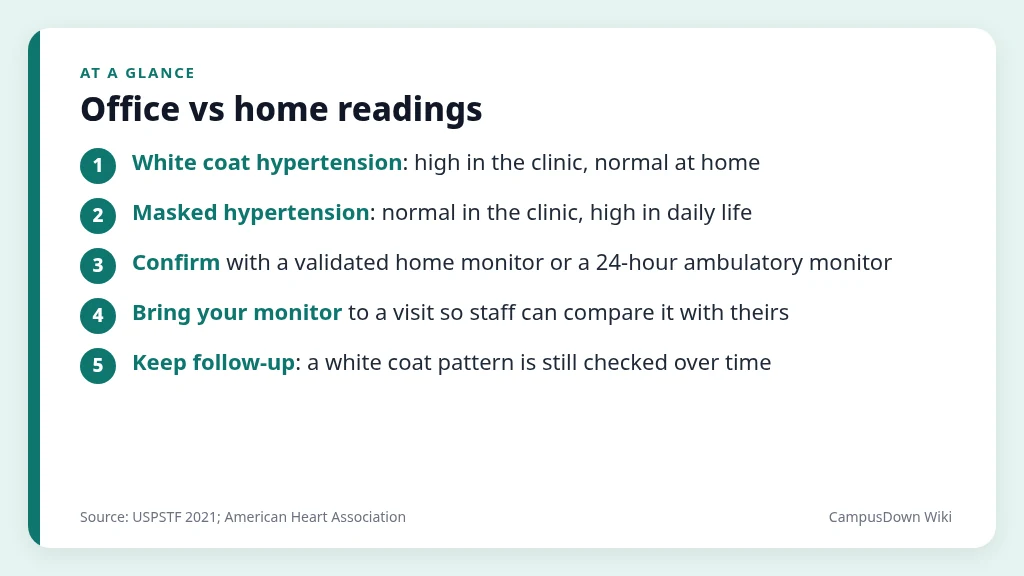
How to check whether it is white coat or real
- Use a validated upper-arm monitor with the right cuff, as described in the cuff size guide.
2. Follow the AHA routine: no caffeine, smoking or exercise for 30 minutes, five minutes of quiet rest, back supported, arm at heart level. 3. Take two readings one minute apart, morning and evening, for about a week. 4. Bring the monitor to your next visit so staff can compare it with the office device. 5. Ask whether a 24-hour ambulatory monitor makes sense, especially if home and office numbers differ a lot.
The full checklist is in how to take blood pressure at home. If you are shopping, the validated monitor list lets you check it for yourself before you spend money.
When to talk to your clinician sooner
White coat hypertension is not always harmless, and it can change over time. Your clinician may want regular rechecks, and some people later develop sustained high blood pressure.
Get help now if
Any reading higher than 180/120 that stays high after a second measurement needs a call to your healthcare professional. If it comes with chest pain, shortness of breath, back pain, numbness, weakness, vision changes or trouble speaking, call 911.
Do not stop or skip a prescribed blood pressure medicine because your home numbers look better. Share the log and decide together.
Related on CampusDown
Start with High Blood Pressure (Hypertension) for the condition itself. If clinic visits make you anxious in general, anxiety chest pain vs heart pain explains how the body's stress response shows up. Device choices are compared in upper arm vs wrist monitors, and nursing students can see the clinical side in mean arterial pressure.
Frequently asked questions
- Is white coat hypertension real or just nerves?
- It is a recognized pattern in which office readings are high but out-of-office readings are normal. Nerves can be part of it, but it is confirmed with home or 24-hour monitoring, not by guessing.
- Does white coat hypertension need treatment?
- Decisions depend on your out-of-office readings and overall risk. Many clinicians monitor it over time rather than starting medicine right away. Ask what follow-up schedule fits you.
- What is masked hypertension?
- It is the reverse: normal readings in the clinic but high readings at home or during the day. It can be missed unless out-of-office readings are checked.
- How long is a 24-hour blood pressure monitor worn?
- An ambulatory monitor is worn for about a day while you go about normal activities. It measures automatically at set intervals, including during sleep.
If your clinic numbers make your heart race every year, you are far from alone, and a calm week of home readings is the most useful thing you can bring to the next visit. Learn more about measuring the right way, then let your clinician compare your monitor with theirs before anyone decides on treatment.
Browse more guides like this in the U.S. Health Topics hub.
This article is for general education and does not replace advice from your own doctor, nurse or pharmacist.