
Is the Omron Silver the "basic" one, or is it basic enough to miss what you need? It's a mid-range upper-arm monitor with a wrap-around cuff, Bluetooth and a short memory, and it sits below the Platinum in Omron's lineup. Here's what the manual and the Validate BP list actually say.
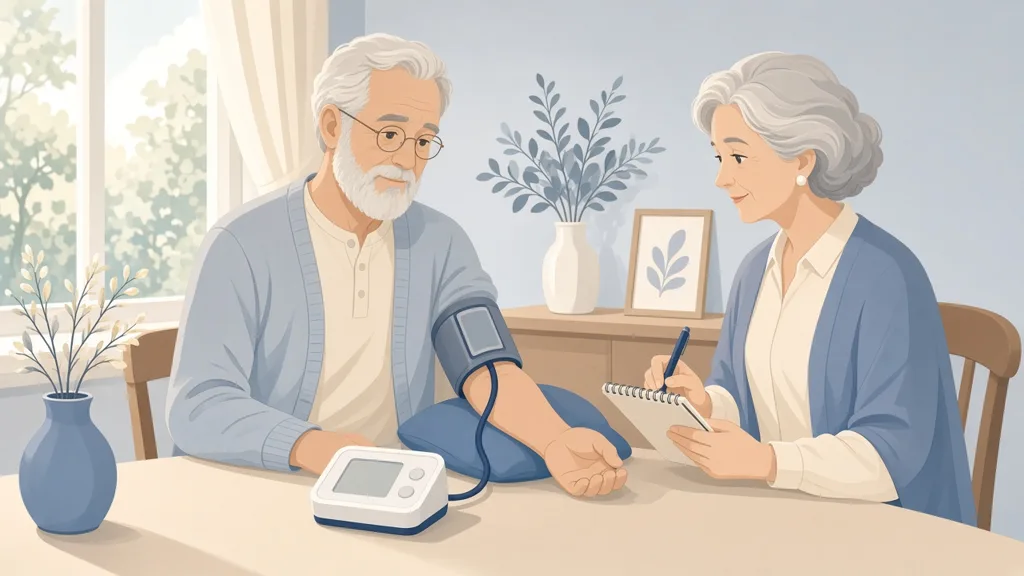
This guide uses Omron's BP5250 instruction manual and the US Validate BP device listing. We explain in detail what's in the box and how to use it. Ask your doctor or pharmacist whether a home monitor suits you and what your readings mean.
What it is
The manual describes the BP5250 as a digital monitor for measuring blood pressure and pulse in adults using the oscillometric method, which senses blood movement through the brachial artery and converts it into a reading. It detects the appearance of irregular heartbeats during measurement and gives a warning symbol. It can be used by multiple users.

Cuff size
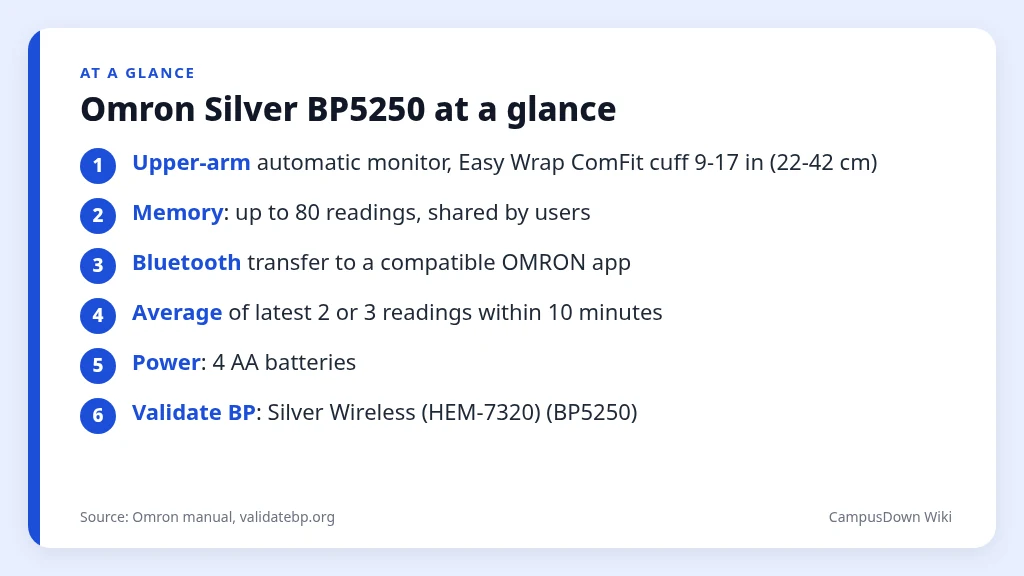
The box includes the Easy Wrap ComFit cuff, for upper arm circumference of 9 to 17 inches (22 to 42 cm). The manual says to use the cuff only on arms within the specified range and to use only the approved cuff, since other cuffs may give incorrect readings. Measure your arm first; see the cuff size guide. The optional replacement is the same size.
Features from the manual
- Memory: stores up to 80 readings; with several users, track your own readings. A sync symbol shows when memory is almost or completely full and says to transfer your readings before the oldest is deleted.
- Average: a symbol flashes when you view the average of the latest 2 or 3 readings taken within the most recent 10 minutes.
- Bluetooth: pair with a compatible OMRON app on a smart device to transfer readings and set the date and time automatically; check Omron's list of compatible devices.
- Irregular heartbeat symbol: appears when an irregular rhythm is detected 2 or more times; it's a prompt to talk with your doctor, not a diagnosis.
- Power: 4 AA batteries (about 1,000 measurements with new alkaline batteries), or an optional AC adapter.
- Specifications: blood pressure range of 60 to 260 mmHg systolic and 40 to 215 mmHg diastolic, pulse 40 to 180 beats per minute, and stated accuracy of plus or minus 3 mmHg for pressure.
The manual also includes the ACC/AHA 2017 category table: normal below 120/80, elevated 120-129 and below 80, stage 1 130-139 or 80-89, stage 2 140 or higher or 90 or higher. It warns: never diagnose or treat yourself based on your readings. For what the numbers mean, read blood pressure 130/80 and blood pressure targets for older adults.
Is it on the validated list?
The US Validate BP listing shows "Silver Wireless (HEM-7320) (BP5250)" for Omron, with adult cuffs 22 to 42 cm validated to ANSI/AAMI/ISO 81060-2:2009, listed for home use and for the general adult and pregnant populations. See how to check any model on the validated monitor list. The manual itself gives the monitor model as BP5250 / HEM-7151T-Z, so match the model on your box to the listing and ask the pharmacist if the numbers differ.
Silver vs Platinum
Based on the manuals, the Omron Platinum BP5450 covers the same 9-17 inch range but lists memory for two users with up to 100 readings each, a guest mode and an optional TruRead mode that averages three readings. The Silver stores up to 80 readings shared across users and shows an average of the latest 2 or 3 readings within 10 minutes. For two people sharing a monitor, separate memories can matter; for one person, the difference may not.
Measuring correctly
The manual's tips: measure in a quiet place at the same times each day (morning and evening is recommended), avoid measuring during stressful times, avoid bathing, alcohol, caffeine, smoking and exercise before measuring, and remember that a single measurement doesn't give an accurate indication of your true blood pressure; take and record several readings over time. Walk through the routine in home blood pressure measurement steps. If your readings are higher at the doctor's office, ask about white coat hypertension. For why upper-arm monitors are preferred over wrist ones, see upper arm vs wrist monitors.
Safety notes from the manual
Don't use it on an arm with an intravenous drip, keep it away from phones and other electronics within about 12 inches (30 cm), and turn off Bluetooth on aircraft and in hospitals. Don't inflate the cuff unless it's on your upper arm, and remove the cuff if it doesn't start deflating.
Get help now if
Call 911 for chest pain, trouble breathing, sudden weakness, trouble speaking or severe headache with very high readings. Don't wait for a second reading.
Example scenario: the buying decision
- Who
- Fitzgerald, 73, a retired ironworker in Pittsburgh, Pennsylvania, stood in a pharmacy with a doctor's note asking for home readings. His wife, Camille, 71, a retired elementary school secretary, read the box while he held another model.
- What happened
- His doctor had asked for readings every morning and evening for two weeks, and his old cuff was a wrist model that gave different numbers every time.
- How it felt
- Fitzgerald felt overwhelmed by the choices and worried he'd waste money. Camille felt it was her job to make sure he used it right.
- What they did
- Camille measured his arm, saw it fit the 9-17 inch range, and checked the model number against the Validate BP list on her phone. They asked the pharmacist about the cuff and paired it with the app. At the appointment, he brought it to compare against the office reading.
- How it turned out
- Fitzgerald said the checklist made the shelf less confusing. Camille said the notebook and the app together kept his two weeks of numbers in one place.
This is an illustrative example, not a real patient or a review.
Fitzgerald's story is an illustrative example. Ask your clinician which monitor fits you.
Most-asked questions about the Omron Silver BP5250
What is the Omron Silver blood pressure monitor?
A wireless upper-arm automatic monitor, model BP5250, with a 9-17 inch cuff and 80-reading memory, per the manual.
Why people ask: "omron silver blood pressure monitor" is #1 for "omron silver" (US autocomplete, November 2026).
What is the Omron Silver BP5250?
The BP5250 is Omron's Silver upper-arm monitor with Bluetooth transfer to a compatible app and irregular heartbeat detection.
Why people ask: "omron silver bp5250" is #3 for "omron silver" (US autocomplete, November 2026).
How does Omron Silver compare with gold and platinum?
We compare it to the Platinum BP5450 above from the manuals; check each manual for the model you're considering.
Why people ask: "omron silver vs gold vs platinum" is #1 for "omron silver vs gold vs platinum" (US autocomplete, November 2026).
Omron Silver vs Platinum?
The Platinum BP5450 lists two-user memory with 100 readings each and a TruRead mode; the Silver stores 80 shared readings.
Why people ask: "omron silver vs platinum" is #10 for "omron silver" (US autocomplete, November 2026).
Where can I read Omron Silver BP5250 reviews?
We don't rate products; we summarize the manual and validation listing. Ask your pharmacist or clinician about options.
Why people ask: "omron silver bp5250 reviews" is #3 for "omron silver bp5250" (US autocomplete, November 2026).
Where do I buy the Omron Silver BP5250?
Use a reputable seller and match the model number on the box to the listing. Ask your pharmacist.
Why people ask: "where to buy omron silver bp5250" is #7 for "omron silver bp5250" (US autocomplete, November 2026).
Related on CampusDown
You can learn more about the Platinum BP5450 and check it for yourself with the validated list.
Frequently asked questions
- What arm size fits?
- 9 to 17 inches (22 to 42 cm).
- How many readings does it store?
- Up to 80, per the manual.
- Does it need an app?
- No; it works without a smart device, and Bluetooth is optional.
- Is it validated?
- Validate BP lists Silver Wireless (HEM-7320) (BP5250) for adults with a 22-42 cm cuff.
A validated monitor in the right cuff size, used the same way each day, gives you readings your doctor can use. Compare it at your next visit.
Browse more guides like this in the Home Medical Devices hub.
This article is for general education and does not replace advice from your own doctor, nurse or pharmacist.