
Ten minutes into a unit of blood, your patient says she feels chilly and her back hurts. Her heart rate is up. What do you do, and in what order?
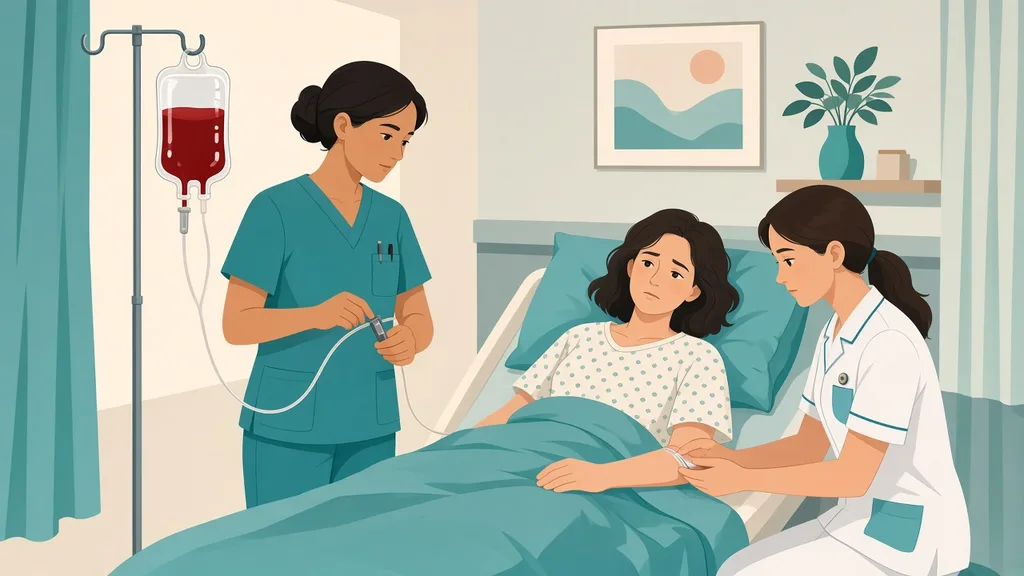
Transfusion reactions are rare and urgent, and the order of your actions is what exams and units test. This guide follows OpenStax's Medical-Surgical Nursing 16.7 (Blood Products and Transfusion Principles) and Clinical Nursing Skills 13.4 (Blood Transfusions), with MedlinePlus's article on hemolytic transfusion reactions. It is a study aid, not a protocol; facility policy and the provider's orders decide what you do. If you want to learn more about report structure, take a closer look at SBAR handoff.
Why the first 15 minutes matter
OpenStax says the most critical cues for a nurse are a reaction within the first 15 minutes of a transfusion; most reactions happen in that window. That's why the nurse starts the infusion slowly, stays at the bedside for the first 15 minutes (or longer per policy), then retakes and documents vital signs before the rate is increased per policy. OpenStax also teaches checking baseline vital signs before starting, so changes are clear, and having two nurses verify the provider's order and match the blood product label to the patient's blood bank bracelet. For the "right" checks, see rights of medication administration.

Actions in order
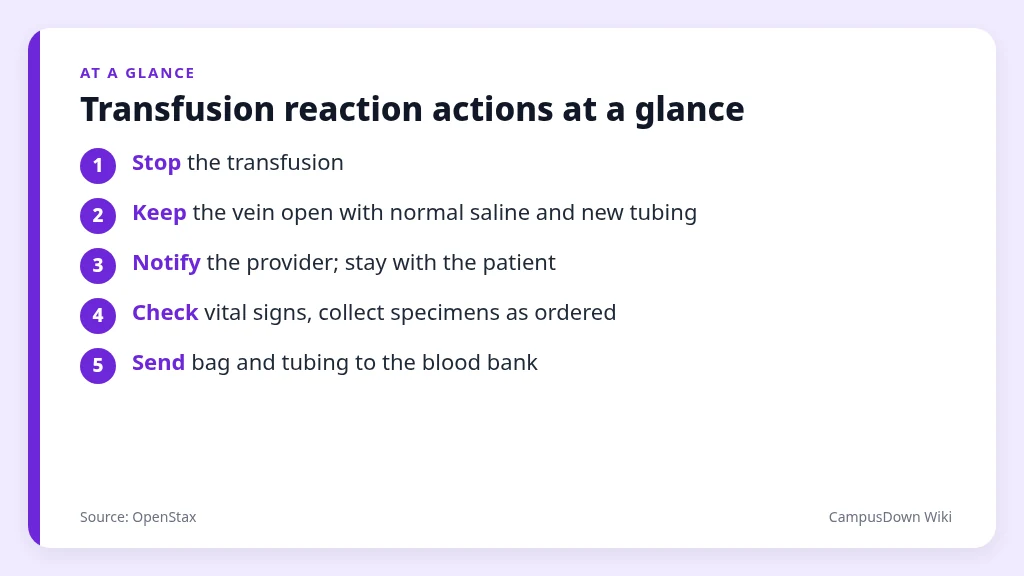
OpenStax lists the steps when a reaction is occurring:
- Stop the transfusion.
2. Disconnect the blood tubing and flush the patient's IV with normal saline. 3. Prime new IV tubing with normal saline and infuse at a lowered rate to keep the vein open (OpenStax gives about 20 mL/h; follow your orders and policy). 4. Notify the provider. 5. Monitor vital signs and remain with the patient. 6. Prepare to collect blood and urine specimens for the lab. 7. Send the used blood bag and IV tubing to the blood bank for testing.
OpenStax's Clinical Nursing Skills chapter adds: if the patient is short of breath, sit the patient upright and start oxygen, check vital signs every 15 minutes and be ready for emergency medicines as ordered. Document what you saw and did.
Get help now if
If a patient getting blood has chills, fever, back or flank pain, shortness of breath, chest pain, hives, flushing, a falling blood pressure or new confusion, stop the transfusion per policy and call for the nurse or rapid response immediately. Stay with the patient.
Types of reactions
OpenStax's list:
| Type | Key idea | |
|---|---|---|
| Febrile nonhemolytic | Most common; temperature rises about 1 degree over baseline; usually acetaminophen, then the provider decides about continuing | |
| Allergic | Reaction to donor proteins; mild itching to rare anaphylaxis; diphenhydramine often relieves mild cases | |
| Acute hemolytic | Usually an administrative mistake causing an ABO mismatch; back pain, chills, fever, low blood pressure, shock, hemoglobin in the urine | |
| Delayed hemolytic | Later than 15 minutes; similar symptoms to other reactions | |
| Septic | Contaminated product (especially platelets); high fever, chills, hypotension, fast heart rate | |
| Transfusion-related lung injury | Respiratory distress, shortness of breath, rales | |
| Circulatory overload (TACO) | Shortness of breath, coarse lung sounds, widespread edema; patients with heart failure may get a diuretic such as furosemide | furosemide |
OpenStax's Clinical Nursing Skills chapter also sorts reactions as mild (such as fever, itching, rash), moderate (more pronounced symptoms like significant shortness of breath or fever) and severe (severe respiratory distress, shock, renal failure, severe hemolysis or cardiovascular collapse). In all cases it says to stop the transfusion and notify the provider; the provider decides if mild reactions can continue with treatment and close monitoring.
Cues by body system
OpenStax's table lists:
- Neurologic: dizziness, anxiety, localized pain; disorientation if shock develops
- Skin: flushing, itching, hives, chills; edema in fluid overload
- Respiratory: wheezing, shortness of breath
- Cardiac: fast heart rate, low blood pressure, shock
- GI: nausea, abdominal pain
- GU and renal: dark or blood-tinged urine, lower back pain
Listen to the chest with the lung sounds guide and review fluid cues in the fluid volume guide. For septic cues, see sepsis recognition and types of shock.
What MedlinePlus says about hemolytic reactions
MedlinePlus says a hemolytic transfusion reaction occurs when the red blood cells given are destroyed by the person's immune system, and that blood between incompatible groups causes a more severe reaction. Symptoms may include back pain, bloody urine, chills, fainting or dizziness, fever, flank pain and flushing, most often during or right after the transfusion, but sometimes days later (delayed). Treatment: the transfusion must be stopped right away, and blood from the recipient and donor is tested. Complications can include kidney failure, anemia, lung problems and shock. Prevention includes ABO and Rh typing, cross-matching and checking again that the right blood is being given.
Documentation and handoff
Record the baseline and ongoing vital signs, time of the first symptoms, the actions in order, who was notified, specimens sent and the patient's response. Use a structured report; see nursing charting basics and SBAR.
Study tips
- Memorize the order: stop, keep the vein open with saline, notify, monitor, specimens, return the bag.
- Know that most reactions occur in the first 15 minutes, and why you stay.
- Link each type to its main cue: fever, itching, back pain with dark urine, shortness of breath.
- Practice saying the first sentence of your report out loud.
Questions for your instructor
- What is our unit's exact stop-and-flush procedure?
- Who is called first for a suspected reaction?
- How often do we check vital signs during a transfusion?
- How do we label and send specimens and the bag?
- How do exam questions rank the types of reaction?
Example scenario: the first fifteen minutes
- Who
- Fenwick, 28, a nursing student in Omaha, Nebraska, was observing a unit of blood run when the patient said she felt chilly and had a pain in her lower back.
- What happened
- He saw her heart rate was higher than at baseline and wondered if he should interrupt his preceptor.
- How it felt
- He felt his pulse quicken too.
- What they did
- He told the nurse right away; she stopped the transfusion, started saline at the keep-open rate, called the provider and the blood bank steps followed. Fenwick wrote the sequence on a card.
- How it turned out
- Fenwick said knowing the order made his hands steady.
This is an illustrative example, not a real patient or a review.
Fenwick's story is an illustrative example. Real situations follow your instructor, your facility and the provider's orders.
Most-asked questions about transfusion reactions in nursing
What are the nursing interventions for a transfusion reaction?
Stop the transfusion, keep the vein open with new tubing and saline, notify the provider, monitor vital signs and stay with the patient.
Why people ask: "blood transfusion reaction nursing interventions" is #1 for "blood transfusion reaction nursing" (US autocomplete, November 2026).
What is nursing management of a transfusion reaction?
The same ordered steps, plus specimens, returning the bag and tubing to the blood bank, and documentation.
Why people ask: "blood transfusion reaction nursing management" is #2 for "blood transfusion reaction nursing" (US autocomplete, November 2026).
What are the nursing responsibilities for a transfusion reaction?
Verify, check baseline vitals, stay for the first 15 minutes, recognize cues, act, report and document.
Why people ask: "blood transfusion reaction nursing responsibilities" is #5 for "blood transfusion reaction nursing" (US autocomplete, November 2026).
What are the nursing actions in a transfusion reaction?
Stop, flush with saline and keep the vein open, notify the provider, monitor, collect specimens, send the bag.
Why people ask: "blood transfusion reaction nursing actions" is #6 for "blood transfusion reaction nursing" (US autocomplete, November 2026).
What are the steps for a transfusion reaction?
See the numbered list above, in that order.
Why people ask: "blood transfusion reaction nursing steps" is #7 for "blood transfusion reaction nursing" (US autocomplete, November 2026).
What are the signs and symptoms of a transfusion reaction?
Fever, chills, back or flank pain, flushing, hives, shortness of breath, dark urine, fast heart rate and low blood pressure.
Why people ask: "blood transfusion reaction signs and symptoms" is #2 for "blood transfusion reaction signs" (US autocomplete, November 2026).
What do vital signs show in a transfusion reaction?
A higher temperature, faster heart rate or breathing and sometimes lower blood pressure compared with baseline.
Why people ask: "blood transfusion reaction vital signs" is #6 for "blood transfusion reaction signs" (US autocomplete, November 2026).
What are delayed transfusion reaction symptoms?
MedlinePlus says symptoms of a hemolytic reaction can appear after several days; OpenStax says delayed reactions have similar symptoms.
Why people ask: "delayed blood transfusion reaction symptoms" is #9 for "blood transfusion reaction signs" (US autocomplete, November 2026).
Related on CampusDown
You can learn more about the nursing student hub and check it for yourself in the sepsis recognition guide. For handoff in detail, see SBAR handoff.
Frequently asked questions
- What is the first step in a suspected reaction?
- Stop the transfusion.
- Why do we keep the IV open?
- To maintain access for emergency medicines and fluids, using new tubing with normal saline.
- When do most reactions occur?
- Within the first 15 minutes, per OpenStax.
- Where do the blood bag and tubing go?
- To the blood bank for testing.
- Can mild reactions continue the transfusion?
- Only if the provider decides after treatment, with close monitoring.
A transfusion reaction is an emergency where the order of actions matters: stop, keep the vein open, notify, monitor and send the bag. Stay with the patient and speak up early.
Browse more guides like this in the Nursing Student and NCLEX hub.
This article is for general education and does not replace advice from your own doctor, nurse or pharmacist.