
You glance down in the toilet and the water is pink. There's no pain, no fever, nothing else. Do you wait a day or two to see if it goes away?
This guide uses MedlinePlus (the encyclopedia article "Urine - bloody," reviewed July 1, 2025) and NIDDK's hematuria page. It is general information, not a diagnosis; a clinician needs to find the reason. If you want to learn more about one of the most common causes, take a closer look at kidney stones.
What hematuria means
Hematuria means there is blood in your urine. NIDDK describes two types: gross hematuria, when you can see the blood, and microscopic hematuria, when you can't see it but it shows up under a microscope or on a urine test called a urinalysis. Gross hematuria makes urine look pink, red or brown, and it takes only a small amount of blood to change the color. NIDDK says in most cases gross hematuria does not cause pain or other symptoms, though clots can cause bladder or back pain or block urine flow. Microscopic hematuria doesn't change the color of the urine and typically has no symptoms, so it is often found during a routine exam. NIDDK says researchers estimate that at least 1 out of 5 people evaluated by a urologist is diagnosed with hematuria.

Common causes
MedlinePlus lists many possible causes:
- Infection of the bladder, kidney, prostate or urethra (see cystitis).
- Inflammation of the bladder, urethra, prostate or kidney (including glomerulonephritis).
- Kidney or bladder stones (see kidney stones).
- Injury to the bladder or kidney.
- Cancer of the bladder or kidney (NIDDK also lists prostate cancer).
- Kidney failure and polycystic kidney disease (see chronic kidney disease).
- A recent urinary procedure such as catheterization, circumcision, surgery or kidney biopsy.
- Bleeding disorders (such as hemophilia), blood clots in the kidneys, sickle cell disease and low platelets.
- Blood thinning medicines such as aspirin or warfarin (see low-dose aspirin).
NIDDK adds that you're more likely to have hematuria with an enlarged prostate (BPH), urinary tract stones, certain medicines (blood thinners, antibiotics, aspirin or other pain relievers), strenuous exercise such as long-distance running and a recent bacterial or viral infection; see finasteride for a BPH medicine.
What can look like blood in the urine
MedlinePlus says blood that looks like it's in the urine may come from the vagina in women, from ejaculation in men (often due to a prostate problem) or from a bowel movement, and urine can turn red from certain medicines, beets or other foods. Your provider may ask whether you ate beets, berries or rhubarb. Ask your provider to test the urine to confirm.
When to call
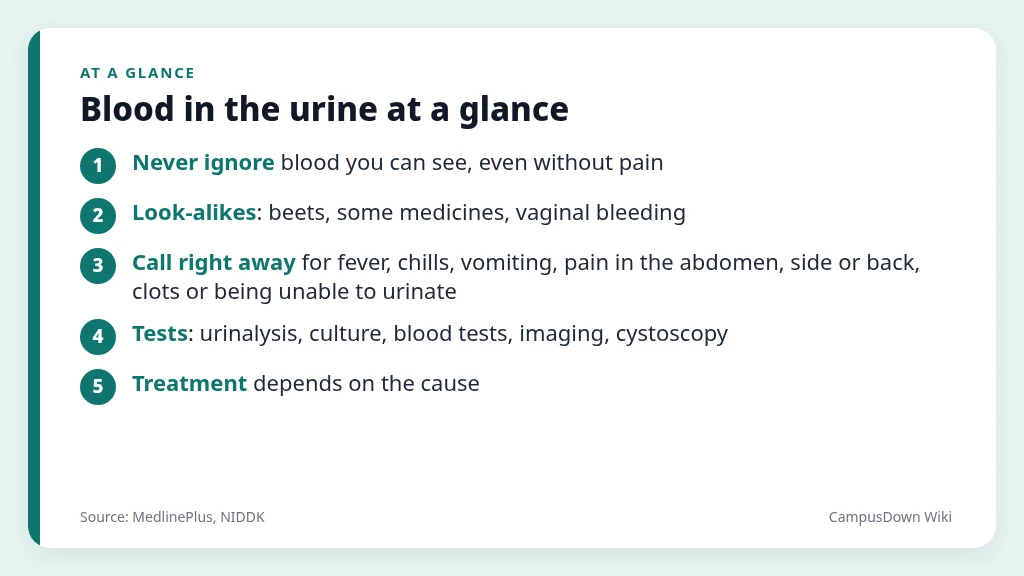
MedlinePlus says: "Never ignore blood you see in your urine. Get checked by your provider," especially if you also have discomfort with urination, frequent urination, urgent urination or unexplained weight loss.
Get help now if
Contact your provider right away for fever, nausea, vomiting, shaking chills or pain in your abdomen, side or back, if you are unable to urinate or if you are passing blood clots in your urine. Also contact your provider for pain with sexual intercourse or heavy menstrual bleeding, or for urinary dribbling, nighttime urination or trouble starting your flow, which MedlinePlus says may point to a prostate problem.
What happens at the visit
Your provider will examine you and ask when you first noticed the blood, whether the amount of urine has changed, the urine color and odor, pain, how often you urinate, which medicines you take, past kidney or urinary problems, recent surgery or injury, and recent foods. MedlinePlus says tests may include urinalysis, urine culture, urinary cytology, blood tests (including creatinine, a complete blood count and clotting tests such as PT, PTT or INR), abdominal ultrasound, CT scan, cystoscopy, kidney biopsy, a strep test, an antinuclear antibody test for lupus and tests for sickle cell. The treatment will depend on the cause of the blood in the urine.
Questions for your doctor
- What are the most likely causes in my case?
- Which tests do I need first, and do I need a specialist such as a urologist?
- Do any of my medicines or supplements matter?
- What symptoms should send me to urgent care?
- When should we recheck my urine?
Example scenario: the pink water
- Who
- Eustace, 58, a retired bus driver in Tucson, Arizona, saw pink in the toilet bowl one morning with no pain.
- What happened
- He decided it was probably beets from dinner and put off calling.
- How it felt
- Three days later it happened again, and he felt anxious and embarrassed to bring it up.
- What they did
- He called his primary care office, mentioned the blood thinner he takes and the urine color and was scheduled for a urine test and a referral to a urologist. Eustace brought a list of his medicines and notes on when it happened.
- How it turned out
- Eustace said making the call felt less scary than waiting and imagining the worst.
This is an illustrative example, not a real patient or a review.
Eustace's story is an illustrative example. Never ignore blood you can see in your urine; call your clinician.
Most-asked questions about blood in the urine
What causes blood in the urine in men?
The same causes apply to men and women, and an enlarged prostate, prostate infection and prostate cancer are also listed; see your provider for tests.
Why people ask: "blood in urine male" is #2 for "blood in urine" (US autocomplete, November 2026).
What causes blood in the urine in women?
Infection, stones, kidney problems and other causes apply to everyone; blood from the vagina can also look like blood in the urine.
Why people ask: "blood in urine female" is #3 for "blood in urine" (US autocomplete, November 2026).
What does blood in the urine mean for a woman without pain?
NIDDK says gross hematuria usually causes no pain, so lack of pain doesn't rule out a cause; see your provider.
Why people ask: "blood in urine female no pain" is #4 for "blood in urine" (US autocomplete, November 2026).
Does a UTI cause blood in the urine?
Infection of the bladder, kidney, prostate or urethra is a listed cause; a urine culture and urinalysis can help check.
Why people ask: "blood in urine uti" is #5 for "blood in urine" (US autocomplete, November 2026).
What are the causes of blood in the urine?
Infection, inflammation, stones, injury, enlarged prostate, kidney disease, bleeding problems, blood thinners and cancer.
Why people ask: "blood in urine causes" is #6 for "blood in urine" (US autocomplete, November 2026).
What is the medical term for blood in the urine?
Hematuria; it can be visible (gross) or found only on testing (microscopic).
Why people ask: "blood in urine medical term" is #7 for "blood in urine" (US autocomplete, November 2026).
What does blood in the urine without pain mean in men?
Gross hematuria usually causes no pain; MedlinePlus lists an enlarged prostate, stones, infection and cancer among causes, so get checked.
Why people ask: "blood in urine male no pain" is #8 for "blood in urine" (US autocomplete, November 2026).
What does blood in the urine with pain in women mean?
Pain in the abdomen, side or back with fever, chills or vomiting needs same-day care; clots can also cause pain; infection and stones are listed causes.
Why people ask: "blood in urine female with pain" is #10 for "blood in urine" (US autocomplete, November 2026).
Can blood in the urine happen without a period?
Blood that looks like it's in the urine may be vaginal bleeding; the sources here don't discuss cycles, so talk to your provider about the source.
Why people ask: "blood in urine female no pain no period" is #2 for "blood in urine female no pain" (US autocomplete, November 2026).
What are the causes of painless blood in the urine in women?
The same list applies; MedlinePlus says never to ignore visible blood.
Why people ask: "blood in urine female no pain causes" is #3 for "blood in urine female no pain" (US autocomplete, November 2026).
What does blood in the urine that is not visible mean?
That is microscopic hematuria, found only on a urine test and typically without symptoms.
Why people ask: "blood in urine female no pain not visible" is #5 for "blood in urine female no pain" (US autocomplete, November 2026).
Can menopause cause blood in the urine?
The sources here don't link menopause to hematuria; blood from the vagina can look like urine blood, so ask your clinician to find the source.
Why people ask: "blood in urine female no pain menopause" is #6 for "blood in urine female no pain" (US autocomplete, November 2026).
Can there be blood in the urine without a UTI?
Yes; stones, kidney disease, bleeding disorders, blood thinners and cancer are also listed causes.
Why people ask: "blood in urine female no pain no uti" is #7 for "blood in urine female no pain" (US autocomplete, November 2026).
Can there be blood in the urine without an infection?
Yes; many non-infectious causes are listed, so get checked.
Why people ask: "blood in urine female no pain no infection" is #8 for "blood in urine female no pain" (US autocomplete, November 2026).
Does pregnancy cause blood in the urine?
The sources here don't discuss pregnancy; blood in the urine always needs a clinician's check.
Why people ask: "blood in urine female no pain pregnancy" is #9 for "blood in urine female no pain" (US autocomplete, November 2026).
Is blood in the urine with frequent urination serious?
MedlinePlus says to get checked when visible blood comes with frequent or urgent urination, which can point to infection or a prostate problem.
Why people ask: "blood in urine female no pain frequent urination" is #10 for "blood in urine female no pain" (US autocomplete, November 2026).
Related on CampusDown
You can learn more about the health topics hub and check it for yourself in dehydration in older adults. For bladder trouble in detail, see urinary incontinence, and for a medicine used for an enlarged prostate see finasteride.
Frequently asked questions
- Is blood in the urine always serious?
- Not always, but MedlinePlus says never to ignore blood you can see; get it checked.
- Can it happen without pain?
- Yes; NIDDK says gross hematuria usually has no pain.
- What can look like blood in the urine?
- Beets, some medicines, vaginal bleeding, ejaculation or blood from a bowel movement.
- When is it urgent?
- With fever, chills, vomiting, pain in the abdomen, side or back, clots or inability to urinate.
- What tests are done?
- Urinalysis, culture, blood tests, ultrasound, CT, cystoscopy and sometimes more.
Blood in the urine has many causes, from infections and stones to prostate problems, blood thinners and cancer, and it often doesn't hurt. Don't ignore blood you can see: call your clinician, get tested and seek urgent care for fever, chills, vomiting, pain or clots.
Browse more guides like this in the U.S. Health Topics hub.
This article is for general education and does not replace advice from your own doctor, nurse or pharmacist.