
Your smartwatch says your resting heart rate is 54 this morning, and 88 yesterday. Is either number a problem? And how do you know the watch is right?

A resting heart rate has a wide normal range, and the numbers on your wrist deserve some context. This guide uses MedlinePlus's pulse article, the American Heart Association's heart rate page (reviewed May 2024) and Mayo Clinic's heart rate overview (October 2025). It is general education, not a diagnosis; if a very fast or very slow heartbeat comes with chest pain, shortness of breath, dizziness or fainting, call 911. To learn more about night-time awareness of your heartbeat, take a closer look at heart palpitations at night.
What "resting" means
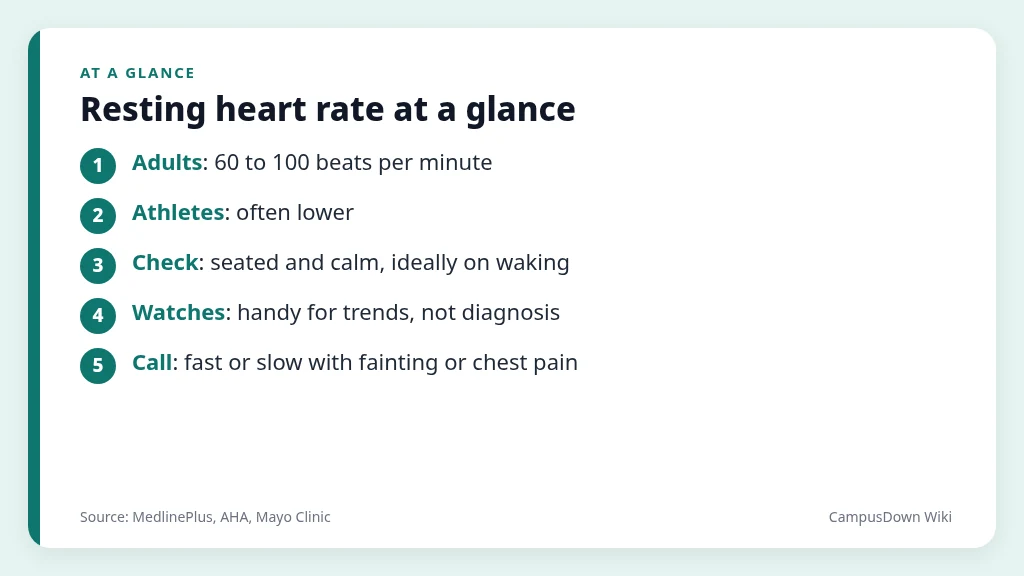
Mayo says your resting heart rate is the number of times your heart beats each minute while you are awake, calm and not moving, and that the best time to check is when you get up in the morning. MedlinePlus says to be at rest for at least 10 minutes before you measure.

Normal ranges
MedlinePlus lists resting heart rates:
- Children 10 and older, and adults (including seniors): 60 to 100 beats per minute
- Well-trained athletes: 40 to 60 beats per minute
- Newborns (0 to 1 month): 70 to 190
- Infants (1 to 11 months): 80 to 160
- Children 1 to 2 years: 80 to 130
- Children 3 to 4 years: 80 to 120
- Children 5 to 6 years: 75 to 115
- Children 7 to 9 years: 70 to 110
The AHA and Mayo give the same adult range, 60 to 100. None of these sources gives a separate normal range for women and men; ask your clinician if you wonder about your own number.
Why yours may be higher or lower
The AHA says a rate under 60 (bradycardia) doesn't always signal a medical problem: it can result from a medicine such as a beta blocker, and is common in athletes, and the heart rate may be lower while sleeping. A rate over 100 (tachycardia) isn't always a problem either and may be a sign of another, temporary condition. The AHA and Mayo list factors that change heart rate, including:
- temperature (a higher body temperature raises it)
- emotions and stress, and pain
- body size and fitness
- medicines, such as beta blockers and calcium channel blockers, which can slow it
- posture (it can rise a little when you first stand)
- smoking, diabetes and heart or blood vessel disease
MedlinePlus adds that a fast pulse may signal an infection or dehydration.
How to check by hand
Mayo and MedlinePlus say to find your pulse at the wrist (inside the wrist, below the thumb) or the side of the neck and count the beats. Count for 60 seconds, or count for 15 seconds and multiply by four, or 30 seconds and multiply by two. When using the neck, MedlinePlus says to sit or lie down, press gently and never check both sides at once, because pressure can slow the heartbeat or cause fainting.
What smartwatches show
Wearables typically show resting heart rate and make it easy to track, but Mayo says they may not always be accurate, and that some devices are better than others. A research paper on wearable optical sensors found that different devices were reasonably accurate at resting heart rate, that absolute error during activity was about 30% higher than at rest, and that devices differed in how well they respond to changes in activity.
Practical takeaways:
- Use trends, such as your usual range over weeks, rather than a single reading.
- Compare with a hand count when a number surprises you.
- Wear it snugly and check at rest.
- Don't diagnose from a watch; if you feel unwell, trust the symptoms and call a clinician.
Fast heart rates with symptoms
MedlinePlus says to talk with your provider if resting rates are continually high or below the normal values, and that a very firm (bounding) pulse lasting more than a few minutes or an irregular pulse should also be checked. The AHA says to call 911 if your heart rate is suddenly very high or very low for you, especially with chest pain, shortness of breath, dizziness or fainting. For irregular rhythm questions, see atrial fibrillation and ECG rhythm basics; for chest symptoms, see anxiety chest pain vs heart pain.
Get help now if
Call 911 for a suddenly very fast or very slow heartbeat with chest pain, trouble breathing, fainting or confusion. Don't wait for a watch alert to confirm it.
When to talk to a clinician
- Your resting rate is regularly above 100, per Mayo
- It is often below 60 and you aren't a trained athlete, per Mayo
- You feel weak, dizzy or faint
- You take a beta blocker and have been asked to track your pulse; the AHA says to ask when and how often to log it
- Your watch shows an unexpected change that persists
Questions to bring to your appointment
- What is a normal resting heart rate for me given my medicines and fitness?
- Could any of my medicines raise or lower it?
- Should I track it, and how often?
- Is my watch accurate enough, or should I check by hand?
- What numbers or symptoms mean I should call right away?
Example scenario: the watch alert
- Who
- Gus, 45, a high school coach in Kansas City, Missouri, saw his watch show a resting heart rate in the low 50s and worried he had a heart problem.
- What happened
- He ran several times a week and had just started a new medicine.
- How it felt
- He felt anxious and unsure whether to ignore it or call.
- What they did
- He checked his pulse by hand, noted that he felt fine, wrote down the numbers for a week and called his clinician with his medicine list. His clinician reviewed his fitness and medicines and told him what to watch for.
- How it turned out
- Gus said knowing what was normal for him took the panic out of the number.
This is an illustrative example, not a real patient or a review.
Gus's story is an illustrative example. Your own numbers are interpreted by your clinician.
Most-asked questions about resting heart rate
What is a normal resting heart rate for women?
The sources used here give 60 to 100 beats per minute for adults, without separate ranges by sex; ask your clinician about your own number.
Why people ask: "normal resting heart rate for women" is #2 for "normal resting heart rate" (US autocomplete, November 2026).
What is a normal resting heart rate for men?
The same adult range, 60 to 100, from MedlinePlus, AHA and Mayo.
Why people ask: "normal resting heart rate for men" is #3 for "normal resting heart rate" (US autocomplete, November 2026).
What is a normal resting heart rate by age?
Adults and children 10 and older are 60 to 100; younger children have higher ranges, as listed above.
Why people ask: "normal resting heart rate by age" is #4 for "normal resting heart rate" (US autocomplete, November 2026).
What is a normal resting heart rate while sleeping?
The AHA says heart rate may be lower while sleeping; ask your clinician if overnight numbers worry you.
Why people ask: "normal resting heart rate while sleeping" is #6 for "normal resting heart rate" (US autocomplete, November 2026).
What is a normal resting heart rate for adults?
60 to 100 beats per minute.
Why people ask: "normal resting heart rate for adults" is #9 for "normal resting heart rate" (US autocomplete, November 2026).
Is there a normal resting heart rate chart by age?
Use the list above, from MedlinePlus.
Why people ask: "normal resting heart rate by age chart" is #5 for "normal resting heart rate by age" (US autocomplete, November 2026).
Related on CampusDown
You can learn more about the health topics hub and check it for yourself in the palpitations guide. For training zones in detail, see zone 2 cardio.
Frequently asked questions
- Is 50 a bad resting heart rate?
- Not necessarily; athletes and people on beta blockers can be below 60. Call a clinician if it comes with dizziness or fainting.
- Is 100 too high?
- 100 is the upper end of the normal range; a rate regularly above it should be discussed with a clinician.
- How accurate is my smartwatch?
- Reasonably accurate at rest, less during activity; use it for trends and compare with a hand count.
- When should I check my pulse?
- At rest, ideally in the morning, as Mayo suggests.
- When is it an emergency?
- A suddenly very fast or slow rate with chest pain, shortness of breath or fainting; call 911.
A normal resting heart rate is a range, and your own baseline matters more than any single reading. Check at rest, track trends and call early if numbers come with symptoms.
Browse more guides like this in the U.S. Health Topics hub.
This article is for general education and does not replace advice from your own doctor, nurse or pharmacist.