
You saw an ad for a sensor that lets you watch your blood sugar move after breakfast. Is it a health tool or a gadget, and who is it actually meant for? The answer is narrower than the marketing suggests.
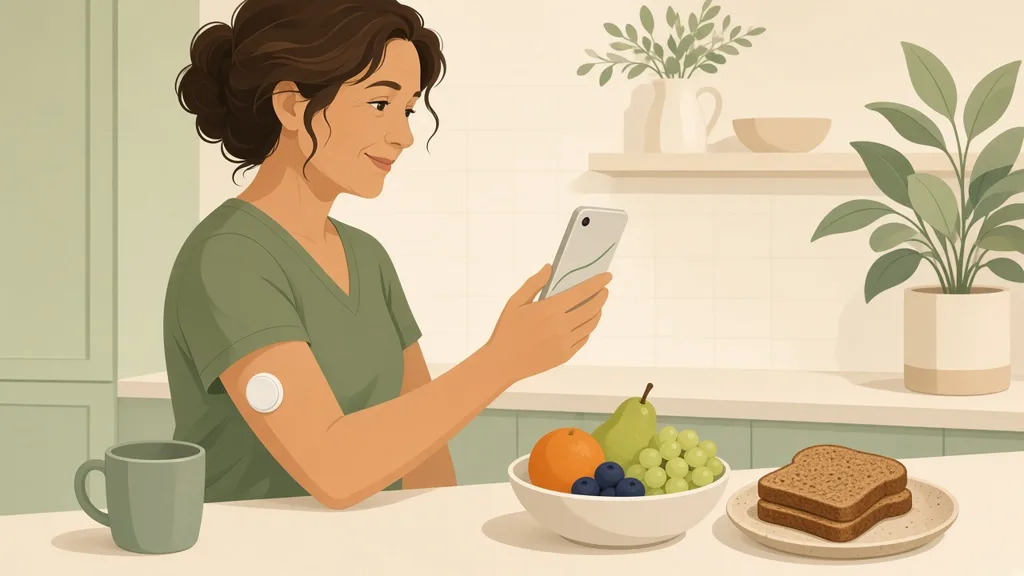
This guide uses the FDA's clearance summary (K233655) and Abbott's own plan page. It doesn't recommend buying anything. Talk with your doctor if you have diabetes, take diabetes medicine or have symptoms. If you want a comparison, take a closer look at Stelo vs Lingo.
What Lingo is
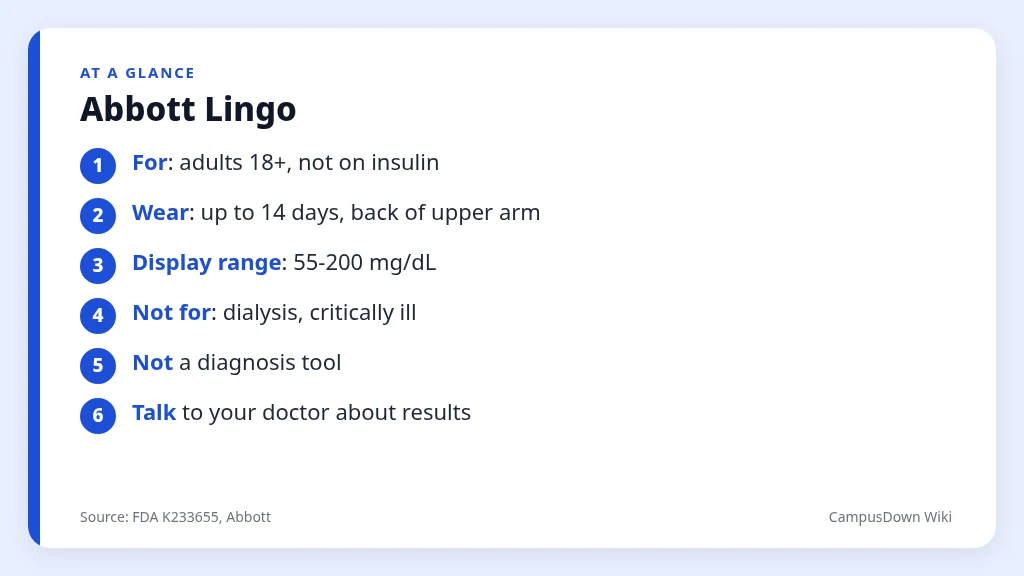
The FDA summary describes the Lingo Glucose System as an over-the-counter (OTC) integrated continuous glucose monitor intended to continuously measure, record, analyze and display glucose values in people 18 years and older not on insulin. It says the system may help users better understand how lifestyle and behavior, including diet and exercise, affect glucose, and that the user is not intended to take medical action based on the device output without consultation with a qualified healthcare professional. The FDA cleared it on May 29, 2024 (decision date), and Abbott announced the clearance on June 10, 2024.
Abbott's page says Lingo isn't intended for diagnosis of diseases, including diabetes.

How it works
Per the FDA summary, the biosensor is based on the FDA-cleared FreeStyle Libre 2 sensor, is single-use and worn up to 14 days, and sends data by Bluetooth to the Lingo app. It measures glucose in the fluid between cells. The sensor goes on the back of the upper arm only; the FDA summary warns it may not function properly if placed elsewhere. Abbott says data appears in 60 minutes after you apply and pair it, and the plan page says the app works with iOS and Android on listed devices. See meter vs CGM for the basics.
What it reports
The FDA summary says the system's reportable range is 55 to 200 mg/dL, and it displays "< 55" or "> 200" outside that range. By comparison, the prescription FreeStyle Libre 2 has a 40 to 400 mg/dL range. The FDA's comparison also lists "none" for diabetes-management features such as alarms, which the prescription predicate has. In other words, Lingo is built for a general-wellness audience, not for managing diabetes treatment. For prescription systems, see the FreeStyle Libre 3 Plus guide.
Who shouldn't use it
- Anyone on insulin: the FDA summary says it isn't intended to be used with insulin devices such as pens or automated insulin dosing systems.
- People on dialysis or who are critically ill: the FDA says it's not known how conditions or medicines common to these groups affect performance.
- Anyone who wants to diagnose or treat diabetes using the device alone.
If you already have diabetes, ask your doctor which tool is appropriate. See diabetes in older adults and what an A1C of 5.7 means.
Sensor life
Abbott says in a study of biosensor life 77.1% lasted the full 14 days, so about 22.9% may not, and 14.7% may last less than 11 days. If a sensor comes off or fails early, see what to do when a CGM sensor falls off and check Abbott's replacement process.
What it costs
Abbott's plan page (checked November 2026) lists a 2-week plan at $54 for one biosensor with no auto-renewal, a 4-week plan at $89 for two biosensors, and a 12-week plan at $249 for six biosensors, shipped every 12 weeks and auto-renewing with an option to cancel. Promotions come and go, and prices change, so check the current page. Ask your plan whether it covers any part of an over-the-counter device. For prescription CGM coverage, see CGM Medicare coverage.
How to use the data wisely
- Look for patterns over days, not single numbers.
- Use it to start a conversation with your clinician, especially if you notice highs after meals or have a family history of diabetes.
- Don't change medicines or skip care because of a sensor reading.
- If you feel unwell, check with a doctor, not an app.
Get help now if
A wearable doesn't diagnose diabetes. If you have symptoms like extreme thirst, frequent urination, blurred vision or unexplained weight loss, contact your doctor. Call 911 for fainting, confusion or trouble breathing.
Example scenario: the cereal curve
- Who
- Sabine, 52, a school bus dispatcher in Albany, New York, had an A1C that her doctor called "borderline" and wanted to see how her usual breakfast affected her.
- What happened
- After her first two days on a 14-day sensor, she saw her curve rise higher after her usual cereal than after eggs and fruit.
- How it felt
- She felt a mix of curiosity and worry, and she stayed up late searching what the numbers "should" be.
- What they did
- She wrote down the foods, times and her energy, took the notes to her doctor, and asked what the pattern meant instead of diagnosing herself. Her doctor ordered standard lab tests and discussed next steps.
- How it turned out
- Sabine said the sensor helped her ask better questions, but the doctor's tests gave her the answers.
This is an illustrative example, not a real patient or a review.
Sabine's story is an illustrative example. A sensor can't replace medical tests.
Most-asked questions about Abbott Lingo
What is Abbott Lingo?
An FDA-cleared OTC glucose biosensor and app for adults 18 and older not on insulin.
Why people ask: "abbott lingo" is #1 for "abbott lingo" (US autocomplete, November 2026).
Is Lingo a CGM?
Yes, the FDA calls it an over-the-counter integrated continuous glucose monitor.
Why people ask: "abbott lingo cgm" is #2 for "abbott lingo" (US autocomplete, November 2026).
What is the Abbott Lingo glucose monitor?
A biosensor worn on the back of the upper arm plus an app.
Why people ask: "abbott lingo glucose monitor" is #3 for "abbott lingo" (US autocomplete, November 2026).
Where can I buy Abbott Lingo?
Abbott sells it through its Lingo website; check there for current availability.
Why people ask: "abbott lingo where to buy" is #5 for "abbott lingo" (US autocomplete, November 2026).
How long does a Lingo sensor last?
Up to 14 days; Abbott says 77.1% lasted the full 14 days in its study.
Why people ask: "abbott lingo sensor" is #6 for "abbott lingo" (US autocomplete, November 2026).
How much does Abbott Lingo cost?
Abbott lists a 2-week plan at $54 for one biosensor as of November 2026.
Why people ask: "abbott lingo price" is #8 for "abbott lingo" (US autocomplete, November 2026).
Is there an Abbott Lingo app?
Yes, for iOS and Android on listed devices.
Why people ask: "abbott lingo app" is #9 for "abbott lingo" (US autocomplete, November 2026).
Related on CampusDown
You can learn more about Stelo by Dexcom and check it for yourself with the Stelo vs Lingo comparison.
Frequently asked questions
- Can Lingo diagnose diabetes?
- No. Abbott says it isn't intended for diagnosis of diseases, including diabetes.
- Can I use Lingo if I take insulin?
- No. It's cleared for adults not on insulin.
- Does Lingo have alarms?
- The FDA's comparison lists no diabetes-management features such as alarms.
- Can children use it?
- It's cleared for people 18 and older.
Lingo is a window into how food and habits move your glucose, not a diagnosis or a treatment plan. Use it to ask better questions, and let your doctor read the answers with you.
Browse more guides like this in the Home Medical Devices hub.
This article is for general education and does not replace advice from your own doctor, nurse or pharmacist.
References
- FDA: 510(k) Substantial Equivalence Determination Decision Summary K233655 (Lingo Glucose System)
- Abbott Lingo: Buy Lingo CGM Biosensor and App (plans and important information)
- Abbott: Abbott Receives U.S. FDA Clearance for Two New Over-the-Counter Continuous Glucose Monitoring Systems (June 10, 2024)
- NIDDK: Continuous Glucose Monitoring