
A nurse calls out two numbers in the delivery room, one at 1 minute and one at 5. What are they measuring, and what do they mean for the baby?

This guide uses the MedlinePlus "Apgar score" page (review date October 20, 2024). It is general information for families and nursing students, not a diagnosis; your baby's care team explains the numbers. If you want to learn more about structured head-to-toe checks, take a closer look at the head-to-toe assessment.
What the Apgar score is
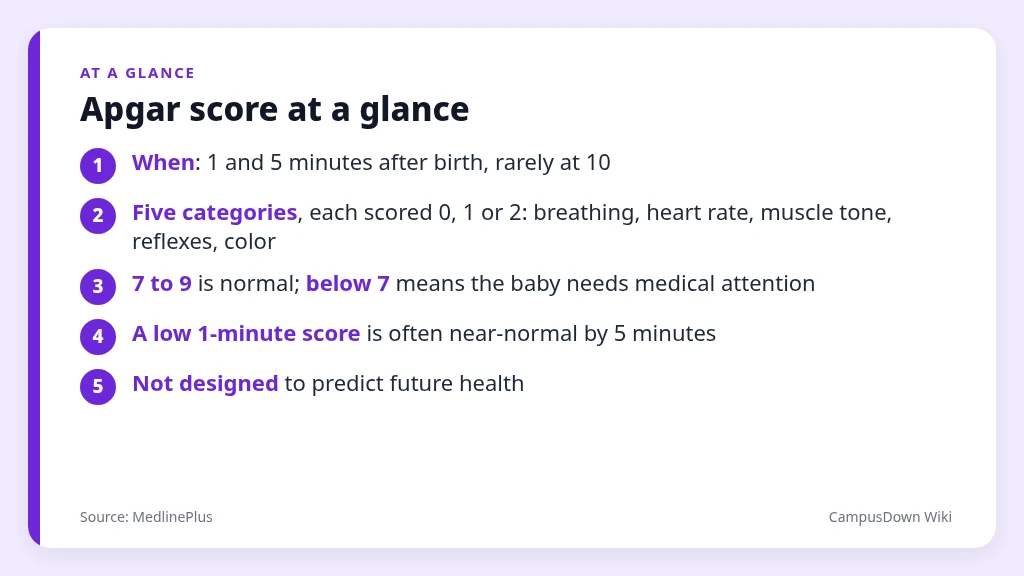
MedlinePlus says the Apgar score is a quick test done at 1 and 5 minutes after birth, and sometimes at 10 minutes. The 1-minute score shows how well the baby tolerated the birth, and the 5-minute score shows how the baby is doing outside the womb. A doctor, midwife or nurse does it. The test determines whether a newborn needs help breathing or is having heart trouble. MedlinePlus notes it was introduced by Virginia Apgar in 1952.

The five categories
Each is scored 0, 1 or 2:
| Category | 0 | 1 | 2 |
|---|---|---|---|
| Breathing effort | Not breathing | Slow or irregular | Cries well |
| Heart rate (by stethoscope) | No heartbeat | Below 100 beats per minute | Above 100 beats per minute |
| Muscle tone | Loose and floppy | Some tone | Active motion |
| Reflex irritability (response to stimulation such as a mild pinch) | No reaction | Grimace | Grimace plus cough, sneeze or vigorous cry |
| Skin color | Pale blue | Pink body, blue extremities | Entire body pink |
MedlinePlus calls heart rate the most important assessment. The page doesn't spell out a memory aid for the name; ask your instructor how your program teaches it.
What the total means
- MedlinePlus says the total is based on a score of 1 to 10; higher is better.
- 7, 8 or 9 is normal and a sign of good health. A 10 is very unusual, because almost all newborns lose 1 point for blue hands and feet, which is normal after birth.
- Any score below 7 means the baby needs medical attention; the lower the score, the more help the baby needs to adjust.
Why a score may be low
MedlinePlus says it is most often caused by a difficult birth, a C-section or fluid in the baby's airway. Treatment may involve oxygen and clearing the airway or physical stimulation to help the heart rate.
What it does and doesn't mean
- A low 1-minute score is often near-normal by 5 minutes; scores are not usually measured after 5 minutes.
- If the score is below 7 at 5 minutes, some providers check again a few minutes later and usually stop once it reaches 7.
- MedlinePlus says a lower Apgar score doesn't mean a child will have serious or long-term health problems, and the score isn't designed to predict the future health of the child.
Get help now if
If you're worried about how your baby is breathing, feeding or acting after you go home, call your pediatric clinician right away, and call 911 for blue color around the lips or face, trouble breathing or a baby who is hard to wake.
Tips for nursing students
- Practice assigning 0, 1 or 2 per category aloud and total them.
- Document the time, each component and any interventions; see nursing charting and documentation.
- Communicate clearly during a handoff; see SBAR handoff.
- Connect it to the larger assessment: head-to-toe assessment and the nursing process.
Questions for the care team
- What were my baby's 1- and 5-minute scores and why?
- Did the baby need oxygen or stimulation?
- What follow-up checks will happen before we go home?
- Which signs after discharge should make me call?
- Who can I call with questions?
Example scenario: the numbers on the whiteboard
- Who
- Cosima, 22, a nursing student in Charlotte, North Carolina, was observing a clinical shift when a newborn had a low 1-minute score after a C-section.
- What happened
- Seeing the numbers go up on the whiteboard, she worried and wasn't sure what to say to the parents.
- How it felt
- She felt her heart pounding.
- What they did
- Her preceptor explained that a low 1-minute score is often near-normal by 5 minutes and that the team was giving oxygen and drying the baby. Cosima documented the times and, with her preceptor present, let the parents know the care team would explain. At 5 minutes the score had risen.
- How it turned out
- Cosima said she learned the score is a starting point, not a verdict.
This is an illustrative example, not a real patient or a review.
Cosima's story is an illustrative example. The care team explains scores to families, and students should follow their program's policies.
Most-asked questions about the Apgar score
What is the Apgar score meaning?
A quick check at 1 and 5 minutes of breathing, heart rate, muscle tone, reflexes and color, each scored 0 to 2.
Why people ask: "apgar score meaning" is #2 for "apgar score" (US autocomplete, November 2026).
Is an Apgar score of 9 good?
Yes; MedlinePlus says 7, 8 or 9 is normal and a sign of good health.
Why people ask: "apgar score 9" is #3 for "apgar score" (US autocomplete, November 2026).
Is an Apgar score of 8 good?
Yes; 7, 8 or 9 is normal.
Why people ask: "apgar score 8" is #4 for "apgar score" (US autocomplete, November 2026).
What does an Apgar score of 1 mean?
MedlinePlus says any score below 7 means the baby needs medical attention and the lower the score, the more help is needed; it doesn't discuss individual low numbers.
Why people ask: "apgar score of 1" is #6 for "apgar score" (US autocomplete, November 2026).
What does an Apgar score of 8 and 9 mean?
A normal result: the baby is doing well after birth.
Why people ask: "apgar score 8 and 9" is #7 for "apgar score" (US autocomplete, November 2026).
Is an Apgar score of 7 okay?
MedlinePlus counts 7 as normal; below 7 is when the baby needs medical attention.
Why people ask: "apgar score 7" is #8 for "apgar score" (US autocomplete, November 2026).
What is the Apgar score range?
MedlinePlus describes a total of 1 to 10, with categories scored 0 to 2.
Why people ask: "apgar score range" is #9 for "apgar score" (US autocomplete, November 2026).
What does an Apgar score of 2 mean?
It is below 7, so MedlinePlus says the baby needs medical attention; ask the care team about the specifics.
Why people ask: "apgar score 2" is #10 for "apgar score" (US autocomplete, November 2026).
Is there an Apgar score chart for a newborn?
The categories and 0-1-2 criteria appear in the table above, per MedlinePlus.
Why people ask: "apgar score chart for newborn" is #2 for "apgar score chart" (US autocomplete, November 2026).
What does the Apgar score chart mean?
Add the five category scores; 7 to 9 is normal and below 7 needs medical attention.
Why people ask: "apgar score chart meaning" is #4 for "apgar score chart" (US autocomplete, November 2026).
Is a 9 on the Apgar score chart good?
Yes, 9 is within the normal 7 to 9 range.
Why people ask: "apgar score chart 9" is #5 for "apgar score chart" (US autocomplete, November 2026).
What is the Apgar score chart for ATI?
The sources here don't cover ATI materials; follow your course resources and instructor.
Why people ask: "apgar score chart ati" is #6 for "apgar score chart" (US autocomplete, November 2026).
Related on CampusDown
You can learn more about the nursing student hub and check it for yourself in the head-to-toe assessment. For handoffs in detail, see SBAR handoff, and for another scoring tool see the Glasgow Coma Scale.
Frequently asked questions
- When is the Apgar score done?
- At 1 and 5 minutes after birth, rarely at 10.
- What is a normal score?
- 7, 8 or 9; a 10 is very unusual.
- What if the score is below 7?
- The baby needs medical attention, such as oxygen, airway clearing or stimulation; many low 1-minute scores are near-normal by 5 minutes.
- Does a low score predict problems later?
- No; MedlinePlus says it isn't designed to predict future health.
- Who scores it?
- A doctor, midwife or nurse.
The Apgar score is a quick, structured check of five signs at 1 and 5 minutes. Scores of 7 to 9 are normal, below 7 signals a need for attention, and neither number predicts a child's future health.
Browse more guides like this in the Nursing Student and NCLEX hub.
This article is for general education and does not replace advice from your own doctor, nurse or pharmacist.