
"Don't give COPD patients too much oxygen." You've heard it on the unit. But what if your patient's saturation is 82% and they're struggling? Do you turn the oxygen down, or up?
This guide uses OpenStax Medical-Surgical Nursing (section 11.5, COPD) and the Oxygen Therapy Clinical Best Practice Guideline from the College of Respiratory Therapists of Ontario (CRTO), which cites the British Thoracic Society (BTS). It is for education only. Follow your instructor, facility policy and the provider's orders. If you want to learn more about COPD flares, take a closer look at COPD flare signs.
The core message
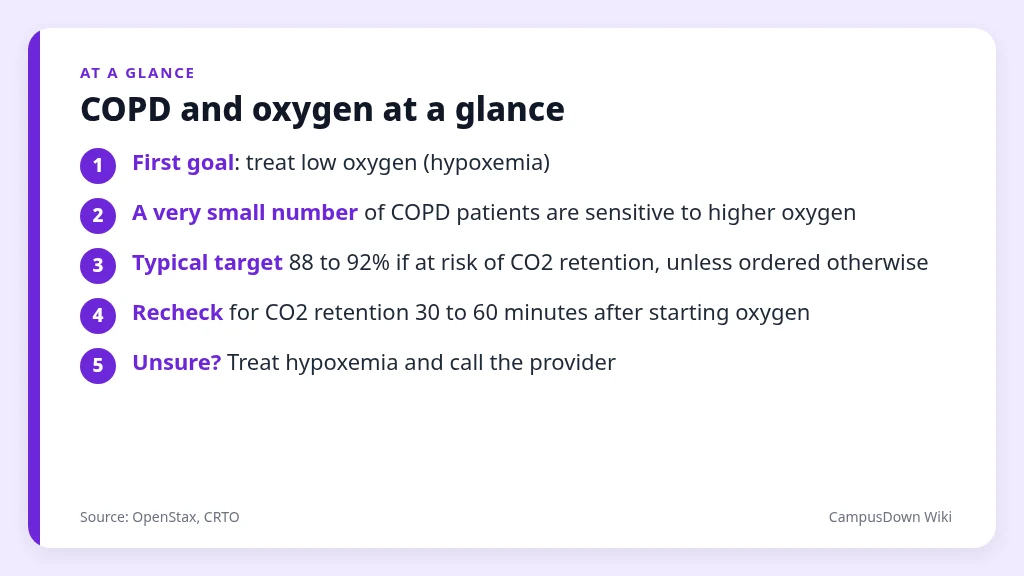
The CRTO guide says the primary goal of oxygen therapy is to treat hypoxemia. It adds that a very small number of patients with COPD have sensitivity to higher levels of oxygen, and that if you are unsure whether a patient has that sensitivity, the main goal is to treat hypoxemia. It stresses avoiding both harmful hypoxemia and hypercapnia by carefully titrating oxygen and monitoring arterial blood gases. The point isn't "oxygen is bad in COPD." It is "give enough, not too much, and watch."

What "hypoxic drive" means
Normally, rising CO2 stimulates breathing. CRTO says patients with certain respiratory diseases such as COPD may have reduced sensitivity to increased CO2. Hypoxic drive refers to a patient depending on low arterial oxygen (PaO2) to stimulate breathing, which CRTO says is seen in some patients with COPD. If too much oxygen is given to such a patient, the blood oxygen level rises but so does CO2, leading to respiratory acidosis and failure. CRTO also notes that normal CO2 is generally accepted as 35 to 45 mmHg. Learn the numbers in ABG interpretation with ROME.
OpenStax says arterial blood gas analysis can show elevated carbon dioxide (above 45 mmHg), that respiratory acidosis is the most common blood gas abnormality in COPD, and that patients with mild or moderate COPD often have mildly low oxygen without elevated CO2. OpenStax does not use the phrase "hypoxic drive," so the explanation above comes from CRTO.
Targets
CRTO says the BTS target saturation for patients at risk of hypercapnic respiratory failure is 88 to 92% unless otherwise prescribed, pending blood gas results. Summaries of the BTS guideline also mention avoiding excessive oxygen and repeating blood gases after 30 to 60 minutes; read the BTS guideline linked below for exact wording. OpenStax says the nurse collaborates with respiratory therapy and the provider to identify SpO2 targets, so the number on your patient's order is the number you follow. If a target hasn't been set, ask.
After oxygen is started
OpenStax says because of the risk of CO2 retention, the nurse should assess for signs of elevated CO2 thirty to sixty minutes after oxygen therapy is initiated. OpenStax doesn't list the signs, so ask your instructor which findings your unit watches (for example, changes in alertness or breathing) and call the provider for orders such as a repeat blood gas. OpenStax also lists monitoring oxygen saturation, pulmonary rehabilitation and correct spacer use in COPD care. See AeroChamber spacers and albuterol inhalers.
Get help now if
A COPD patient who becomes drowsy, confused, has a worsening headache, slow or shallow breathing or blue lips after oxygen is started needs urgent evaluation. Call the provider or rapid response team per your facility's policy; do not simply remove oxygen without an order.
Don't withhold oxygen
CRTO's emphasis is on treating hypoxemia, and it says that if you are unsure whether a patient is sensitive to oxygen, treating hypoxemia is the main goal. So a patient with low oxygen is not left without it; the amount is adjusted, monitored and ordered. Your provider or the rapid response team sets the plan.
Safety and teaching
- Home oxygen safety: OpenStax says to teach chronic oxygen safety; your instructor or facility handout lists the specifics
- Do not change the flow on your own: use only the prescribed setting
- Know when to call: ask your clinician which changes (more breathlessness, new confusion or drowsiness) mean calling right away
- Use inhalers and spacers correctly, and ask about pulmonary rehabilitation
For lung assessment practice see lung sounds in nursing, and for asthma medicines compared with COPD see asthma medicines for nursing.
Questions to ask your instructor or preceptor
- What SpO2 target does our unit use for COPD, and who sets it?
- How do we monitor for CO2 retention after starting oxygen?
- When do we get a blood gas?
- Which device (nasal cannula or mask) do we start with?
- How do we teach home oxygen safety?
Example scenario: the number on the monitor
- Who
- Alphonse, 31, a night-shift nurse in Baltimore, Maryland, saw his patient with COPD drop to 84% and was warned by a colleague not to "turn up the oxygen."
- What happened
- He worried about harming the patient either way.
- How it felt
- He felt torn and under time pressure.
- What they did
- He applied the oxygen per the order set, called respiratory therapy and the provider for the target, and rechecked the patient's alertness and breathing within the unit's timeframe; the provider ordered a blood gas. Alphonse documented the changes.
- How it turned out
- Alphonse said following the target and watching the patient beat guessing.
This is an illustrative example, not a real patient or a review.
Alphonse's story is an illustrative example. Always follow your facility's policy and the provider's orders.
Most-asked questions about COPD and oxygen
What is hypoxic drive in COPD?
CRTO says it means depending on low arterial oxygen to stimulate breathing, seen in some patients with COPD.
Why people ask: "copd hypoxic drive oxygen" is #2 for "copd hypoxic drive" (US autocomplete, November 2026).
What is the respiratory drive in COPD?
Normally CO2 stimulates breathing; patients with COPD may have reduced sensitivity to CO2.
Why people ask: "copd respiratory drive" is #3 for "copd hypoxic drive" (US autocomplete, November 2026).
How does oxygen affect respiratory drive in COPD?
Too much oxygen in a patient who relies on hypoxic drive can raise CO2 and cause respiratory acidosis, per CRTO.
Why people ask: "copd respiratory drive oxygen" is #4 for "copd hypoxic drive" (US autocomplete, November 2026).
Is the COPD respiratory drive a myth?
CRTO describes it as affecting only a very small number of COPD patients, so the key is treating hypoxemia and watching CO2 rather than withholding oxygen.
Why people ask: "copd respiratory drive myth" is #5 for "copd hypoxic drive" (US autocomplete, November 2026).
Do COPD patients have a hypoxic drive?
Some do; CRTO says a very small number are sensitive to higher oxygen levels.
Why people ask: "copd patients hypoxic drive" is #6 for "copd hypoxic drive" (US autocomplete, November 2026).
What is the mechanism of hypoxic drive in COPD?
Reduced sensitivity to CO2 means low PaO2 becomes the breathing stimulus; raising oxygen too much can remove it and let CO2 rise.
Why people ask: "copd and hypoxic drive mechanism" is #7 for "copd hypoxic drive" (US autocomplete, November 2026).
Can COPD patients lose their hypoxic drive?
With too much oxygen in a sensitive patient, breathing may slow and CO2 may rise; titrate carefully and monitor.
Why people ask: "copd loss of hypoxic drive" is #8 for "copd hypoxic drive" (US autocomplete, November 2026).
How is CO2 retention connected to hypoxic drive in COPD?
Too much oxygen in a sensitive patient can raise CO2 and lead to respiratory acidosis.
Why people ask: "co2 retention copd hypoxic drive" is #9 for "copd hypoxic drive" (US autocomplete, November 2026).
What is the meaning of hypoxic drive in COPD?
Dependence on low arterial oxygen, rather than high CO2, to stimulate breathing.
Why people ask: "hypoxic drive copd meaning" is #10 for "copd hypoxic drive" (US autocomplete, November 2026).
What are the guidelines for COPD oxygen therapy?
CRTO cites the BTS 88 to 92% target for patients at risk of hypercapnic respiratory failure unless otherwise prescribed, with blood gases; CRTO also lists a 2020 American Thoracic Society home oxygen guideline.
Why people ask: "copd oxygen therapy guidelines" is #2 for "copd oxygen therapy" (US autocomplete, November 2026).
How many liters of oxygen do COPD patients get?
The sources here don't give a flow rate; the order specifies the device and amount and titrates to the target.
Why people ask: "copd oxygen therapy how many liters" is #3 for "copd oxygen therapy" (US autocomplete, November 2026).
What is the CO2 retention risk with COPD oxygen therapy?
OpenStax says to assess for signs of elevated CO2 thirty to sixty minutes after oxygen starts.
Why people ask: "copd oxygen therapy co2 retention" is #4 for "copd oxygen therapy" (US autocomplete, November 2026).
Is there a limit on oxygen for COPD?
Follow the prescribed target; avoid excessive oxygen but never withhold it from a hypoxic patient.
Why people ask: "copd oxygen therapy limit" is #6 for "copd oxygen therapy" (US autocomplete, November 2026).
What oxygen levels are targeted in COPD?
CRTO cites 88 to 92% for patients at risk of hypercapnic respiratory failure unless otherwise prescribed.
Why people ask: "copd oxygen therapy levels" is #7 for "copd oxygen therapy" (US autocomplete, November 2026).
Related on CampusDown
You can learn more about the nursing student hub and check it for yourself in COPD flare signs. For blood gases in detail, see ABG interpretation with ROME, and for the care framework see the nursing process.
Frequently asked questions
- What is the first goal of oxygen therapy?
- Treat hypoxemia, per CRTO.
- What target is used for COPD?
- CRTO cites 88 to 92% (BTS) for patients at risk of hypercapnic respiratory failure unless otherwise prescribed, pending blood gases.
- When do I check for CO2 retention?
- OpenStax says thirty to sixty minutes after starting oxygen.
- Should I withhold oxygen from a hypoxic COPD patient?
- No; treat hypoxemia, titrate and monitor, and follow the provider's plan.
- Who sets the target?
- The nurse collaborates with respiratory therapy and the provider, per OpenStax.
In COPD, oxygen is a treatment for low oxygen, not something to withhold. Know that only a very small number are sensitive, use the ordered target (often 88 to 92% when at risk), recheck for CO2 retention 30 to 60 minutes after starting, and escalate changes in alertness or breathing.
Browse more guides like this in the Nursing Student and NCLEX hub.
This article is for general education and does not replace advice from your own doctor, nurse or pharmacist.