
It's 6:45 a.m., you've just heard report on your patient, and the information is already slipping away. Where did you write the allergy? Was the pain medicine due at nine or ten? This is the moment a good report sheet earns its place.

This guide is for nursing students. It draws on The Joint Commission's Sentinel Event Alert 58 on inadequate hand-off communication (2017) and AHRQ's I-PASS tool. A "brain" is an informal worksheet, not an official record, and there is no single required format; your school and your facility set the rules, so follow them first. To learn more about the structure behind a good sheet, take a closer look at SBAR for nursing students.
What a "brain" is
A brain or report sheet is a page you build to hold the key facts about each patient and your own tasks for the shift. You'll find many versions, for med-surg, ICU and other areas. The common idea is that it's your organizing tool, and what you write on it is for your learning and your work that day. It doesn't replace the chart; for what does go in the record, see nursing documentation.
Don't worry if your classmate's looks different from yours. The best sheet is the one that matches how you think and what your school asks for.

Why the structure matters
The Joint Commission says inadequate hand-off communication is a contributing factor to adverse events, including wrong-site surgery, delay in treatment, falls and medication errors. It says hand-offs sometimes happen too casually, when they should be structured and focused to ensure continuity of care, and that tools such as forms, templates, checklists and mnemonics can help. AHRQ says its I-PASS tool has become a preferred handoff tool in many organizations and that a facility should set a standard protocol.
A report sheet is how you capture what you hear during report so you can use it later, ask better questions and give a good report yourself.
What to include: a checklist from The Joint Commission
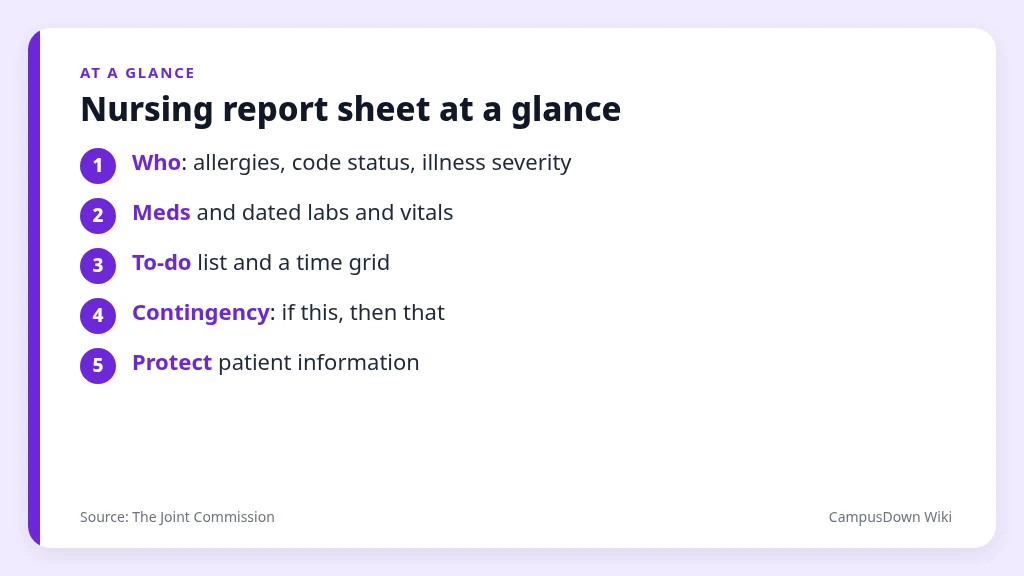
The alert lists the critical content a hand-off should include. It's a handy skeleton for a sheet:
- Sender contact information: who gave you report and how to reach them
- Illness assessment, including severity: how sick is this patient right now?
- Patient summary: events leading up to the illness or admission, hospital course, ongoing assessment and plan of care
- To-do action list
- Contingency plans: "if this happens, do that"
- Allergy list
- Code status
- Medication list
- Dated laboratory tests
- Dated vital signs
Dates matter: a lab or vital sign without a time can mislead you. Medication details should come from the chart and orders, not from memory; see the rights of medication administration and high-alert medications.
A simple layout to try
You can sketch this on paper or adapt your school's template. This is an idea for a layout, not a required form.
| Box | What to write | |
|---|---|---|
| Top strip | Room, age, code status, allergies, isolation precautions, diagnosis | |
| Story | Short summary in your own words: why they're here and what's changed | |
| Systems | A line for each system you assess; see head to toe assessment | head to toe assessment |
| Meds and labs | Scheduled times, high-alert drugs, dated labs worth watching | |
| Vital signs | Time-stamped values and when the next set is due | |
| To-do | Tasks, with who is responsible and a checkmark when done | |
| Questions | Things to ask the nurse, provider or instructor | |
| If/then | Contingency notes from report |
Leave room to write "what I need to tell the next person."
A time grid for the shift
Many students add a grid with hours down the side. Write the scheduled medications, treatments, assessments, and appointments in the hour they're due, and cross them off as you finish. Your clinical judgment decides priorities; the grid just keeps you from forgetting. See the nursing process for how assessment leads to planning and evaluation.
Using the sheet for report
The Joint Commission recommends face-to-face hand-offs in a place free from interruptions where possible, with time to ask questions, and says the receiver should be able to discuss. A few ways to use your sheet:
- While receiving report, write the facts and mark the items you aren't sure about.
- Ask questions before the sender leaves, such as "Any pending labs?" or "What should I watch for?"
- Repeat back the key points to make sure you heard them correctly.
- When giving report, go through your sheet in a consistent order. AHRQ's I-PASS stands for Illness severity, Patient summary, Action list, Situation awareness and contingency plans, Synthesis by receiver.
When you need to call a provider, switch to SBAR: SBAR template and examples.
Get help now if
Protect patient privacy. Your school and facility have rules about what identifying information may appear on a student sheet and how to dispose of it. Follow them exactly, never leave a sheet where others can see it and never take it out of the facility unless your policy says you may.
Common mistakes
- Copying the whole chart onto the sheet. A sheet is a summary, not a copy.
- Writing a value without a time. Always date and time labs and vital signs.
- Using the sheet instead of the chart. Check the chart and orders for current information.
- Skipping the contingency plan. Ask "what should I do if...?" during report.
- Forgetting to update it. Mark changes through the shift so your report at the end is accurate.
- Not asking your instructor what is allowed. Some programs require a specific form.
If you're heading toward your first job, the new grad first year guide covers how reports and routines change after school.
Example scenario: the lost allergy
- Who
- Faustina, 25, a nursing student in Savannah, Georgia, was getting her first morning report on a patient with several medicines due early.
- What happened
- She scribbled notes on the back of a hand-out, and by 8 a.m. she couldn't remember whether the allergy had been mentioned.
- How it felt
- She felt her face flush, worried that she had missed something important and embarrassed to ask again.
- What they did
- She checked the chart for the allergy list, told her nurse what had happened and built a one-page sheet with the Joint Commission list across the top. The next shift she wrote each item in a box, asked about pending tests and read key points back.
- How it turned out
- Faustina said the sheet didn't make her faster, but she stopped feeling like she was falling behind.
This is an illustrative example, not a real patient or a review.
Faustina's story is an illustrative example. Follow your instructor's direction and your facility's policies.
Most-asked questions about nursing brain sheets
Is there a free nursing brain sheet PDF?
Many schools provide their own. Ask your instructor what format is allowed.
Why people ask: "nursing brain sheet pdf free" is #2 for "nursing brain sheet" (US autocomplete, November 2026).
Is there a nursing brain sheet template?
Yes, but the best one is the one your program approves. The Joint Commission's content list is a good skeleton.
Why people ask: "nursing brain sheet template" is #3 for "nursing brain sheet" (US autocomplete, November 2026).
What should a med-surg brain sheet include?
Allergies, code status, illness severity, patient summary, medications, dated labs and vital signs, a to-do list and contingency plans.
Why people ask: "nursing brain sheet med surg" is #5 for "nursing brain sheet" (US autocomplete, November 2026).
What changes on an ICU brain sheet?
Ask your unit; the same core content applies, and your facility decides which extra details to track.
Why people ask: "nursing brain sheet icu" is #9 for "nursing brain sheet" (US autocomplete, November 2026).
Is there a printable nursing brain sheet?
Often, from your school. Check privacy rules before printing or storing anything with patient information.
Why people ask: "nursing brain sheet printable" is #10 for "nursing brain sheet" (US autocomplete, November 2026).
Related on CampusDown
You can learn more about SBAR and check it for yourself in the nursing student hub. For what goes in the chart in detail, see nursing documentation.
Frequently asked questions
- Is a brain sheet part of the medical record?
- No. It's a personal organizing tool, and your school or facility sets the rules for using and discarding it.
- What does The Joint Commission say a hand-off should include?
- Sender contact information, illness assessment and severity, patient summary, to-do list, contingency plans, allergies, code status, medications, dated labs and dated vital signs.
- What is I-PASS?
- A hand-off mnemonic: Illness severity, Patient summary, Action list, Situation awareness and contingency plans, Synthesis by receiver, per AHRQ and The Joint Commission.
- Can I keep my sheets after clinical?
- Follow your school's and facility's policy on patient information; many require secure disposal.
- How do I practice using one?
- Fill it out for a practice case in skills lab, give report out loud to a classmate and ask for feedback.
A brain doesn't make you smarter; it makes your thinking visible. Build it around the essentials, keep it private and let it guide a clear, structured report.
Browse more guides like this in the Nursing Student and NCLEX hub.
This article is for general education and does not replace advice from your own doctor, nurse or pharmacist.