
You're 72 and your surgeon says you'll be walking the day after your new hip. It sounds impossible. What does recovery actually look like, week by week, and what should you ask before you go home?

This guide uses two MedlinePlus encyclopedia articles: "Hip joint replacement" (reviewed September 2, 2025) and "Hip replacement - discharge" (reviewed November 7, 2024). It is general information, not a rehab plan; your surgeon and physical therapist set your timeline and precautions. If you want to learn more about the fall that sometimes leads to hip surgery, take a closer look at hip fracture recovery.
What the surgery involves
MedlinePlus says hip joint replacement is surgery to replace all or part of the hip joint with a man-made joint, made of a socket, a liner, a ball and a stem. You have general anesthesia or regional (spinal or epidural) anesthesia, and the surgery takes about 1 to 3 hours. The most common reason is to relieve arthritis (see osteoarthritis); fractures of the thighbone are another reason, often in older adults. Most of the time it's done in people 60 and older.

In the hospital
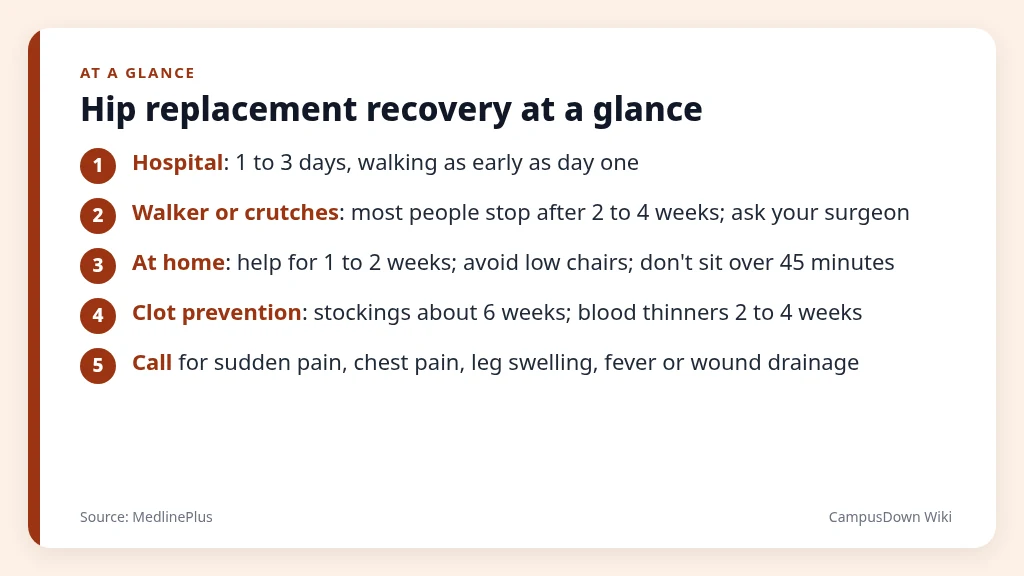
You stay 1 to 3 days and are asked to start moving and walking as soon as the first day. Some people need a short stay in a rehabilitation center before going home. Ask your surgeon beforehand whether you'll need one.
Recovery time and age
MedlinePlus doesn't give recovery times by age. It says by the time you go home you should be able to walk with a walker or crutches without much help, dress with little help and get in and out of bed or a chair, and most people don't need walkers or crutches after 2 to 4 weeks; check with your surgeon before you stop. You'll need someone with you at home for 1 to 2 weeks, and you should be careful not to dislocate the hip, especially in the first few months. Results are very often excellent: most or all pain and stiffness should go away, and over time you should be able to return to your former level of activity. Ask your surgeon how your own age and health may change the timeline.
Precautions at home
- Avoid sitting in a low chair or soft sofa.
- Try not to sit more than 45 minutes at a time; get up and move.
- Don't put full weight on the new hip's side until your surgeon says it's OK; start with short periods of activity and build up.
- Keep moving and walking.
- Don't squat to clean; skip heavier chores such as vacuuming or laundry at first.
- Don't carry things while walking; use a walker pocket or basket.
- Wear compression stockings for about 6 weeks and take blood thinners for 2 to 4 weeks if prescribed to lower clot risk; see apixaban (Eliquis) for one blood thinner.
- Take pain medicine when pain starts, and about 30 minutes before activity or therapy early in recovery.
- Wound care: keep the dressing clean and dry, stitches or staples come out about 10 to 14 days after surgery, no shower until 3 to 4 days or until your surgeon says, and no soaking in a tub, hot tub or pool.
- Protect against infection: tell your dentist and doctors you have a joint prosthesis, and check with your surgeon about antibiotics before dental work.
Home setup
MedlinePlus advises a bed low enough for your feet to touch the floor and high enough that your hips are higher than your knees, a firm mattress, no tripping hazards (loose cords or throw rugs, uneven flooring, no small pets), good lighting, hand rails in the tub, shower and next to the toilet, a slip-proof mat, firm-back chairs in the rooms you use and a first-floor bed or bathroom/commode so you don't have to climb steps. See the fall prevention checklist, aging in place modifications and cane height and use.
Exercises
MedlinePlus says you'll learn exercises that make the new hip stronger, and your surgeon or physical therapist will give you exercises to do at home. It doesn't list specific exercises or give a PDF, so follow the plan your therapist gives you rather than a generic sheet. You may also be advised to practice before surgery with a physical therapist, and you can ask your therapist whether balance work fits your plan; see balance exercises for seniors.
Get help now if
Contact your surgeon for a sudden increase in pain, chest pain or shortness of breath, swelling in one leg that is red and warmer than the other, pain in the calf, fever over 101°F (38.3°C), redness, increasing pain or drainage at the incision, frequent or burning urination, blood in stools or dark stools, nosebleeds or blood in urine or stools if you take blood thinners, pain not controlled by medicine, a fall or injury to the leg, or a feeling that your hip has slipped out of position. Call 911 for chest pain or trouble breathing.
Long term
MedlinePlus says over time the artificial joint can loosen, after as long as 15 to 20 years, younger, more active people may wear out parts sooner, and you should check with your surgeon periodically. Avoid downhill skiing and contact sports like football and soccer; hiking, gardening, swimming, tennis and golf are low-impact activities you should be able to do.
Questions for your surgeon
- What are my hip precautions and for how long?
- When can I stop the walker or crutches and when can I drive?
- Which blood thinner will I take and for how long?
- Which exercises should I do and how often?
- Will I need a rehab stay or home health?
Example scenario: the low sofa
- Who
- Bertrand, 74, a retired machinist in Pittsburgh, Pennsylvania, went home two days after a hip replacement.
- What happened
- At his daughter's house he sank into a soft low sofa and struggled to stand.
- How it felt
- He felt embarrassed and worried he had hurt the new hip.
- What they did
- He remembered the discharge instructions about low chairs, called the surgeon's office, who advised him on what to watch for, and swapped to a firm chair with arms. Bertrand also set a timer to stand up every 45 minutes and kept his therapy exercises on the fridge.
- How it turned out
- Bertrand said following the chair rule was easier than he had expected.
This is an illustrative example, not a real patient or a review.
Bertrand's story is an illustrative example. Follow your own surgeon's precautions and call the office if you are unsure.
Most-asked questions about hip replacement recovery
What is the recovery time after a hip replacement at age 80?
MedlinePlus gives no age-specific times; walkers or crutches are usually stopped after 2 to 4 weeks, but ask your surgeon how age and health affect your timeline.
Why people ask: "hip replacement recovery time 80 year old" is #2 for "hip replacement recovery time" (US autocomplete, November 2026).
What is the hip replacement recovery timeline?
A 1 to 3 day hospital stay, help at home for 1 to 2 weeks, stockings about 6 weeks, blood thinners 2 to 4 weeks and stitches out at 10 to 14 days.
Why people ask: "hip replacement recovery timeline" is #3 for "hip replacement recovery time" (US autocomplete, November 2026).
What is the recovery time at age 60?
The sources don't give age-specific times; surgery is most often done at 60 and older, so the general timeline applies; ask your surgeon.
Why people ask: "hip replacement recovery time 60 year old" is #4 for "hip replacement recovery time" (US autocomplete, November 2026).
What is the recovery time at age 70?
MedlinePlus doesn't give age-specific times; most people stop walking aids after 2 to 4 weeks, but confirm with your surgeon.
Why people ask: "hip replacement recovery time 70 year old" is #5 for "hip replacement recovery time" (US autocomplete, November 2026).
What is the recovery time at age 65?
No age-specific times are given; follow the general timeline and your surgeon's plan.
Why people ask: "hip replacement recovery time 65 year old" is #6 for "hip replacement recovery time" (US autocomplete, November 2026).
What is the recovery time at age 75?
The sources give no age-specific timeline; ask your surgeon and therapist.
Why people ask: "hip replacement recovery time 75 year-old" is #7 for "hip replacement recovery time" (US autocomplete, November 2026).
What is the recovery time at age 50?
MedlinePlus notes younger people may put extra stress on the new hip so it can wear out earlier; it gives no age-specific recovery times.
Why people ask: "hip replacement recovery time 50 year old" is #8 for "hip replacement recovery time" (US autocomplete, November 2026).
What is the recovery time at age 85?
No age-specific times are given; fractures in older adults are a reason for replacement, so ask your surgeon about rehab needs.
Why people ask: "hip replacement recovery time 85 year old" is #9 for "hip replacement recovery time" (US autocomplete, November 2026).
What is the recovery time at age 90?
The sources don't give age-specific times; a rehab stay or home health may be available, so ask before surgery.
Why people ask: "hip replacement recovery time 90 year old" is #10 for "hip replacement recovery time" (US autocomplete, November 2026).
Is there a PDF of hip replacement recovery exercises?
MedlinePlus doesn't provide one; ask your surgeon or physical therapist for the exercise sheet that fits your procedure.
Why people ask: "hip replacement recovery exercises pdf" is #2 for "hip replacement recovery exercises" (US autocomplete, November 2026).
What hip replacement recovery exercises can I do at home?
Your surgeon or therapist will give you exercises to do at home; keep walking and avoid sitting more than 45 minutes.
Why people ask: "hip replacement recovery exercises at home" is #3 for "hip replacement recovery exercises" (US autocomplete, November 2026).
What are hip replacement rehab exercises?
MedlinePlus says you'll learn exercises that make the hip stronger but doesn't list them; follow your therapist's plan.
Why people ask: "hip replacement rehab exercises" is #5 for "hip replacement recovery exercises" (US autocomplete, November 2026).
What are hip surgery recovery exercises?
Your surgeon or physical therapist gives them to you; take pain medicine about 30 minutes before therapy early on if prescribed.
Why people ask: "hip surgery recovery exercises" is #6 for "hip replacement recovery exercises" (US autocomplete, November 2026).
What are hip replacement rehabilitation exercises?
Exercises that strengthen the new hip, taught by your surgeon or physical therapist; the page doesn't list specific moves.
Why people ask: "hip replacement rehabilitation exercises" is #8 for "hip replacement recovery exercises" (US autocomplete, November 2026).
What are hip joint recovery exercises?
The same therapist-guided exercises; avoid squatting and heavier chores at first.
Why people ask: "hip joint recovery exercises" is #9 for "hip replacement recovery exercises" (US autocomplete, November 2026).
Related on CampusDown
You can learn more about the senior health hub and check it for yourself in the fall prevention checklist. For recovery after a broken hip in detail, see hip fracture recovery, and for home changes see aging in place modifications.
Frequently asked questions
- How long is the hospital stay?
- Usually 1 to 3 days, with walking starting as soon as the first day.
- When can I stop the walker?
- Most people stop after 2 to 4 weeks, but check with your surgeon.
- How long should I avoid sitting in low chairs?
- Be careful especially in the first few months; ask your surgeon for your specific precautions.
- How long do I take blood thinners?
- Possibly 2 to 4 weeks, as your surgeon directs, with compression stockings for about 6 weeks.
- When should I call my surgeon?
- For sudden pain, chest pain, leg swelling, fever, wound drainage, blood thinner bleeding or a fall.
Most people recover well from hip replacement, but recovery is gradual and depends on following your surgeon's precautions. Set up your home, keep moving, do your exercises, protect against clots and infection and call your surgeon for warning signs.
Browse more guides like this in the Senior Health and Medicare hub.
This article is for general education and does not replace advice from your own doctor, nurse or pharmacist.