
Your annual blood work comes back with two flagged lines: ALT and AST. You feel fine. Does "elevated" mean something is wrong with your liver, or could it be something else?

This guide uses MedlinePlus (the ALT and AST blood test encyclopedia articles, both reviewed January 1, 2025, and its liver function tests page). It is general information, not a diagnosis; your clinician interprets your results. If you want to learn more about the most common liver condition behind mildly high enzymes, take a closer look at fatty liver disease.
What ALT and AST are
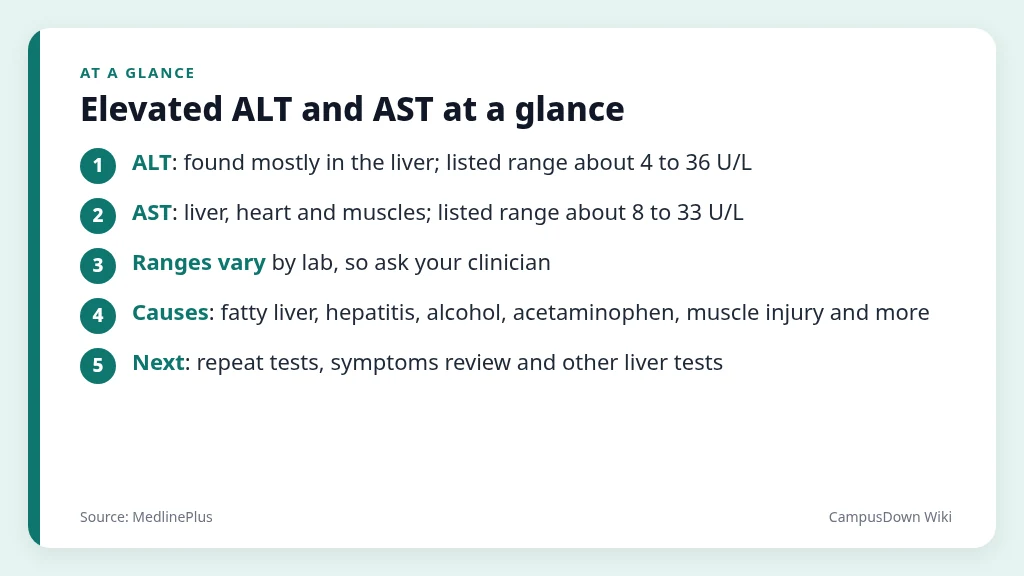
MedlinePlus says ALT (alanine transaminase) is an enzyme found in a high level in the liver, and AST (aspartate aminotransferase) is found in high levels in the liver, heart and muscles, and in lesser amounts in other tissues. Injury to the liver results in release of these enzymes into the blood. The tests are mainly done along with other tests (such as ALP and bilirubin) to diagnose and monitor liver disease. Liver function tests are often part of a comprehensive metabolic panel at a routine checkup.

What counts as elevated
MedlinePlus lists normal ranges of 4 to 36 U/L for ALT and 8 to 33 U/L for AST, and says normal ranges vary slightly among labs, some use different measurements, and you should talk to your provider about your specific results. Don't compare your result to a range from another lab. The page doesn't give a cutoff for "high," how fast to repeat the test or how to grade severity.
Causes of a high ALT
MedlinePlus says an increased ALT is often a sign of liver disease, even more likely when other liver blood tests are also high, and lists cirrhosis, death of liver tissue, hepatitis, too much iron in the body (hemochromatosis), too much fat in the liver (fatty liver), lack of blood flow to the liver, a liver tumor or cancer, medicines and drugs that are toxic to the liver (such as alcohol or acetaminophen), mononucleosis and pancreatitis. See hepatitis C, cirrhosis, acetaminophen and alcohol and aging.
Causes of a high AST
AST has many of the same causes, and since it also comes from the heart and muscles, MedlinePlus adds heart attack, muscle disease or trauma. AST can also increase after deep burns, heart procedures, seizures and surgery, and pregnancy and exercise may also cause an increased AST. This is why a high AST alone doesn't prove a liver problem, and why your clinician looks at both enzymes.
Reading the pattern
MedlinePlus says liver function tests alone usually can't diagnose specific diseases, so if results are abnormal you will usually need other tests to find the exact cause, and that your provider compares all the substances measured to look for patterns that suggest different types of liver conditions. The patterns can show whether the liver is inflamed (hepatitis), whether it is from alcohol or other causes such as infection, whether the liver isn't working well, a bile duct problem or medicine harm. Abnormal results don't always mean a liver problem, and if you have been ill recently, results may be temporary and your provider may repeat the tests. The pages don't explain the meaning of a high ALT with a normal AST or normal bilirubin, so ask your clinician about your own pattern.
Symptoms that go with liver trouble
MedlinePlus lists nausea and vomiting, lack of appetite, fatigue, weakness, jaundice (yellow skin and eyes), swelling or pain in the abdomen, swelling in the ankles and legs, dark urine and light-colored stool and frequent itching. Your risk may be higher with a family history of liver disease, alcohol use disorder, obesity, diabetes, certain medicines or hepatitis. Many people with mildly high enzymes have no symptoms, so don't wait for symptoms before asking your doctor.
Getting ready for a retest
Tell your provider about everything you take, since certain medicines can affect results; don't stop any unless your provider tells you to. You will probably need to fast 10 to 12 hours if your provider says so, and the blood draw takes less than five minutes. Bring a list of all medicines and supplements; see the brown bag medication review and lab values for nursing students.
Get help now if
Call your doctor promptly for yellow skin or eyes, dark urine with pale stools, severe belly pain or swelling, confusion or persistent vomiting. Seek emergency care for chest pain, trouble breathing or sudden severe symptoms, since a high AST can also come from the heart or muscles.
Questions for your doctor
- Which of my medicines or supplements could raise my enzymes?
- Should we repeat the test, and when?
- Which other tests do I need to look for a cause?
- How much alcohol is safe for me while we investigate?
- When should I call about new symptoms?
Example scenario: the flagged lines
- Who
- Octavio, 49, a long-haul trucker in Amarillo, Texas, saw two flagged lines on his annual lab results.
- What happened
- He felt fine and tried to ignore them.
- How it felt
- His wife pushed him to call, and he worried about liver damage.
- What they did
- His doctor asked about alcohol, over-the-counter pain relievers and supplements and ordered more tests. Octavio brought his medicine list, cut back on the pain relievers he had been taking daily and kept his follow-up lab appointment.
- How it turned out
- Octavio said the plain questions about what he took each day made the call easier.
This is an illustrative example, not a real patient or a review.
Octavio's story is an illustrative example. Don't stop a prescribed medicine on your own because of a lab result.
Most-asked questions about elevated ALT and AST
What do elevated ALT levels mean?
An increased ALT is often a sign of liver disease, especially when other liver tests are also high; your clinician compares the pattern.
Why people ask: "elevated alt levels" is #2 for "elevated alt" (US autocomplete, November 2026).
What does elevated ALT with normal AST mean?
MedlinePlus doesn't discuss this pattern; both enzymes are read with other liver tests, so ask your clinician about your results.
Why people ask: "elevated alt normal ast" is #6 for "elevated alt" (US autocomplete, November 2026).
What is the measurement for ALT?
MedlinePlus lists 4 to 36 U/L (0.07 to 0.60 µkat/L) for ALT, and ranges vary between labs.
Why people ask: "elevated alt measurement" is #7 for "elevated alt" (US autocomplete, November 2026).
What are the causes of elevated ALT?
Liver conditions such as fatty liver, hepatitis, cirrhosis and hemochromatosis, plus alcohol, acetaminophen, mononucleosis and pancreatitis.
Why people ask: "elevated alt causes" is #10 for "elevated alt" (US autocomplete, November 2026).
What do elevated ALT and AST levels mean?
Often a sign of liver disease, especially when other liver tests are high, but AST also rises with heart, muscle and exercise-related causes.
Why people ask: "elevated alt and ast levels" is #2 for "elevated alt and ast" (US autocomplete, November 2026).
What does elevated ALT and AST mean?
Liver injury is the most common concern, but the tests alone usually can't diagnose a specific disease, so more testing is usual.
Why people ask: "elevated alt and ast meaning" is #4 for "elevated alt and ast" (US autocomplete, November 2026).
What are the causes of elevated ALT and AST?
Cirrhosis, hepatitis, fatty liver, hemochromatosis, alcohol or acetaminophen, mononucleosis and pancreatitis; for AST also heart attack, muscle injury, surgery and exercise.
Why people ask: "elevated alt and ast causes" is #5 for "elevated alt and ast" (US autocomplete, November 2026).
Can pregnancy cause elevated ALT and AST?
MedlinePlus says pregnancy and exercise may cause an increased AST; it doesn't say this for ALT, so ask your clinician about pregnancy-related testing.
Why people ask: "elevated alt and ast in pregnancy" is #6 for "elevated alt and ast" (US autocomplete, November 2026).
What does elevated ALT and AST with normal bilirubin mean?
MedlinePlus says clinicians compare all the tests together; the pages don't interpret this specific pattern, so ask your clinician.
Why people ask: "elevated alt and ast but normal bilirubin" is #8 for "elevated alt and ast" (US autocomplete, November 2026).
What are the symptoms of elevated ALT and AST?
The enzymes themselves cause no symptoms; liver trouble can cause nausea, fatigue, jaundice, dark urine, itching and abdominal or leg swelling, though many people have none.
Why people ask: "elevated alt and ast symptoms" is #10 for "elevated alt and ast" (US autocomplete, November 2026).
Related on CampusDown
You can learn more about the health topics hub and check it for yourself in fatty liver disease. For liver scarring in detail, see cirrhosis and hepatic encephalopathy, and for a common pain reliever and the liver see acetaminophen.
Frequently asked questions
- What are ALT and AST?
- Enzymes released into the blood when liver cells are injured; AST is also found in the heart and muscles.
- What is the normal range?
- MedlinePlus lists 4 to 36 U/L for ALT and 8 to 33 U/L for AST, and ranges vary by lab.
- Does a high result always mean liver disease?
- No; it is often a sign of liver disease, but other causes such as muscle injury and exercise can raise AST.
- What tests come next?
- Other liver tests, a review of medicines and symptoms and sometimes repeat testing.
- Which medicines can matter?
- Alcohol and acetaminophen are named as toxic to the liver; tell your provider about everything you take.
Elevated ALT and AST are often a sign of liver disease, but they can also come from muscle, heart and other causes, and the pair alone rarely gives a diagnosis. Bring your medicine and supplement list, ask about repeat and follow-up tests and report symptoms such as jaundice, dark urine or severe belly pain.
Browse more guides like this in the U.S. Health Topics hub.
This article is for general education and does not replace advice from your own doctor, nurse or pharmacist.