
Which is safer for your father: a shower chair, or a bench that helps him get over the edge of the tub? The answer depends on his balance, his bathroom and how he gets in and out. A wrong guess can mean an expensive seat that he won't use or one that makes the real problem worse.
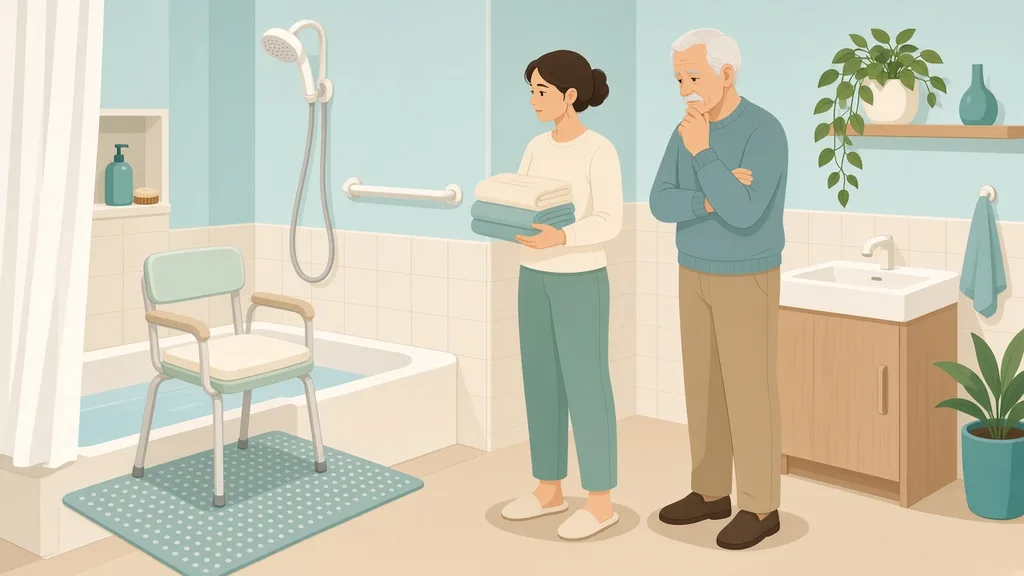
This guide is based on MedlinePlus's "Bathroom safety for adults" and CMS's Durable Medical Equipment (DME) Reference List (NCD 280.1). It explains in detail how the choices differ. A doctor, occupational therapist or physical therapist can tell you which equipment fits you.
Why bathrooms matter
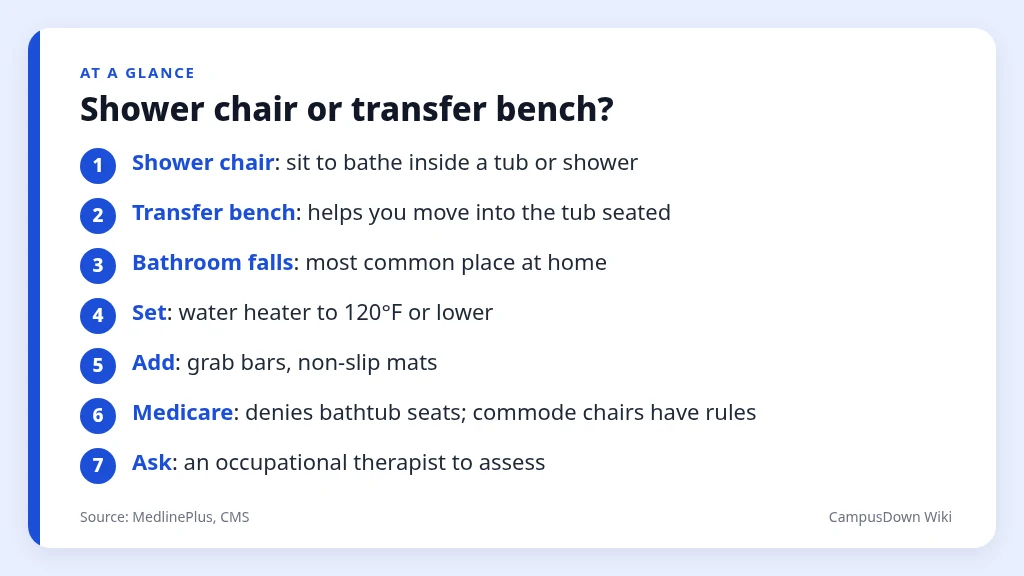
MedlinePlus says the bathroom is a place in the home where falls most often happen, and that people with joint pain, muscle weakness or a physical disability need extra precautions. MedlinePlus advice for bath or shower includes to sit on a bath chair or bench when taking a shower, put non-slip suction mats or rubber silicone decals in the tub, use a non-skid mat outside the tub, install a single-lever faucet, keep the floor outside the tub dry, and set the water heater to no more than 120°F (49°C) to prevent burns.

Shower chair vs transfer bench
- Shower chair (bath chair): you sit to wash, in a tub or a walk-in shower. You still have to step in over the tub edge unless it's a walk-in shower.
- Transfer bench: designed to span the edge of the tub, so you sit on the outside part, then slide across rather than stepping over. This helps people who can't lift their legs over the tub wall safely.
If you're not sure, consider: Can you stand safely to step over the edge? Can you lift your legs over? Is there a curtain or door that gets in the way? Does the person need a back, arms or a commode opening? Check each product's weight limit, the rubber feet and height adjustment on the label or product page.
Grab bars and other add-ons
MedlinePlus says to secure grab bars vertically or horizontally, not diagonally, and not to use towel racks as grab bars. It recommends two: one to get in and out of the tub and another to stand up from sitting. Learn more about installation in grab bar installation. A handheld shower head and a raised toilet seat can also help. For a full home review, use our fall prevention checklist.
Does Medicare cover shower chairs?
CMS's Durable Medical Equipment Reference List says:
- Bathtub seats: denied, as a comfort or convenience item, hygienic equipment and not primarily medical in nature.
- Grab bars: denied, as self-help devices not primarily medical in nature.
- Toilet seats: denied, not medical equipment.
- Commodes: covered if the patient is confined to bed or room, meaning leaving the room is medically contraindicated.
Medicare.gov says Part B covers commode chairs when a doctor orders them for use in your home; after the Part B deductible you pay 20% of the Medicare-approved amount if the supplier accepts assignment. See our Medicare DME guide. Medicare Advantage plans sometimes include bathroom safety extras; check your plan's benefits.
Ask an occupational therapist
MedlinePlus says that if you aren't sure what changes you need, ask your provider for a referral to an occupational or physical therapist, who can visit your bathroom and make safety recommendations. You can also ask at hospital discharge; see hospital discharge planning. Strength and balance training matters too; see balance exercises for seniors.
Get help now if
A shower chair doesn't make the bathroom fall-proof. If the person is dizzy, very weak or confused, they shouldn't bathe alone. If someone falls, don't rush to lift them; see our guide to getting up after a fall. Call 911 for severe injury.
For people who resist bathing
If dementia is part of the picture, a new seat can feel threatening. Our bathing resistance in dementia guide has gentler approaches.
Example scenario: the bench that fit his stiff knees
- Who
- Wolfgang, 80, a retired piano tuner in Burlington, Vermont, loved his long soaks, but a stiff right hip meant he could barely lift his leg over the tub wall. His wife, Imelda, 78, waited outside the door whenever he bathed.
- What happened
- One evening he slid on the tub floor trying to step in, grabbed the curtain rod, and pulled it down. He wasn't hurt, but he sat on the bathroom floor for ten minutes before calling for help.
- How it felt
- Wolfgang felt ashamed to be afraid of his own bathtub. Imelda felt a knot of worry each time she heard the water running.
- What they did
- His doctor referred him to an occupational therapist, who visited the bathroom, measured the tub and suggested a transfer bench with a back, a handheld shower head, a grab bar and a non-slip mat. They checked the weight limit and had the water heater set to a safer temperature. Medicare didn't pay for the bench, but Imelda checked the plan for any benefit and bought the item herself.
- How it turned out
- Wolfgang said he still misses soaking but can shower without gripping the curtain. Imelda said she now waits in the next room and hears nothing but humming.
This is an illustrative example, not a real patient or a review.
Wolfgang's story is an illustrative example. Equipment choices depend on a bathroom assessment.
Most-asked questions about shower chairs and transfer benches
Does Medicare cover shower chairs?
CMS's equipment list denies bathtub seats as comfort or convenience items, so Original Medicare generally doesn't pay. Some Medicare Advantage plans offer extras.
Why people ask: "does medicare cover shower chairs" is #1 for "does medicare cover shower chairs" (US autocomplete, November 2026).
Does Medicare cover shower chairs and grab bars?
CMS denies both bathtub seats and grab bars as not primarily medical. Check your Medicare Advantage plan's benefits.
Why people ask: "does medicare cover shower chairs and grab bars" is #3 for "does medicare cover shower chairs" (US autocomplete, November 2026).
Does Medicare cover bath chairs?
Same rule: bathtub seats are denied. Commode chairs are different; Part B covers them when ordered and the patient meets the rules.
Why people ask: "does medicare cover bath chairs" is #5 for "does medicare cover shower chairs" (US autocomplete, November 2026).
Does Medicare cover shower benches?
Bathtub seats, including benches used in a tub, are on CMS's denied list.
Why people ask: "does medicare cover shower benches" is #8 for "does medicare cover shower chairs" (US autocomplete, November 2026).
What's the best shower chair for the elderly?
The best one fits the person and the bathroom: stable, correct height, within the weight limit and used every time. Ask an occupational therapist.
Why people ask: "shower chair for elderly" is #3 for "shower chair" (US autocomplete, November 2026).
Transfer bench vs shower chair: which is better?
A transfer bench helps with getting over the tub edge; a shower chair helps with sitting once you're in. The right choice depends on your mobility.
Why people ask: "transfer bench vs shower chair" is #10 for "transfer bench" (US autocomplete, November 2026).
What is a transfer bench for a bathtub?
A bench that sits across the tub wall so you can sit, then slide in, rather than stepping over.
Why people ask: "transfer bench for bathtub" is #3 for "transfer bench" (US autocomplete, November 2026).
Related on CampusDown
You can learn more in our fall prevention checklist and take a closer look at grab bar installation.
Frequently asked questions
- Do I need a prescription for a shower chair?
- Usually not to buy one privately. Medicare doesn't cover bathtub seats anyway. Ask your therapist what to buy.
- Should the water heater be turned down?
- MedlinePlus says to set it to no more than 120°F (49°C) to prevent burns.
- Can a towel rack be a grab bar?
- No. MedlinePlus says towel racks can't support your weight.
- Is a commode chair covered?
- Part B covers commode chairs if your doctor orders one and you meet the rules, such as being bed or room confined. Check it for yourself with your doctor and supplier.
A bath seat is one piece of a safer bathroom. Ask an occupational therapist to assess your tub, add grab bars and mats, lower the water temperature and make sure the seat fits the person who will use it.
Browse more guides like this in the Home Medical Devices hub.
This article is for general education and does not replace advice from your own doctor, nurse or pharmacist.