
Is it your chair that's the problem, or the way you're getting out of it? That's the question behind most lift chair shopping. A power lift recliner can be a gift for someone who can't stand from a seat, but it's often also a very expensive substitute for fixes that cost less.

This guide is based on CMS's National Coverage Determination (NCD) 280.4 "Seat Lift", the DME MAC policy L33801 "Seat Lift Mechanisms" and CMS's Durable Medical Equipment (DME) Reference List. We explain in detail what is and isn't covered. Ask your doctor or physical therapist what's right for your body before buying.
What Medicare may cover: the mechanism, not the chair
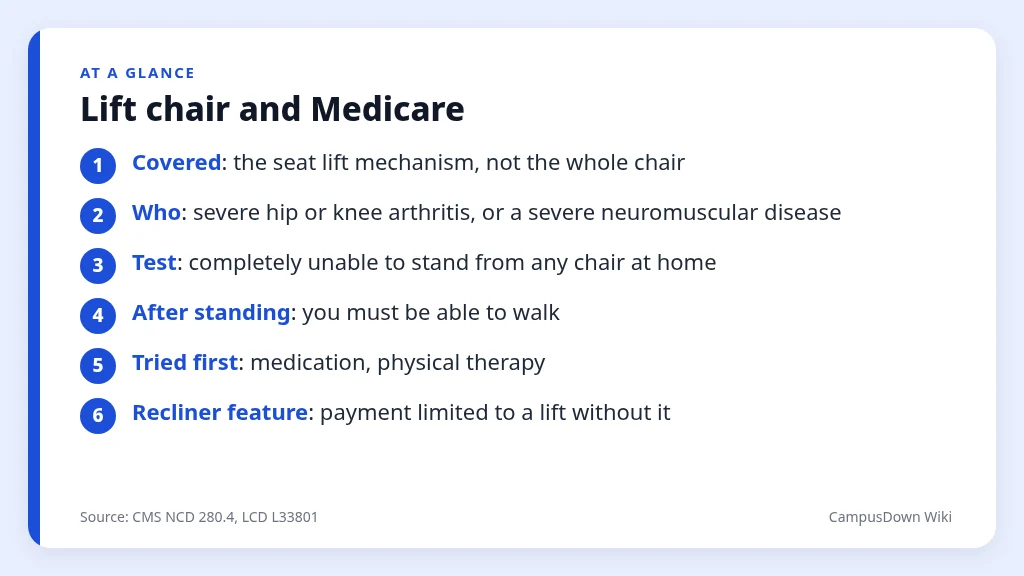
NCD 280.4 says Medicare may pay to rent or buy a medically necessary seat lift when a physician prescribes it for a patient with severe arthritis of the hip or knee, or with muscular dystrophy or other neuromuscular diseases, when the patient can benefit therapeutically from it. CMS also says payment for a unit that includes a recliner feature is limited to the amount payable for a seat lift without that feature. In practice, the recliner furniture is mostly your cost. Our Medicare DME guide covers the general rules, including the 20% coinsurance for covered DME.

The criteria Medicare uses
The DME MAC policy (L33801) says a seat lift mechanism is covered only if all of these are met:
- You have severe arthritis of the hip or knee, or a severe neuromuscular disease.
- The lift is part of your practitioner's course of treatment, prescribed to improve, or arrest or retard deterioration in your condition.
- You are completely incapable of standing up from a regular armchair or any chair in your home.
- Once standing, you can walk.
- The practitioner's record shows that appropriate treatments (for example medication and physical therapy) have been tried and failed to let you get from sitting to standing.
The policy is blunt about one point: having difficulty, or even being unable, to get up from a low chair isn't enough. It says almost everyone who can walk can get out of an ordinary chair if the seat height is appropriate and the chair has arms.
What kind of lift is covered
Coverage is limited to lifts that operate smoothly, can be controlled by the patient and effectively help you stand and sit without other assistance. A spring-release "catapult" lift that jolts you from sitting to standing is excluded.
Paperwork
The DME MAC policy requires a Standard Written Order before the supplier bills. Medicare.gov says the supplier must be Medicare-enrolled, and our hospital bed guide explains assignment and rental terms that apply to other DME items too.
Try these first
Before spending money, ask your doctor, physical therapist or occupational therapist about:
- Raising the seat with a firm cushion or furniture risers, and using a chair with arms.
- Strength and balance work: our balance exercises for seniors guide has simple starting points.
- Checking medications that cause dizziness or weakness, using a brown bag review with your pharmacist.
- A walking aid: see walker vs rollator.
- Home safety fixes: use our fall prevention checklist.
Get help now if
A lift chair tips you forward onto your feet. If you're dizzy or unsteady when you first stand, stay seated and take a moment before walking. If you fall, see getting up after a fall.
Buying privately
If you don't meet Medicare's criteria, you can buy a lift chair yourself. If you do, try several models in person where possible, and check seat height and depth, how fast the lift moves, the weight limit, what happens in a power cut (a battery backup may be offered), and the return and warranty terms. You can check it for yourself by sitting in the chair and standing up several times.
Example scenario: the chair that lifted too little
- Who
- Osric, 78, a retired long-haul trucker in Amarillo, Texas, had severe knee arthritis and found it harder every month to stand from his favorite armchair. His granddaughter, Valentina, 24, visited on weekends and kept finding him stuck.
- What happened
- Osric lost his balance one Sunday trying to pull himself up and caught the coffee table on the way down. He wasn't hurt, but he hadn't called anyone for twenty minutes.
- How it felt
- Osric felt humiliated that his legs, which had carried him across forty states, wouldn't let him leave his own chair. Valentina felt guilty for wanting to say "just buy a lift chair" without knowing whether it would help.
- What they did
- They took the question to his doctor, who sent him to physical therapy and asked about the seat height. A firm cushion and a chair with arms made standing easier, and therapy improved his leg strength. His doctor also explained that Medicare could pay only for the lift mechanism if he met every criterion, and that Osric could still stand from a chair with arms, so he didn't qualify.
- How it turned out
- Osric said he was relieved to be on his feet without buying anything big. Valentina said she was glad they asked before spending money on it, and that she now checks the chair arms each visit.
This is an illustrative example, not a real patient or a review.
Osric's story is an illustrative example. Whether a lift chair makes sense depends on a medical evaluation.
Most-asked questions about lift chairs
Does Medicare cover lift chairs?
Medicare may cover the seat lift mechanism, not the whole chair, if your doctor prescribes it and you meet all of the criteria, including being completely unable to stand from any chair at home.
Why people ask: "does medicare cover lift chairs" is #1 for "does medicare cover lift chairs" (US autocomplete, November 2026).
Are lift chairs covered by Medicare for seniors?
Age alone doesn't qualify you. CMS requires severe hip or knee arthritis or a severe neuromuscular disease, plus the other criteria.
Why people ask: "lift chairs covered by medicare" is #10 for "lift chair" (US autocomplete, November 2026).
Does Medicare cover lift recliners?
CMS limits payment for units with a recliner feature to the amount payable for a seat lift without it.
Why people ask: "does medicare cover lift recliners" is #10 for "does medicare cover lift chairs" (US autocomplete, November 2026).
Does Medicare cover lift chair rental?
CMS says seat lifts may be rented or bought when medically necessary. Confirm the supplier's terms.
Why people ask: "does medicare cover lift chair rental" is #9 for "does medicare cover lift chairs" (US autocomplete, November 2026).
Is a lift chair good for the elderly?
It can help someone who can't stand, but it doesn't treat weakness or balance problems. Ask a therapist what else you need.
Why people ask: "lift chair for elderly" is #3 for "lift chair" (US autocomplete, November 2026).
Related on CampusDown
Looking at other equipment? You can learn more about power wheelchair coverage, and take a closer look at caregiver burnout if you're the one doing the lifting.
Frequently asked questions
- Does Medicare Advantage cover lift chairs?
- Plans must cover what Original Medicare covers, and some add extras. Check your plan.
- Can a lift chair replace a walker?
- No. It helps you stand, but you still need to walk safely afterward.
- Is it safe to sleep in a lift recliner?
- Some people do, but ask your doctor if you have breathing problems, swelling or skin issues.
- Will insurance pay for the whole chair?
- Original Medicare pays only for the lift mechanism when you qualify. Other insurers vary.
A lift chair is a tool for one specific problem: standing up. Before you buy one, ask for a medical evaluation, try a higher seat or arms, and keep working on strength and balance.
Browse more guides like this in the Home Medical Devices hub.
This article is for general education and does not replace advice from your own doctor, nurse or pharmacist.