
Someone at the table bites into a dish that contained a hidden allergen, their lips swell and their voice goes hoarse. Do you know what you would do in the next 60 seconds?

This guide uses the MedlinePlus epinephrine injection page (AHFS patient information, last revised June 15, 2026). It covers the prefilled automatic injection devices this page describes. It is general information, not a substitute for the instructions that come with your device or for emergency care. If you want to learn more about reactions that happen after food, take a closer look at alpha-gal syndrome.
Get help now if
If you or someone else may be having a serious allergic reaction, use the prescribed epinephrine device right away as directed and call 911. Do not wait to see whether symptoms improve.
What it is used for
MedlinePlus says epinephrine injection is used along with emergency medical treatment for life-threatening allergic reactions caused by insect bites or stings, foods, medications, latex and other causes. In hospitals it is also used for life-threatening low blood pressure from septic shock, given into a vein by a doctor or nurse; see sepsis. Epinephrine relaxes the muscles in the airways and tightens the blood vessels. The page lists these brands: Adrenaclick, Adrenalin, Auvi-Q, EpiPen, EpiPen Jr, Symjepi and Twinject (discontinued). Newer products may not be covered; ask your pharmacist how yours works and follow its own instructions.

Signs of a serious reaction
MedlinePlus lists closing of the airways, wheezing, sneezing, hoarseness, rash, hives, itching, swelling of the face, eyes, mouth, throat or hands, skin redness, fast heartbeat, weak pulse, anxiety, confusion, stomach pain, vomiting, diarrhea, losing control of urine or bowels, faintness, seizures and loss of consciousness. It says to inject as soon as you suspect a serious reaction and to talk with your doctor about how to tell when to use it. See asthma attack signs for breathing symptoms.
How to use an auto-injector
- Read the patient information that comes with your device and ask your doctor or pharmacist to show you and any caregivers how to use it. Training devices are available, and they contain no medicine and have no needle.
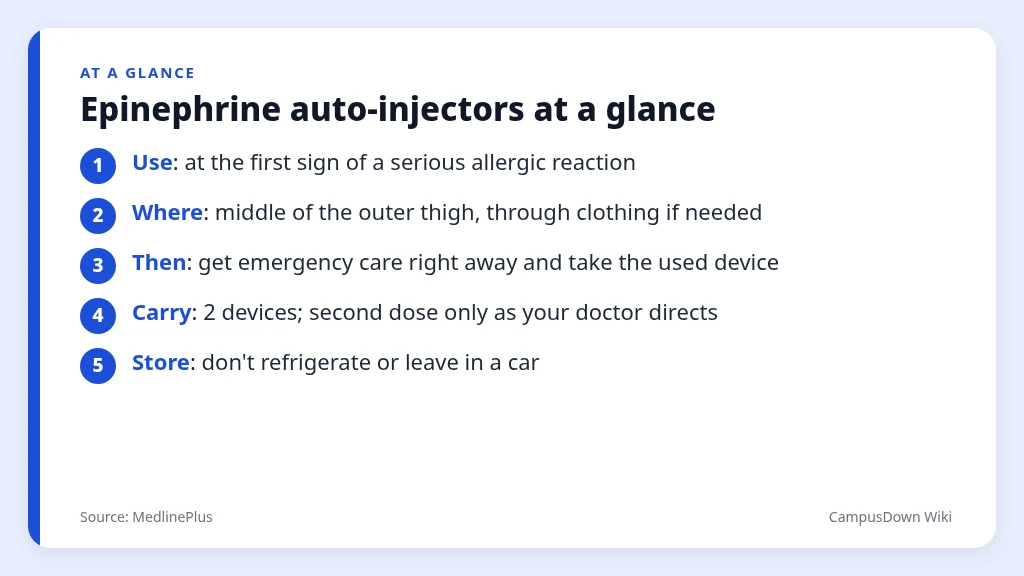
- Inject only into the middle of the outer side of the thigh, which can be done through clothing in an emergency.
- Never inject into the buttocks, fingers, hands, feet or a vein.
- Keep your thumb, fingers and hand away from the needle end. If injected there by accident, get emergency treatment right away.
- For a young child, hold the leg firmly to limit movement.
- Get emergency medical treatment immediately after injecting, and rest quietly while you wait.
- Some liquid stays in the device; that is normal and doesn't mean you missed the dose. Take the used device with you to the emergency room or ask your provider how to dispose of it.
Carrying two devices and second doses
MedlinePlus says to keep 2 automatic injection devices with you or available at all times, because one dose may not be enough and so you can inject quickly. If symptoms continue or return, your doctor may tell you to use a second dose with a new device, so know how and when. Only a healthcare provider should give more than 2 injections for a single episode. Use exactly as directed.
Storage
Keep it in the plastic carrying tube, tightly closed, at room temperature, away from light, heat and moisture (not the bathroom). Don't refrigerate it or leave it in your car in hot or cold weather. If you drop it, check for breakage or leaking, throw away damaged medicine and have a replacement available. Get a replacement right away after using one. Don't let anyone else use your medication.
Who should tell their doctor first
Tell your doctor or pharmacist about allergies, all medicines and supplements, and chest pain, irregular heartbeat, high blood pressure, asthma, diabetes, an overactive thyroid, depression, Parkinson's disease, heart or kidney disease, pregnancy or breastfeeding. MedlinePlus says antihistamines such as chlorpheniramine and diphenhydramine may interact, so don't start them without discussing it; see diphenhydramine and cetirizine. Antihistamines don't replace epinephrine for a serious reaction.
Side effects
Tell your doctor when you get emergency care if you notice: redness, swelling, warmth or tenderness at the injection site, difficulty breathing, pounding, fast or irregular heartbeat, nausea, vomiting, sweating, dizziness, nervousness, anxiety, restlessness, weakness, headache and uncontrollable shaking of a body part. In an overdose call poison control at 1-800-222-1222 or 911 for collapse, a seizure or trouble breathing.
Questions for your doctor or pharmacist
- Which device did I get, and can you show me how it works?
- Which symptoms mean I should inject?
- How many devices should I carry, and where do I store them?
- When should I use a second dose?
- Which medicines do I need to avoid or discuss?
Example scenario: the practice pen
- Who
- Pascal, 44, a father of two in Madison, Wisconsin, carried an epinephrine auto-injector for a bee-sting allergy.
- What happened
- At a picnic his friend's wife was stung and began wheezing, and her husband froze.
- How it felt
- Pascal's heart raced, and he worried he'd hurt her by using his own device.
- What they did
- He remembered the pharmacist had told him to ask for training, so he called 911 and talked the husband through using her own prescribed device on her outer thigh. Pascal stayed with her until the paramedics arrived.
- How it turned out
- Pascal said practicing with a trainer made the moment less frightening.
This is an illustrative example, not a real patient or a review.
Pascal's story is an illustrative example. Use only the epinephrine prescribed for the person in need, call 911 and follow your clinician's instructions.
Most-asked questions about epinephrine auto-injectors
Is there a video on how to use an EpiPen?
MedlinePlus doesn't link a video; ask your pharmacist for a demonstration and a training device, and read the patient information that comes with your device.
Why people ask: "epipen how to use video" is #2 for "epipen how to use" (US autocomplete, November 2026).
Is there an EpiPen how-to PDF?
Each device comes with patient information that includes instructions; MedlinePlus tells you to read it before first use.
Why people ask: "epipen how to use pdf" is #3 for "epipen how to use" (US autocomplete, November 2026).
Is there an EpiPen how-to poster?
MedlinePlus doesn't mention a poster; ask your pharmacist or doctor for the written instructions for your device.
Why people ask: "epipen how to use poster" is #6 for "epipen how to use" (US autocomplete, November 2026).
Is there an EpiPen how-to on YouTube?
MedlinePlus doesn't cite online videos; training devices and your pharmacist's demonstration are what the page recommends.
Why people ask: "epipen how to use youtube" is #8 for "epipen how to use" (US autocomplete, November 2026).
What is the epinephrine auto-injector dose?
Use exactly as prescribed; MedlinePlus says to inject at the first sign of a serious reaction and that a second dose with a new device is only if your doctor says so.
Why people ask: "epinephrine auto injector dose" is #2 for "epinephrine auto injector" (US autocomplete, November 2026).
Is there a generic epinephrine auto-injector?
MedlinePlus lists brands such as Adrenaclick, Auvi-Q, EpiPen and Symjepi but doesn't discuss generics; ask your pharmacist what is available.
Why people ask: "epinephrine auto injector generic" is #6 for "epinephrine auto injector" (US autocomplete, November 2026).
How do you use an epinephrine auto-injector?
Inject into the middle of the outer thigh, keep your hand away from the needle end, get emergency care right away and take the used device with you.
Why people ask: "epinephrine auto injector how to use" is #7 for "epinephrine auto injector" (US autocomplete, November 2026).
What are the epinephrine auto-injector brands?
Adrenaclick, Adrenalin, Auvi-Q, EpiPen, EpiPen Jr, Symjepi and Twinject (discontinued), per MedlinePlus.
Why people ask: "epinephrine auto injector brands" is #8 for "epinephrine auto injector" (US autocomplete, November 2026).
What are epinephrine auto-injector side effects?
Redness at the site, pounding heartbeat, nausea, sweating, anxiety, tremor and headache; tell your doctor when you get emergency care.
Why people ask: "epinephrine auto injector side effects" is #9 for "epinephrine auto injector" (US autocomplete, November 2026).
What are the indications for an epinephrine auto-injector?
Life-threatening allergic reactions to stings, foods, medicines, latex and other causes.
Why people ask: "epinephrine auto injector indications" is #10 for "epinephrine auto injector" (US autocomplete, November 2026).
Related on CampusDown
You can learn more about the medicines hub and check it for yourself in high-alert medications. For allergic skin reactions in detail, see hives, and for the allergy to red meat see alpha-gal syndrome.
Frequently asked questions
- When do I inject epinephrine?
- At the first sign of a serious allergic reaction, then get emergency care.
- Where do I inject it?
- The middle of the outer thigh, through clothing if needed; never the buttocks, fingers, hands, feet or a vein.
- Why carry two devices?
- One dose may not be enough, and your doctor may tell you to use a second dose.
- Can I store it in the car?
- No; don't refrigerate it or leave it in a hot or cold car.
- What should I do with the used device?
- Take it to the emergency room or ask your provider how to dispose of it; some liquid remaining is normal.
An epinephrine auto-injector can be life-saving, but only if you recognize the signs, know where to inject, carry two devices and get emergency care afterward. Practice with a training device, store it correctly and ask your pharmacist about anything on your label.
Browse more guides like this in the Home Medical Devices hub.
This article is for general education and does not replace advice from your own doctor, nurse or pharmacist.