
Spring comes, the sneezing starts and you reach for the same allergy pill you've used for years. Then one day you skip it and your skin itches like crazy. Could stopping really cause that?

This guide uses the MedlinePlus cetirizine page (AHFS patient information, last revised April 15, 2026). It is general information, not medical advice; your doctor and pharmacist know your health history. If you want to learn more about allergy symptoms that come with the seasons, take a closer look at allergic rhinitis.
What it is used for
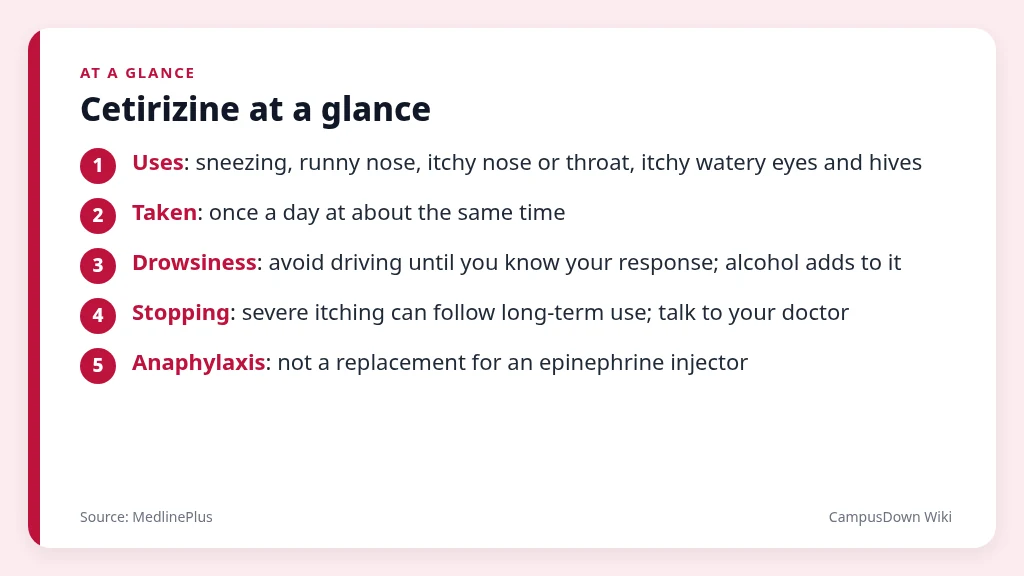
MedlinePlus says cetirizine treats allergy symptoms: sneezing, runny nose, itching of the nose or throat, and red, itchy or watery eyes, and it also treats urticaria (hives; itchy raised red bumps on the skin). It is an antihistamine that blocks histamine, a substance in the body that causes allergic symptoms. MedlinePlus lists the brands Aller-Tec, Alleroff and Zyrtec and combination products such as Zyrtec-D, which contain a decongestant.

How it is taken
It comes as a tablet, a chewable tablet, a capsule, an orally disintegrating tablet and a syrup, and is taken once a day with or without food, at around the same time every day. For the orally disintegrating tablet, use dry hands to peel back the foil, place the tablet on your tongue and swallow with saliva. Follow label directions exactly. Missed dose: take it when you remember, but skip it if it's almost time for the next dose; never double up.
Hives: when to stop and call
MedlinePlus says don't use cetirizine for hives that are bruised or blistered, are an unusual color or don't itch, and to call your doctor for those. Stop taking it and call your doctor if hives don't improve in the first 3 days or last longer than 6 weeks, and if you don't know the cause of your hives, call your doctor. See hives.
Get help now if
If you have hives and develop trouble swallowing, speaking or breathing, swelling in or around the mouth or of the tongue, wheezing, drooling, dizziness or loss of consciousness, get emergency help right away; these can be anaphylaxis. MedlinePlus says cetirizine must not be used in place of an epinephrine injector if your doctor has prescribed one. See epinephrine auto-injectors.
Who should be careful
Tell your doctor or pharmacist if you are allergic to cetirizine, any of its ingredients or any other medication, food or substance, about all prescription and nonprescription medicines, vitamins and supplements you take, and if you have or have had kidney or liver disease or are pregnant, planning pregnancy or breastfeeding. MedlinePlus says cetirizine may make you drowsy, so don't drive or use machinery until you know how it affects you, and alcohol can add to the drowsiness. Another page on this site lists cetirizine among medicines that can interact with ADHD stimulants; see Adderall and diphenhydramine for another sedating antihistamine.
Stopping long-term use
MedlinePlus says you could develop severe itching within a few days after you stop taking cetirizine, which can happen after taking it regularly for a few months or years. Talk to your doctor if you have questions about the risks. If you've used it daily for a long time, ask your doctor or pharmacist before stopping on your own.
Side effects
Tell your doctor if severe or lasting: drowsiness, excessive tiredness and dry mouth. Call your doctor immediately for rash, difficulty breathing or swallowing, or itching that starts a few days after stopping long-term use. Report serious effects to FDA MedWatch (fda.gov/Safety/MedWatch, 1-800-332-1088). In an overdose, MedlinePlus lists restlessness, irritability and drowsiness; call poison control at 1-800-222-1222, or 911 for collapse, a seizure or trouble breathing.
Questions for your pharmacist
- Which form and generic name fit me?
- Will this make me drowsy, and should I avoid it with alcohol?
- Is it safe with my kidney or liver condition, or during pregnancy?
- What should I do if I've taken it daily for years and want to stop?
- When should I see a doctor for hives?
Example scenario: the itch after stopping
- Who
- Leocadia, 52, an elementary school librarian in Raleigh, North Carolina, had taken a daily cetirizine tablet for years during allergy season.
- What happened
- She stopped for a weekend trip and developed severe itching a couple of days later.
- How it felt
- She worried she'd developed a new allergy and almost doubled her next dose.
- What they did
- She called her pharmacist, who explained that itching after stopping long-term use is a listed warning, confirmed she should not double up and recommended she talk with her doctor about a plan. Leocadia kept a written medication list and shared it at her visit.
- How it turned out
- Leocadia said knowing the itch had a name made it less frightening.
This is an illustrative example, not a real patient or a review.
Leocadia's story is an illustrative example. Talk with your doctor or pharmacist before changing how you take a long-term medicine.
Most-asked questions about Zyrtec
What are Zyrtec side effects in the elderly?
MedlinePlus doesn't give separate guidance for older adults; drowsiness, tiredness and dry mouth are listed, so ask your pharmacist about driving and falls.
Why people ask: "zyrtec side effects in elderly" is #2 for "zyrtec side effects" (US autocomplete, November 2026).
What are Zyrtec side effects in adults?
Drowsiness, excessive tiredness and dry mouth; call right away for rash or trouble breathing or swallowing.
Why people ask: "zyrtec side effects in adults" is #4 for "zyrtec side effects" (US autocomplete, November 2026).
What are long-term Zyrtec side effects?
MedlinePlus warns that severe itching can occur within a few days after stopping after months or years of regular use; it doesn't list other long-term effects.
Why people ask: "zyrtec side effects long-term" is #7 for "zyrtec side effects" (US autocomplete, November 2026).
Does Zyrtec cause anxiety?
Anxiety isn't listed on the MedlinePlus page; tell your doctor about any unusual problem.
Why people ask: "zyrtec side effects anxiety" is #8 for "zyrtec side effects" (US autocomplete, November 2026).
What is the generic name for Zyrtec?
Cetirizine; MedlinePlus lists Zyrtec, Aller-Tec and Alleroff as brand names.
Why people ask: "zyrtec generic name" is #2 for "zyrtec generic" (US autocomplete, November 2026).
Is there a generic brand of Zyrtec?
Yes, cetirizine; check the active ingredient on the label and ask your pharmacist if products differ.
Why people ask: "zyrtec generic brand" is #3 for "zyrtec generic" (US autocomplete, November 2026).
What is the generic Zyrtec dose?
MedlinePlus says take it once a day and follow the label; it doesn't state a dose, so ask your pharmacist.
Why people ask: "zyrtec generic dose" is #7 for "zyrtec generic" (US autocomplete, November 2026).
Is generic Zyrtec 10 mg?
MedlinePlus doesn't state strengths; read the product label and ask your pharmacist or doctor about the right strength for you.
Why people ask: "zyrtec generic 10 mg" is #9 for "zyrtec generic" (US autocomplete, November 2026).
Related on CampusDown
You can learn more about the medicines hub and check it for yourself in the brown bag medication review. For allergy symptoms in detail, see allergic rhinitis, and for medicines with anticholinergic effects see anticholinergic drugs and memory.
Frequently asked questions
- What is cetirizine used for?
- Allergy symptoms such as sneezing, runny nose and itchy eyes, and hives.
- Does it cause drowsiness?
- It can; avoid driving until you know how it affects you, and avoid alcohol.
- Can stopping cause itching?
- MedlinePlus says severe itching can develop within a few days of stopping after months or years of regular use.
- When should I call about hives?
- If they don't improve in 3 days, last over 6 weeks, are bruised, blistered, an unusual color or don't itch.
- Can it replace an epinephrine injector?
- No; get emergency help for signs of anaphylaxis.
Cetirizine can ease allergy symptoms and hives, but it can cause drowsiness, it has a warning about itching after long-term use is stopped and it isn't a substitute for an epinephrine injector. Take it once a day as directed and ask your pharmacist or doctor before changing how you use it.
Browse more guides like this in the Medicines hub.
This article is for general education and does not replace advice from your own doctor, nurse or pharmacist.