
Why would anyone pay a price they think is too high? According to the greater fool theory, because they expect someone else to pay even more. The idea explains much of what happens inside market bubbles, and it is a common search when Americans watch stocks, crypto or collectibles soar.

How it works
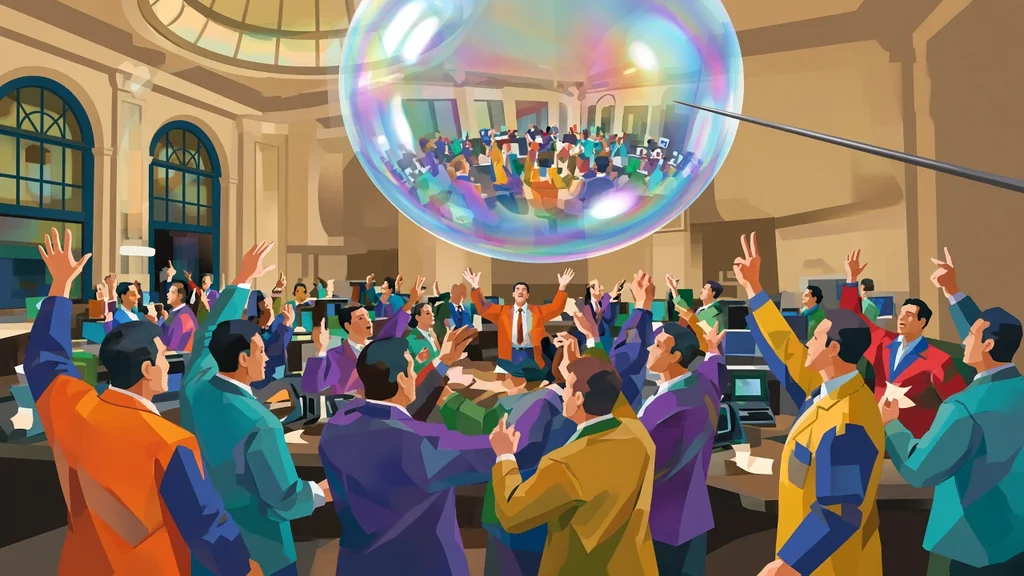
A buyer pays more than an asset seems to be worth, not because of its earnings, rent or use, but because they believe a "greater fool" will buy it from them later at a higher price. As long as new buyers keep arriving, everyone in the chain can profit on paper. When the supply of new buyers dries up, the last holders are left with an asset whose price may fall toward its fair value, which in some cases could be close to zero.
Princeton economist Burton Malkiel described the process in A Random Walk Down Wall Street: rising prices attract media coverage, coverage attracts new buyers, and new buyers push prices higher. He compared the mechanism to a kind of Ponzi scheme in which ever more credulous investors must be found.
Key idea
The greater fool theory is not a reason an asset is valuable. It is a reason a price can rise for a while even when the asset is not worth it.

US cases
- When and where
- Late 1990s to 2002, Nasdaq and Silicon Valley
- What happened
- Investors poured money into internet start-ups, many of which had never made a profit. The Nasdaq Composite peaked at 5,048.62 on Friday, March 10, 2000. San Francisco-based Pets.com, which launched in November 1998 and became famous for its sock puppet mascot, shut down in November 2000. By the end of the 2002 downturn, stocks had lost about $5 trillion in market value from the peak.
- Why it matters
- The dot-com crash is the textbook American example of prices driven by the expectation of resale rather than by business results.
- When and where
- March 2021 sale and 2022 resale attempt
- What happened
- A non-fungible token of the first tweet by Twitter co-founder Jack Dorsey sold for $2.9 million in March 2021. When the owner listed it for sale in 2022 at $48 million, the top bid was about $280.
- Why it matters
- The episode became a widely cited illustration of what happens when the next buyer does not appear.
Criticisms and limits
- Hard to identify in real time: high prices are not always a bubble. Investors may be correctly pricing future growth.
- Blames buyers, not conditions: critics argue the theory overlooks easy credit, low interest rates and other conditions that fuel bubbles.
- Timing risk: even an investor who knows a market is overvalued cannot know when it will turn, so playing the greater fool game is risky.
Related concepts
The Austrian school of economics links booms and busts to cheap credit, and the Big Mac index is a simple way to ask whether a price is out of line with fundamentals. Debates about what an asset is really worth also go back to the labor theory of value, and the limits of adding more money to a speculative position echo diminishing returns.
Study material (Korean): 「달러 강세 시대, 비트코인과 ETF로 하는 자산관리」
Frequently asked questions
- What is the greater fool theory in simple terms?
- It is the idea that you can profit from buying something overpriced if someone else will later pay even more for it.
- Is the greater fool theory a valid investment strategy?
- It can produce profits for a while, but it depends on finding new buyers and on timing the market, which makes it very risky.
- What are examples of the greater fool theory?
- Common examples include the dot-com bubble of the late 1990s and some NFT sales, such as the Jack Dorsey tweet NFT that sold for $2.9 million in 2021 and drew a top bid of about $280 in 2022.