
What gets you out of bed in the morning? In Japanese there's a word for that: ikigai.

What the word means
BBC Worklife explains that ikigai combines iki (life) and gai (value or worth). Clinical psychologist Akihiro Hasegawa traces the word back to the Heian period (794 to 1185). The gai part, he says, comes from kai, the word for shells, which were once highly valuable.
The classic Japanese book on the subject is psychiatrist Mieko Kamiya's About Ikigai (1966). She described it as close to happiness, but different: ikigai is what lets you look forward to the future even when you're miserable now.

The Venn diagram myth
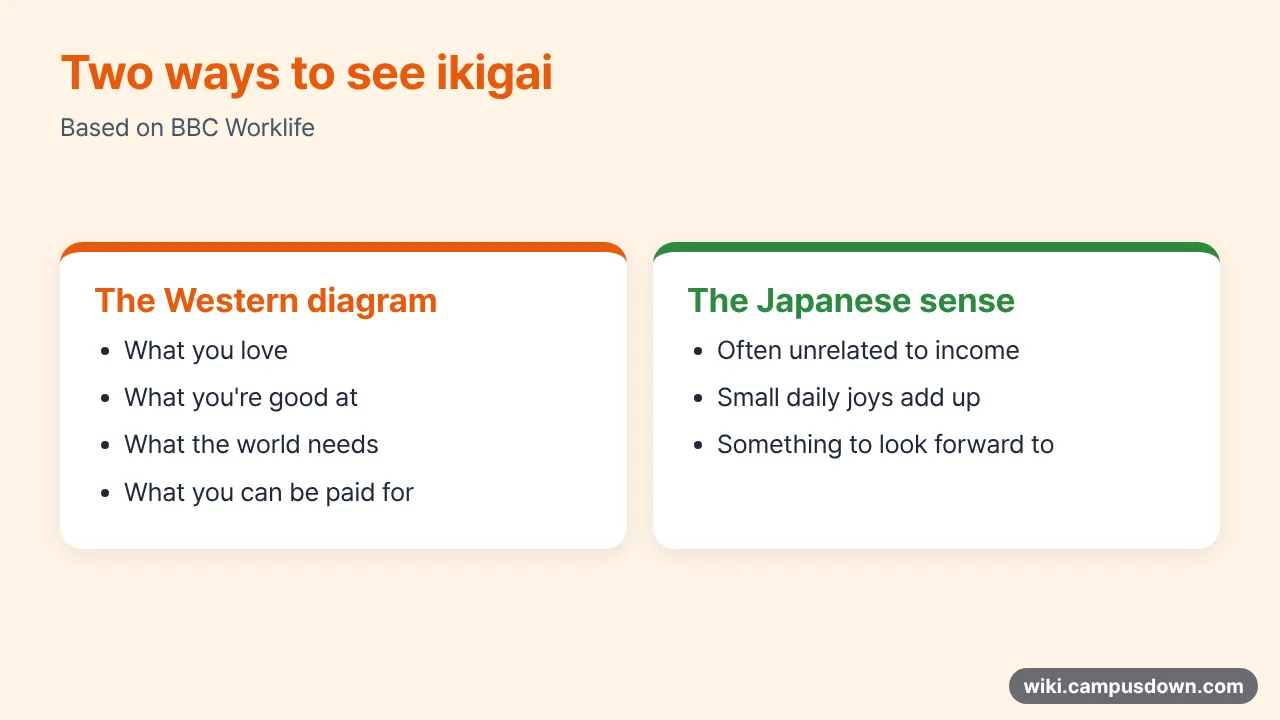
In the West, ikigai is usually shown as four overlapping circles: what you love, what you're good at, what the world needs, and what you can be paid for. The BBC points out that the Japanese idea is different. Ikigai may have nothing to do with income.
In a 2010 survey of 2,000 Japanese men and women, only 31% said work was their ikigai.
Okinawa and long lives
Writer Dan Buettner, who studies long-lived communities he calls "blue zones," believes ikigai plays a part in Okinawa's remarkably high number of centenarians, alongside diet. Older people there feel a duty to pass their wisdom on, which gives them purpose beyond themselves.
FAQ
- What does ikigai mean?
- Roughly "a reason for being": from iki (life) and gai (value or worth).
- Is the ikigai Venn diagram Japanese?
- It's mostly a Western presentation. In Japan, ikigai often isn't about income at all.
- Does ikigai help you live longer?
- Researcher Dan Buettner thinks it plays a part in Okinawa's long lives, alongside diet.
Sources reviewed: 2026-11-20
References
- Mitsuhashi, Y. (2017). Ikigai: A Japanese concept to improve work and life. BBC Worklife. Meaning of iki and gai, Heian-period origin, Mieko Kamiya's 1966 book, the 2010 survey (31% said work), the Western Venn diagram, Okinawa.