
Key points
- Klinefelter syndrome is a sex chromosome condition in which a male has an extra X chromosome (47,XXY).
- It affects about 1 in 650 male newborns and is the most common sex chromosome disorder (MedlinePlus).
- Features are often mild; many men never know they have it, and it is often found during fertility tests.
- It is not inherited: the extra X comes from nondisjunction when an egg or sperm forms.
- There is no cure, but testosterone replacement, speech therapy and learning support help manage it.

What is Klinefelter syndrome?
Klinefelter syndrome is a sex chromosome condition in which a male is born with an extra X chromosome in addition to the usual X and Y, giving the karyotype 47,XXY. Extra copies of X-linked genes can affect testicular development, so the testes may produce less testosterone (NHS). According to MedlinePlus, it affects about 1 in 650 male newborns and is the most common sex chromosome disorder; because features can be mild, many people are never diagnosed. Harry Klinefelter first described it in 1942, and Jacobs and Strong identified the 47,XXY karyotype in 1959.
| Details | |
|---|---|
| Karyotype | 47,XXY (mosaic 46,XY/47,XXY if only some cells are affected) |
| Frequency | About 1 in 650 male newborns (MedlinePlus) |
| Inherited? | No; arises by chance as egg or sperm cells form |
| Confirmation | Blood chromosome test (karyotype) |
| Management | Testosterone replacement, speech therapy, learning and psychological support, fertility treatment |
Possible features
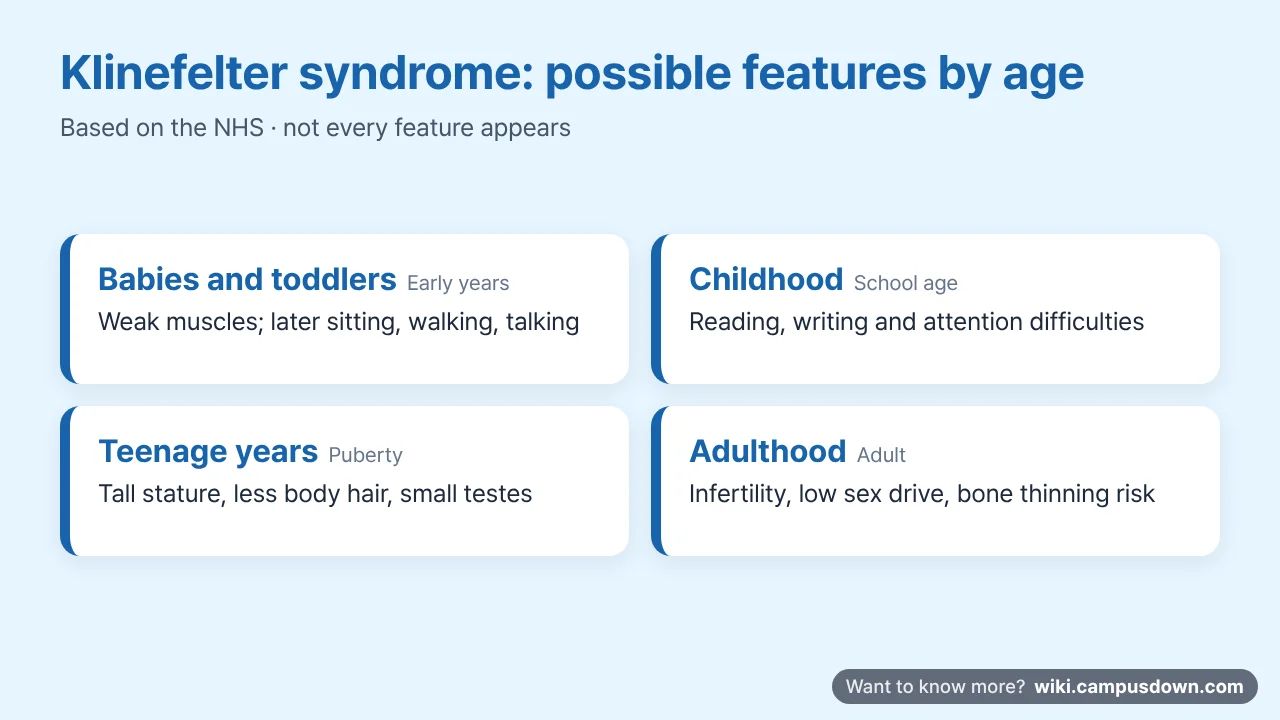
Features vary and are not always present. The NHS lists the following by age. Babies and toddlers may have weak muscles and sit, walk or talk later than usual. Children may have problems with reading, writing, spelling and attention, or mild dyslexia. Teenagers may grow taller than expected for the family, with long arms and legs, less facial and body hair, small firm testes and enlarged breasts. Adults may have infertility and low sex drive. Intelligence is usually unaffected.
Causes
Klinefelter syndrome is not inherited. During the cell division that forms eggs or sperm, an error called nondisjunction leaves an extra X chromosome in the egg or sperm, so the pattern after conception is XXY instead of XY (MedlinePlus). It can come from either parent, and the NHS notes the risk may be slightly higher with older parents. About 10% of people with the condition are thought to have the mosaic form, in which only some cells carry the extra X; their features may be milder.
Testing and management
After an examination, a doctor may check reproductive hormone levels in a blood sample; the diagnosis is confirmed by finding the extra X chromosome in a blood chromosome test. It is sometimes picked up by screening during pregnancy. There is no cure, but problems can be managed as needed. Testosterone replacement therapy, usually considered once puberty begins, can support secondary sex characteristics, muscle mass and energy; long-term treatment in adulthood may help with osteoporosis and low mood but cannot reverse infertility (NHS). Speech and language therapy, educational and behavioural support, occupational therapy and psychological support are also used, and assisted reproduction such as sperm retrieval with ICSI can make biological parenthood possible (reproductive technology). Anyone concerned about symptoms should talk to a doctor.
Frequently asked questions
Is Klinefelter syndrome inherited?
No. It arises by chance when an X chromosome fails to separate as an egg or sperm forms.
How common is it?
According to MedlinePlus, it affects about 1 in 650 male newborns.
How is it confirmed?
A blood chromosome test (karyotype) shows the extra X chromosome. It is often found in adulthood during fertility tests.
Can it be treated?
There is no cure, but testosterone replacement, speech therapy, learning and psychological support, and assisted reproduction help manage symptoms and health risks.
See also: Reproductive Technology (Artificial Insemination and Somatic Cell Cloning)
References
- Groth, K. A., Skakkebæk, A., Høst, C., Gravholt, C. H., & Bojesen, A. (2013). Klinefelter syndrome: A clinical update. Journal of Clinical Endocrinology & Metabolism, 98(1), 20-30.
- Klinefelter, H. F., Reifenstein, E. C., & Albright, F. (1942). Syndrome characterized by gynecomastia, aspermatogenesis without A-Leydigism, and increased excretion of follicle-stimulating hormone. Journal of Clinical Endocrinology, 2(11), 615-627.
- Jacobs, P. A., & Strong, J. A. (1959). A case of human intersexuality having a possible XXY sex-determining mechanism. Nature, 183, 302-303.
- Bojesen, A., Juul, S., & Gravholt, C. H. (2003). Prenatal and postnatal prevalence of Klinefelter syndrome: A national registry study. Journal of Clinical Endocrinology & Metabolism, 88(2), 622–626.
- NHS. (n.d.). Klinefelter syndrome. https://www.nhs.uk/conditions/klinefelters-syndrome/
- MedlinePlus Genetics. (n.d.). Klinefelter syndrome. U.S. National Library of Medicine. https://medlineplus.gov/genetics/condition/klinefelter-syndrome/