
Can fear be learned like a habit? In 1920 a psychologist at Johns Hopkins University in Baltimore set out to prove that it could, using a nine-month-old baby. The Little Albert experiment became one of the most famous, and most criticized, studies in American psychology.
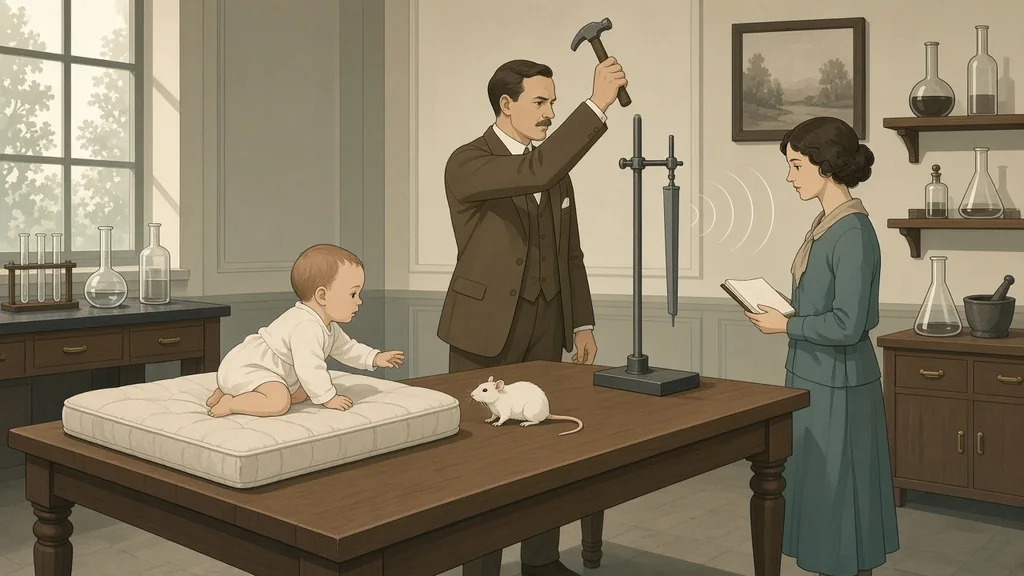
The experiment
John B. Watson, a leading figure in behaviorism, and his graduate student Rosalie Rayner wanted to show that emotions could be conditioned, just as Ivan Pavlov had conditioned dogs to salivate. They chose an infant from a hospital, known in their paper as "Albert B."
The procedure followed the logic of classical conditioning:
- Baseline: Albert was shown a white rat, a rabbit, a dog, a monkey, masks and other objects. He showed no fear.
- Conditioning: each time Albert touched the rat, the researchers struck a suspended steel bar with a hammer behind his back, making a loud noise that startled him and made him cry.
- Result: after repeated pairings, Albert cried and tried to crawl away at the sight of the rat alone.
Key idea
A neutral stimulus (the rat), paired with one that naturally causes fear (the loud noise), came to cause fear by itself. Watson and Rayner reported that Albert also reacted to some other furry objects.
The results appeared in the February 1920 issue of the Journal of Experimental Psychology. Albert was removed before any attempt to undo the conditioning.

US cases
- When and where
- 1919–1920, Johns Hopkins University, Baltimore, Maryland
- What happened
- Watson and Rayner conducted the conditioning sessions on the hospital-raised infant and published "Conditioned Emotional Reactions."
- Why it matters
- The paper became a textbook staple and helped shape behaviorist ideas that fears and phobias are learned, which later informed exposure-based therapies.
- When and where
- 2009–2014, American and Canadian psychologists
- What happened
- In 2009, psychologist Hall P. Beck and colleagues argued that Albert was Douglas Merritte, the son of a wet nurse at the hospital, who died at age six of hydrocephalus. Researchers Russ Powell, Nancy Digdon and Ben Harris later contested this and proposed Albert Barger, born within a day of Merritte to a mother who also worked at the hospital.
- Why it matters
- The dispute matters because if Albert was neurologically impaired, the original results would be even harder to interpret.
Criticisms
- Ethics: the study deliberately frightened an infant and did not reverse the fear. It would not be approved under modern rules for research with human subjects.
- Weak method: there was one subject, no control condition and subjective descriptions of fear.
- Overstated generalization: later readers note that the paper's own report shows the fear did not generalize as cleanly as textbooks often claim.
- Never properly replicated: with a single subject, the finding was not reproduced under controlled conditions.
Related concepts
Like the Milgram experiment, Stanford prison experiment and Rosenhan experiment, Little Albert is now taught as much for its ethical lessons as for its findings.

Study material (Korean): 「행동주의 학습이론의 배경과 대표학자, 교육현장 적용 사례 – 왓슨 공포 조건화」
Frequently asked questions
- What did the Little Albert experiment show?
- That a fear response could be conditioned in a human infant by pairing a neutral object, a white rat, with a frightening loud noise.
- Why is the Little Albert experiment unethical?
- The researchers deliberately caused distress in a baby without lasting protections and never removed the fear they created.
- What happened to Little Albert?
- His identity is disputed. One team identified him as Douglas Merritte, who died at six; another argued he was Albert Barger, who lived into adulthood.