
What makes ice sheets grow over North America and then melt away, again and again? A big part of the answer is the slow dance of Earth's orbit. Milankovitch cycles are regular changes in the shape of Earth's orbit, the tilt of its axis and the wobble of that axis. Over tens of thousands of years they change how much sunlight reaches different latitudes and seasons, helping set the rhythm of the ice ages.
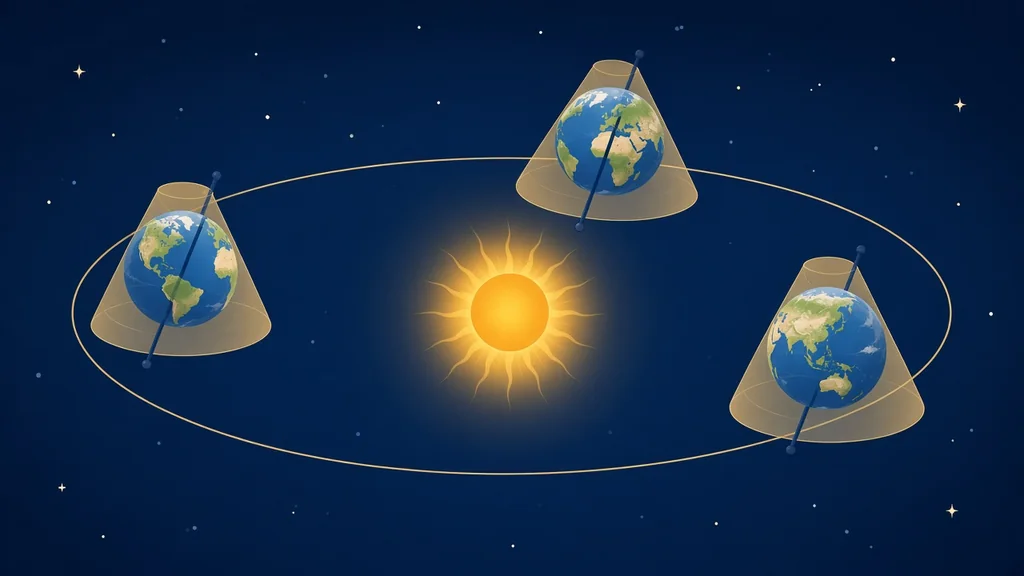
The three cycles
- Eccentricity: the orbit stretches from nearly circular to slightly oval, in cycles that loosely combine into about 100,000 years.
- Obliquity: the tilt of Earth's axis varies by a few degrees over about 41,000 years. More tilt means stronger seasons.
- Precession: the axis wobbles like a spinning top, shifting which season happens when Earth is closest to the sun, over roughly 23,000 years on average.
Serbian scientist Milutin Milanković calculated these effects by hand in the early 20th century and argued that cool northern summers, which let snow survive the year, allow ice sheets to grow.
Key idea
The cycles do not change the total sunlight much. They change where and when it arrives, and feedbacks from ice, oceans and carbon dioxide amplify those small shifts into ice ages.

US cases
- When and where
- December 10, 1976, Science; James Hays and John Imbrie of Columbia's Lamont-Doherty observatory and Brown University, with Nicholas Shackleton
- What happened
- Analyzing deep-sea sediment cores, the team found climate rhythms matching the orbital periods Milanković had predicted.
- Why it matters
- The paper is widely seen as the turning point that brought Milankovitch theory into mainstream climate science.
- When and where
- October 9, 1992, Devils Hole, Nevada; US Geological Survey team led by Isaac Winograd
- What happened
- A 36-centimeter calcite core from a water-filled cave produced a continuous 500,000-year climate record. The authors argued its timing was inconsistent with Milankovitch theory, since warming seemed to start earlier than orbital forcing predicted.
- Why it matters
- A 2016 study with new cores revised the timing near the last-but-one deglaciation and found it consistent with orbital forcing, while Winograd disputed the revision, a live example of how science tests a famous theory.
Limits and misuses
- The 100,000-year problem: eccentricity has the weakest direct effect on sunlight, yet it matches the dominant ice age rhythm of the last million years, which models explain through feedbacks.
- Not today's warming: orbital changes act over thousands of years, far too slowly to explain the rapid warming measured since the 20th century.
- Regional effects vary: the same orbital change can affect the two hemispheres differently.
Related concepts
Milankovitch cycles explain the timing of the ice ages, while carbon dioxide and the greenhouse effect amplify them. Scientists contrast them with modern climate change, which is driven mainly by human emissions. On even longer timescales, plate tectonics shapes climate by moving continents, and the Gaia hypothesis asks how life itself helps regulate Earth.

Study material (Korean): 「기후변화의 원인: 해수면·에어로졸 중심 핵심 내용 정리」
Frequently asked questions
- What are Milankovitch cycles in simple terms?
- Slow, repeating changes in Earth's orbit, tilt and wobble that shift how sunlight is spread across the planet and help pace ice ages.
- Do Milankovitch cycles explain current global warming?
- No. They work over tens of thousands of years, and current orbital trends would, if anything, favor slow cooling, not the rapid warming seen today.
- How do scientists know Milankovitch cycles affect climate?
- Records from deep-sea sediments, ice cores and cave deposits show climate rhythms that match the orbital periods.
References
- Hays, Imbrie & Shackleton (1976), Variations in the Earth's Orbit: Pacemaker of the Ice Ages, Science
- Winograd et al. (1992), Continuous 500,000-Year Climate Record from Vein Calcite in Devils Hole, Nevada (USGS)
- Moseley et al. (2016), Reconciliation of the Devils Hole climate record with orbital forcing, Science
- Wikipedia: Milankovitch cycles