
Why has Earth stayed livable for billions of years while the Sun grew brighter and the atmosphere changed? The Gaia hypothesis offers a bold answer: life itself helps keep the planet's conditions in a range that suits life.
What the hypothesis says
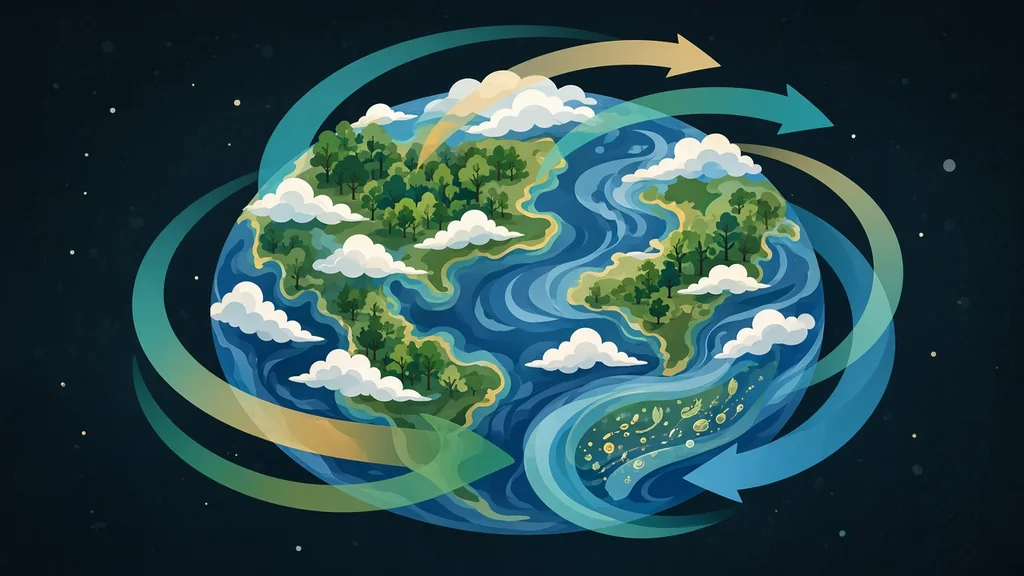
The Gaia hypothesis proposes that living organisms and their inorganic surroundings, including the atmosphere, oceans and rocks, form a single self-regulating system. Feedback loops between life and the environment help stabilize things like global temperature, ocean saltiness and atmospheric oxygen. Chemist James Lovelock formulated it in journal articles in 1972 and 1974 and in his 1979 book Gaia: A New Look at Life on Earth. Microbiologist Lynn Margulis co-developed it, adding knowledge of how microbes shape the atmosphere. The name came from Lovelock's neighbor, novelist William Golding, after the Greek earth goddess.
Key idea
The hypothesis does not need Earth to "want" anything. Lovelock argued that regulation can emerge from ordinary organisms changing their surroundings, a claim he illustrated with the Daisyworld model.
In Daisyworld, built with Andrew Watson, a planet holds only dark and light daisies. Dark daisies warm their surroundings and light ones cool them, so as the star brightens, the mix of daisies shifts and the planet's temperature stays stable over a wide range.

US cases
- When and where
- September 1965, Southern California
- What happened
- While working at JPL on methods to detect life on Mars, Lovelock began defining the idea of a self-regulating Earth controlled by living organisms. He reasoned that life would alter a planet's atmosphere, and he saw a stark contrast between Earth's chemically active air and the atmosphere of Mars, which sits close to chemical equilibrium.
- Why it matters
- A NASA planetary science problem became the seed of a new way to look at Earth as a whole system.
- When and where
- Built 1987–1991; closures 1991–1993 and March–September 1994, Oracle, Arizona
- What happened
- A crew of eight lived inside a sealed glass facility meant to test whether a closed ecosystem could support humans. During the first closure, oxygen fell from about 20.9% to 14.5% over 16 months. Columbia University scientists Jeff Severinghaus and Wallace Broecker traced part of the loss to carbon dioxide reacting with exposed concrete.
- Why it matters
- The project showed how hard it is to engineer even a small self-sustaining biosphere, which highlights how complex Earth's own regulation is. The University of Arizona now runs the site for Earth system research.
Criticisms
- Natural selection: W. Ford Doolittle and Richard Dawkins argued that organisms cannot evolve to regulate the whole planet, since selection acts on individuals, not on a global system.
- Teleology: early versions sounded as if Earth had purpose; Lovelock rejected that reading, and Daisyworld was offered in reply.
- Testability: geologist James Kirchner argued that "weak" versions are already accepted and "strong" versions cannot be tested.
Related concepts
Questions about how life began are covered in abiogenesis and panspermia. Long-term climate changes driven by orbital shifts are explained by Milankovitch cycles. The gene-level view behind Dawkins' criticism is described in selfish gene theory.

Study material (Korean): 「기후변화의 원인: 해수면·에어로졸 중심 핵심 내용 정리」
Frequently asked questions
- What is the Gaia hypothesis in simple terms?
- The idea that life on Earth and its physical environment work together as a self-regulating system that keeps conditions suitable for life.
- Who came up with the Gaia hypothesis?
- Chemist James Lovelock, with major contributions from microbiologist Lynn Margulis in the 1970s.
- Is the Gaia hypothesis accepted by scientists?
- Its strong form is not widely accepted, but its focus on feedback between life and the environment helped shape modern Earth system science.