
If evolution rewards selfishness, why do worker bees die defending their hive and why do animals share food? Richard Dawkins' 1976 book The Selfish Gene offered a striking answer: look at evolution from the point of view of genes, not individuals or species, and much apparent altruism makes sense.
Definition
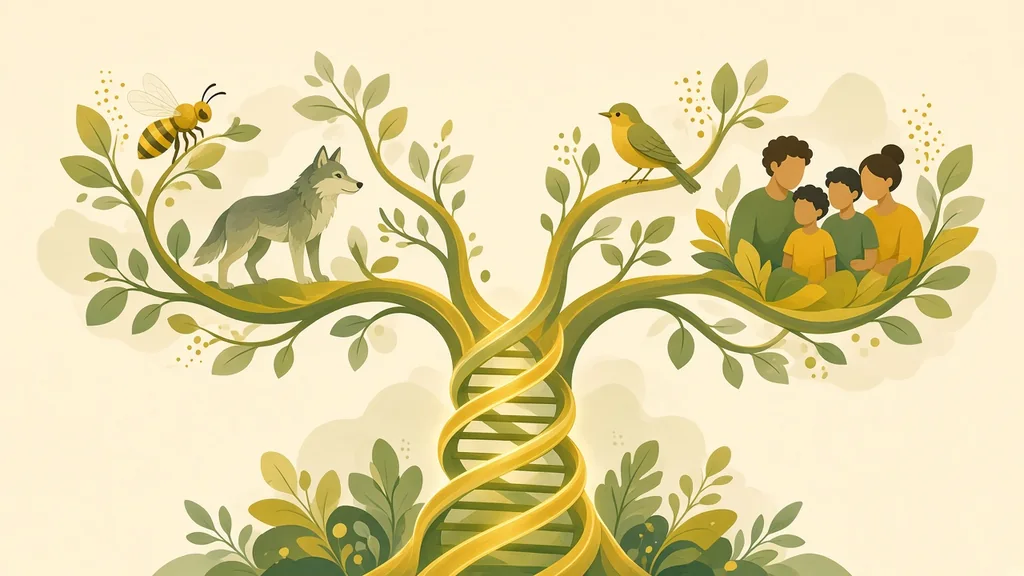
The gene-centered view holds that natural selection ultimately favors genes that make more copies of themselves. Dawkins called genes "replicators" and organisms "vehicles" or "survival machines" built by them. A gene is "selfish" only in a metaphorical sense: it has no intentions, but genes that happen to build bodies that spread them become more common. The book built on George C. Williams' Adaptation and Natural Selection (1966) and W. D. Hamilton's work on kin selection. It also coined the word "meme" for a unit of cultural transmission.
Key idea
Selfish genes can produce unselfish individuals. Helping relatives who share your genes, or trading favors that pay back, can be the best way for a gene to spread.

How cooperation fits
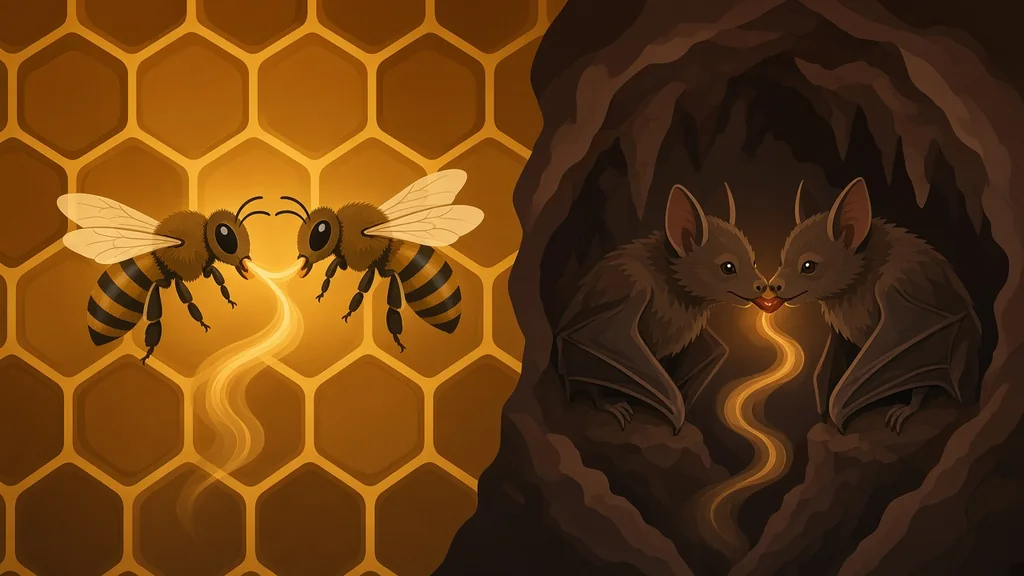
Kin selection explains why animals help close relatives: a gene for helping can spread if it aids copies of itself in siblings or offspring. Reciprocal altruism explains help between non-relatives when favors are likely to be returned. Game theory, especially strategies like tit-for-tat, showed how such cooperation can be stable.
US cases
- When and where
- 1971–1976, Harvard University, Massachusetts
- What happened
- Trivers, then at Harvard, published the theory of reciprocal altruism in 1971 and of parental investment in 1972, ideas Dawkins drew on heavily. The first edition of The Selfish Gene in 1976 carried a foreword by Trivers.
- Why it matters
- Trivers' American work supplied key building blocks of the gene's-eye view, linking it to behavior people see every day, from grooming to favor trading.
- When and where
- 1975 onward, Harvard University
- What happened
- E. O. Wilson's Sociobiology: The New Synthesis applied similar evolutionary reasoning to animal and, in its last chapter, human behavior. Harvard colleagues Stephen Jay Gould and Richard Lewontin, members of the Sociobiology Study Group, attacked it in an open letter as a deterministic view of human society.
- Why it matters
- The dispute, in which Gould also criticized calling the gene the "unit of selection," shaped how American scientists and the public argued about genes and human nature for decades.
Criticisms
- Level of selection: Gould and others argued selection acts on bodies and traits, not directly on genes.
- Misleading metaphor: readers often take "selfish" to mean genes cause selfish behavior, which Dawkins did not claim.
- Genetic determinism: critics worry the view underplays culture, development and environment, especially in humans.
Related concepts
The Selfish Gene is a modern account of evolution and draws on game theory explored in the evolution of cooperation. It interacts with ideas like coevolution and contrasts with the emphasis on random drift in the neutral theory of molecular evolution. Genes act through the steps described by the central dogma of molecular biology.
Study material (Korean): 「이기적 유전자: 책이·추천도서 중심 핵심 내용 정리」
Frequently asked questions
- What is the main idea of The Selfish Gene?
- Evolution is best understood as competition between genes, with organisms acting as vehicles that genes build to copy themselves.
- Does The Selfish Gene say people are naturally selfish?
- No. Dawkins argued that selfish genes can produce cooperative and altruistic individuals.
- What word did The Selfish Gene introduce?
- The word "meme," meaning a unit of cultural information that spreads from person to person.