
Could one equation, short enough to fit on a T-shirt, explain everything in the universe? That is the dream behind a theory of everything. Physicists have unified several forces already, but one stubborn force, gravity, still refuses to fit.
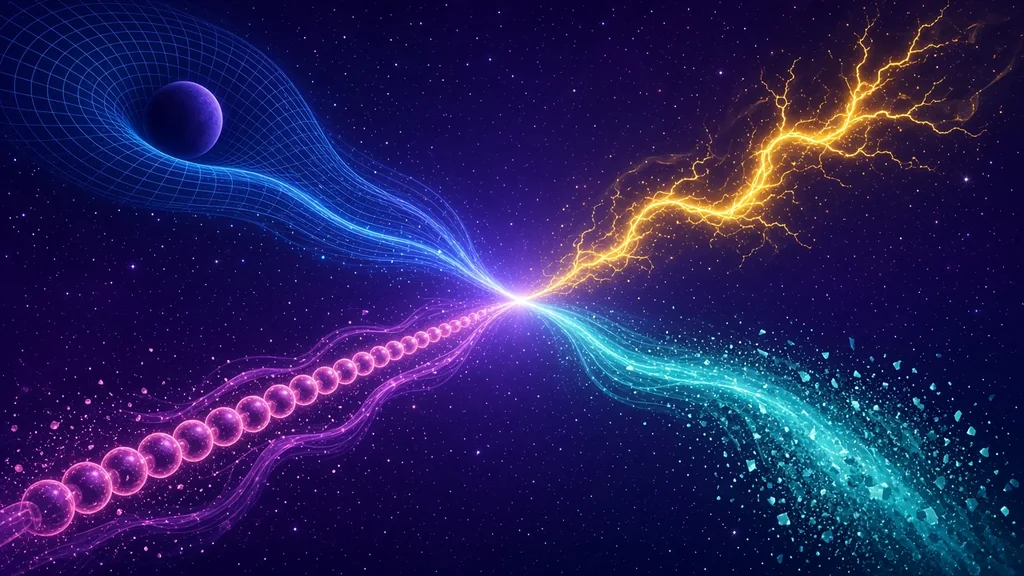
What it would unify
Nature appears to run on four fundamental forces:
- Gravity: holds planets and galaxies together; described by Einstein's general relativity.
- Electromagnetism: governs light, electricity and chemistry.
- The strong force: binds quarks into protons and neutrons.
- The weak force: drives some radioactive decay.
The last three are described by quantum theory in the Standard Model. Gravity is described by general relativity, which treats space-time as smooth and curved. The two frameworks work brilliantly on their own but give nonsense when combined, for example at the center of a black hole or at the moment of the Big Bang.
Key idea
A theory of everything would reconcile general relativity with quantum mechanics, giving one consistent description of all forces and particles.

Candidates
The best-known candidate is string theory, which replaces point particles with tiny vibrating strings and naturally includes gravity. Loop quantum gravity is another approach. Neither has been confirmed by experiment.

US cases
- When and where
- 1933–1955, Institute for Advanced Study, Princeton, New Jersey
- What happened
- After leaving Germany, Albert Einstein took a position at the Institute for Advanced Study and stayed until his death in 1955. During those years he tried to build a unified field theory by extending his geometric theory of gravity to include electromagnetism.
- Why it matters
- The effort did not succeed and drew him away from mainstream quantum physics, but it set the template for the modern search.
- When and where
- 1979 Nobel Prize; 1991–1993 Waxahachie, Texas
- What happened
- American physicists Steven Weinberg and Sheldon Glashow shared the 1979 Nobel Prize in Physics with Abdus Salam for unifying the electromagnetic and weak forces. To probe further, the US began building the Superconducting Super Collider near Waxahachie, Texas, but Congress canceled it in 1993 after about 14 miles of tunnel had been bored and about $2 billion spent.
- Why it matters
- Unification made real progress, while the cancellation showed how costly testing deeper theories can be.
Criticisms
- Testability: many candidate theories make predictions only at energies far beyond any planned experiment.
- Too many solutions: string theory appears to allow an enormous number of possible universes, which critics say weakens its predictive power and connects it to the multiverse debate.
- Philosophical limits: some physicists argue that a final theory may not exist, or that explaining all forces would still not explain everything, such as consciousness or why the laws are what they are.
Frequently asked questions
- What is the theory of everything in simple terms?
- A single theory that would explain all forces and all matter in the universe, including both gravity and the quantum world.
- Has a theory of everything been found?
- No. String theory and other ideas are candidates, but none has been confirmed by experiment.
- Why is gravity hard to unify with the other forces?
- General relativity treats space-time as smooth, while quantum theory treats forces as made of discrete particles; combining them gives infinite or meaningless results.