
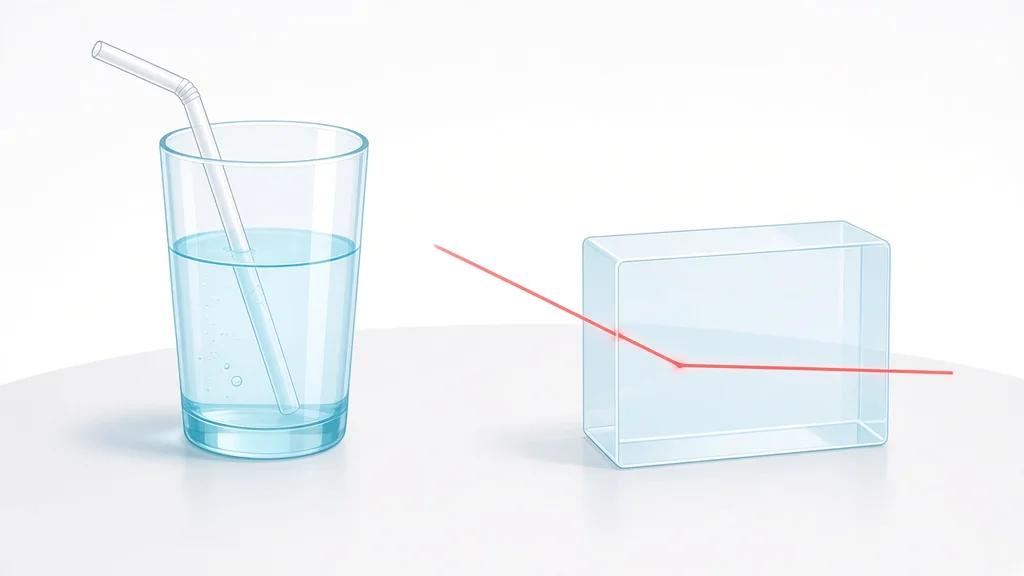
Why does a straw look broken where it enters a glass of water? Why can a hair-thin strand of glass carry internet traffic across the ocean? Both answers start with Snell's law, the rule that tells us how much light bends when it crosses from one material into another.
Definition
Light travels at different speeds in different materials. The refractive index (n) measures how much a material slows light compared with a vacuum. Snell's law states n1 sin θ1 = n2 sin θ2, where θ1 is the angle of the incoming ray and θ2 the angle of the refracted ray, both measured from a line perpendicular to the surface. When light enters a denser medium, such as from air into water, it bends toward the perpendicular. When it leaves, it bends away.
Key idea
Snell's law turns the bending of light into a precise calculation. Knowing two refractive indices and one angle is enough to predict the other angle.

Total internal reflection
When light travels from a higher index material into a lower one, the refracted angle is larger than the incoming one. Beyond a certain critical angle, no light escapes and all of it reflects back inside. This total internal reflection is what keeps light trapped inside an optical fiber and what makes diamonds sparkle.

History
The law was first described by the Persian scientist Ibn Sahl at the Baghdad court in 984. Thomas Harriot rediscovered it in 1602 without publishing, and Dutch astronomer Willebrord Snellius derived it in 1621, though his work stayed unpublished in his lifetime. René Descartes published a derivation in 1637, and Pierre de Fermat later explained it with his principle of least time.
US cases
- When and where
- 1852–1910, US coasts
- What happened
- The United States Lighthouse Board, created in 1852, moved quickly to buy and install Fresnel lenses, which use rings of glass prisms to refract and reflect lamp light into a strong beam.
- Why it matters
- The lenses greatly increased how far a lighthouse could be seen, an everyday maritime use of refraction long before modern optics.
- When and where
- 1970, Corning Glass Works, Corning, New York
- What happened
- Researchers Robert Maurer, Donald Keck, Peter Schultz and Frank Zimar first achieved fiber attenuation below the crucial limit of 20 decibels per kilometer. Their fiber guides light by total internal reflection, a direct consequence of Snell's law.
- Why it matters
- The breakthrough made fiber-optic communication practical and led to the networks that carry most long-distance internet traffic today.
Common mistakes
- Measuring from the surface: angles in Snell's law are measured from the perpendicular, not from the surface.
- Ignoring color: the refractive index changes with wavelength, which is why prisms split white light into colors.
- Assuming all light passes: some light always reflects at a boundary, even below the critical angle.
Related concepts
Snell's law describes how photons change direction at boundaries and can be derived from the wave picture in wave–particle duality. Once light is inside a material, the Beer–Lambert law describes how much is absorbed. Like the photoelectric effect, refraction is a basic piece of the physics of light, and Fermat's least-time idea mirrors how Newton's laws of motion can be restated as principles of optimization.
Study material (Korean): 「색채와 빛이, 파장 관련 핵심 내용 요약 정리」
Frequently asked questions
- What does Snell's law say in simple terms?
- Light bends when it passes between materials, and the amount of bending depends on how much each material slows light.
- What is total internal reflection?
- When light hits a boundary with a less dense material at a steep enough angle, it reflects back completely instead of passing through.
- Why does a straw look bent in water?
- Light from the straw bends as it leaves the water and enters the air, so your eyes see the underwater part in a shifted position.